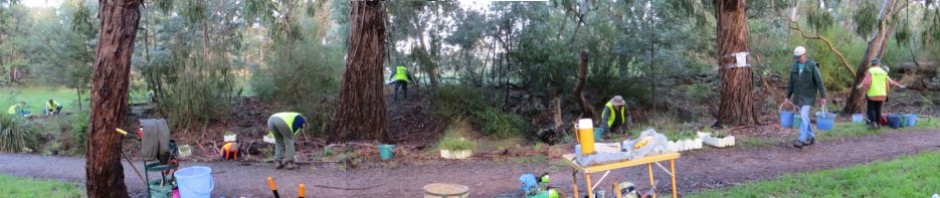
Blackburn Creeklands Advisory Committee Wins Deakin Award
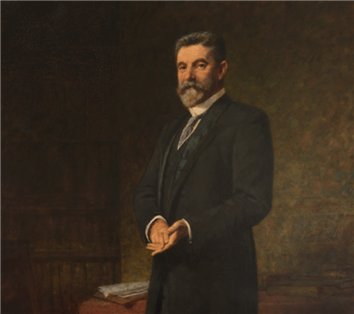
Deakin applauds work in the Creeklands?
- The Deakin Community Awards recognise “our unsung local community leaders and volunteers who generously give their time and energy to make our community a better place to live” within the federal seat of Deakin which is named after one of the nation’s founding fathers – Alfred Deakin (shown above).
- To our pleasant surprise, we were nominated for a Deakin Award by locals in appreciation of our work in the park for the community. During August, we were notified that we had won an award! Our thanks for the nomination and congratulations to other award winners.
Working Bee Report (Sunday, 5th August)
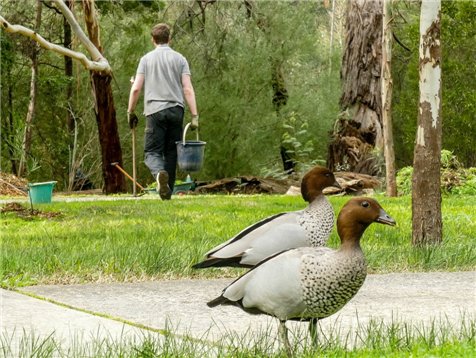
- Speaking of volunteers who generously give their time and energy – Sunday, 5th August was a pleasant day for a working bee. More or less half of the team weeded while the other half in-fill planted wild flowers and shrubs – as well as a Eucalypt grown from seed collected in the school grounds a couple of years ago.
- Interestingly, the ladies far outnumbered the men on the day – Sean was the only gentleman present! We do know some of our committee men were excused due to being away in warmer climes. Luckily, some of the local wood ducks were able to join in and lend a hand… (or were they just winging it?).
- Our thanks to all who participated.
- Next working bee will be Sunday, 9th September – again in Furness Park north.
Our Rubbish Collectors
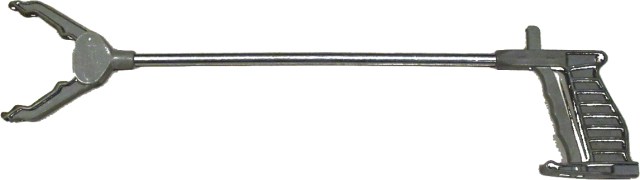
- Whilst on the subject of unsung heroes, we’d also like to say “thanks” to those who regularly collect rubbish in the park.
- We’ve been following up some of the issues raised in the ABC TV program “War on Waste” – and the issue of discarded plastic drink bottles in particular. One (rather nice) problem we have is that any rubbish in the park disappears before it can be counted – largely due to the efforts of our indefatigable collectors.
- We’ve spoken to our Friend Mandy – one of the regular collectors – who thinks drink bottles are not such a problem – especially compared to polystyrene.
- Polystyrene is very problematic in that it is very light, single-use (eg old style take-away coffee cups) or short-term packaging that does not readily decompose. However, it is inclined to blow out of rubbish containers onto roads and then disintegrate into smaller particles after it has been run over or otherwise stressed. Eventually, it enters the drainage system and our creek – on its way via the Yarra, to the bay and then to the ocean – unless it’s left tracing the high-water mark along the creek bed!
Where can you get water in the park ?
- Especially in the warmer weather, many people carry their own water bottles when walking or exercising because it is so important to stay well-hydrated.
- Should you not be carrying your own, or need to refill yourself or your bottle, the map snippet below shows the location of two water fountains in the park – in between the Kalang Pavilion and the children’s play equipment along Kalang Street and in the southwest corner of the children’s playground in Furness Park.
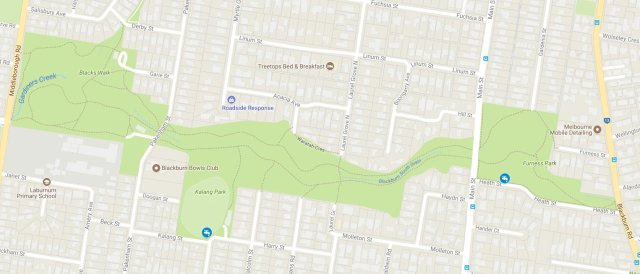
Water Fountains – Click to Enlarge
- Both are old-style facilities. However, the Kalang Park fountain does have a dog bowl if you have a thirsty representative of man’s best friend with you.
Corridor News
- Spring is now upon us – time to get into your garden and make a contribution to our corridor by planting some indigenous plants!
- To assist, both of our local volunteer nurseries are having sales in September:
- Our congratulations to our friends at Greenlink who are celebrating the 30th anniversary of their nursery. More unsung heroes!
Transformer Weeds
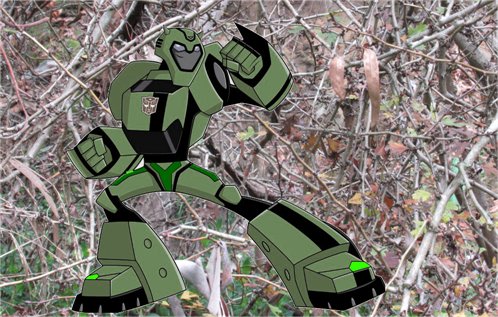
- Transformer weeds are defined as invasive species that have the ability to undermine the ecological processes which maintain the habitat of indigenous plants and animals. For example, in Victoria, the Eltham Copper Butterfly is believed to be threatened by the spread of Cape Broom, Monterey/Radiata Pine and Quaking Grass – which, incidentally, all occur in our park.
- Basically, transformers are weeds that can change the environment to suit themselves. They are highly invasive plants that are increasingly being recognised for the high impact that they can have on indigenous flora and fauna communities.
- The State Government’s DELWP lists nearly 400 transformer species in Victoria. Several are among our worst weeds – for example:
- Blackberry is a recurrent problem throughout the park. It is capable of out-competing all other plants.
- Hawthorn produces impassable thickets. It develops exceedingly tough and penetrating roots soon after germination and is capable of dominating under-storey vegetation. It remains a problem in Blacks Walk but has largely been eliminated elsewhere in the park.
- Bridal Creeper is also capable of engulfing under-storey vegetation, inhibiting germination and establishment of all other species by creating a continuous subterranean mat of fleshy tubers. It regularly reappears in Furness Park.
- Grasses: Annual Veldt and Quaking Grass occur at points throughout the park. In bush areas, they contribute to the flammability of under-storey vegetation. Chilean Needle-grass has the potential to invade grassland and grassy woodland to the complete exclusion of all native species. We’ve had several infestations in recent years (in Furness and Kalang Parks).
- Willow uses dense rootlet mats to trap sediment thereby choking stream beds, increasing water turbidity, altering stream flow and the ambient temperature. Many large Willows have been removed over the years – nevertheless, smaller plants are regularly removed along the creek – no doubt arising from trees seeding upstream.
- Other notables are: Agapanthus, Broom, Monterey Pine, Spider Plant, Cotoneaster, Jasmine, Wandering Trad and Soursob (Oxalis).
Sightings
- Recent bird sightings include: a group of five Common Bronzewings (hopefully breeding!), an immature Golden Whistler (see below) and White-faced herons have returned to the oval – thought to be nesting again in the Acacia Street area.
- Many of us know there are lots of smaller birds flitting around in the park – but they are often too small or too quick to get a good look at.
- Ruth has come to the rescue with some interesting photos of two of our small birds taken in Furness Park earlier in the month:
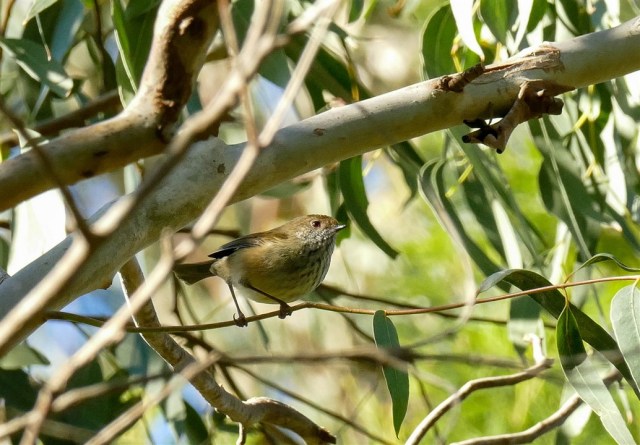
Brown Thornbill
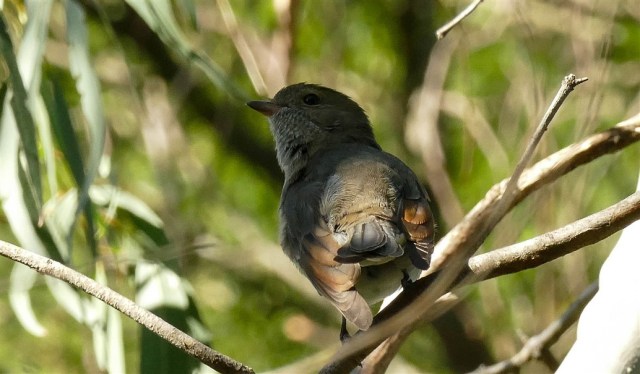
Immature Golden Whistler
- One of the objectives of some of our more recent plantings in quieter parts of the park has been to provide habitat for our smaller birds. They need good cover and food sources – ironically, some nasty weeds like Blackberry (one of our transformers!) actually have the side benefit of providing both needs for small birds…
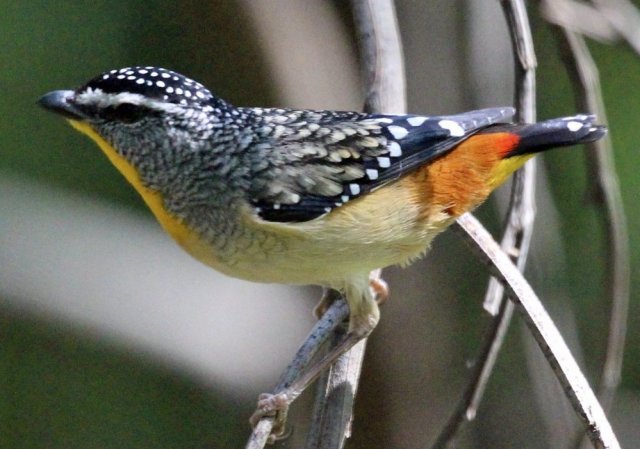
- This shot of Michael’s from last year’s Spring Bird Survey shows an adult male Spotted Pardalote – one of our smallest birds:
- Of course, some of our larger birds are often too well disguised and stoic to spot well:
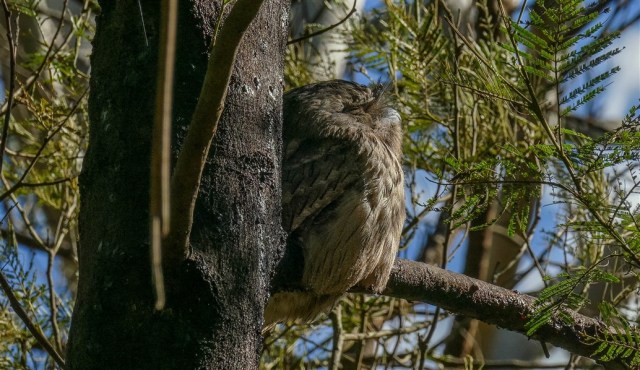
Tawny Frogmouth Basking in the sun
- Speaking of our Spring bird survey – the date for this year’s has been set for Saturday, 6th October – why not come along and see for yourself ? Under expert guidance, you’re pretty sure to see many more birds than you ordinarily would…
Plant of the Month
- Despite our wattles looking so wonderful at the moment (check out our Notice Board if you’d like to know more), our Plant of the Month is Small-leaved Clematis (Clematis microphylla).
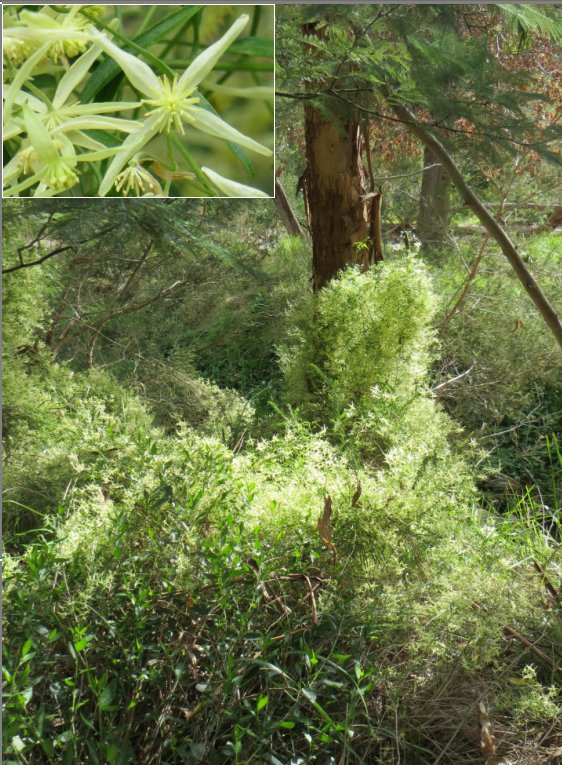
- Particularly beautiful this year, this Clematis with large white starry flowers, has long twining branches that tend to climb up and over other bushes and trees.
- A word of warning though, this clematis can vigourously climb onto neighbouring plants and tend to smother them. Nevertheless, it can work very well on a fence for the same reason.
- If you are looking for a less vigorous variety, another Clematis is indigenous to the area – Mountain Clematis (Clematis aristata) which has much larger and darker leaves.
Weed of the Month
- Weed of the Month is Fumitory (Fumaria sp).
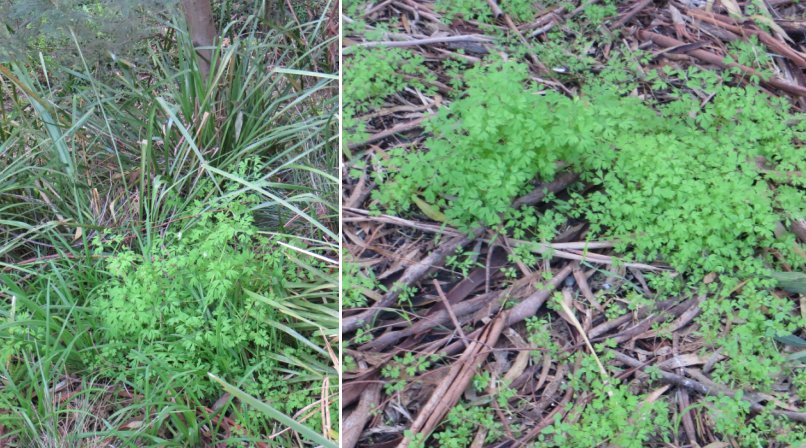
- We seem to have two species of Fumitory in the park –
- White Fumitory (Fumaria capreolata) – also called Climbing Fumitory, White Ramping Fumitory and White-flower Fumitory.
- Common Fumitory (Fumaria officinalis) – also called Drug Fumitory or Earth Smoke Fumitory.
- Both plants are similar in appearance and habits though the first has a white flower with purple tips and the latter has pink flowers with claret coloured tips.
- The Fumitories are herbaceous annuals in the poppy family and are native to Europe, west Asia and north Africa. You may have noticed plants in your garden coming up in late winter and spring.
- Mainly a weed of riparian areas including creek banks and urban bushland, its preference is partly shady, wetter habitats where it can form a dense ground cover and may also climb up over lower-growing vegetation – often smothering them.
- Both varieties have bright light green foliage and seem to seed prolifically. The examples above (near the Billabong) show Fumitory beginning to smother a Lomandra at left and the density of seedlings coming up through leaf litter. The good news is that it pulls out quite easily.
Vale Peter Short
- Peter Short died suddenly on 12th August. Many would know Peter as a regular park walker with his wife Megan, dear old dog Jack and, depending on the day, grandkids going to or from Laburnum Primary School. In recent times, Peter was becoming very adept at using his white cane in preparation for graduating to a guide dog.
- Peter was an educator, sportsman, hiker, father and key supporter of the Creeklands from its inception in the early 1980s. In fact, he was one of the founding members of the Blackburn Creek Conservation Group which is the forerunner of today’s Blackburn Creeklands Advisory Committee. More recently, he was also particularly interested in recording our park’s history.
- Our sincere condolences to Peter’s family and friends – especially to his wife Megan (who is the current Chair of the Creeklands Advisory Committee) and to his daughter Liz who lives locally with her husband and children.
- Our park will simply not be the same without him, and indeed, it would not even exist – but for his, and his colleagues’, successful efforts in the early days ! Thanks Peter…
 Blackburn Creeklands
Pingback: Park News – October, 2018 | The Blackburn Creeklands