All the Best for 2019!
- Now that life is returning to normal after the festive season, kids are returning to school and annual holidays are over – we wish our Friends all the best for a happy and prosperous 2019!
- We are expecting big things in the park this year particularly focussed around Laurel Grove:
- This year’s project area is regeneration of an area on the south side of the creek west of the Laurel Grove bridge (see next article).
- Refurbishment of the Laurel Grove pedestrian bridge: latest word from Council is that the renovation work is expected to commence in February.
- Development of the Laurel Grove North Wetlands: Council has advised that a tender for the project will be released in the next couple of weeks – work is expected to commence this Autumn. As many would already know, complementary work in Laurel Grove North and surrounds has been going for a few months with drainage improvements, vehicle crossings and road resurfacing.
- In recent good news, we heard that we’ve been successful in gaining a Melbourne Water Grant to assist in our administration. Our sincere thanks to Melbourne Water for continuing to support our activities for the community.
This Year’s Project Area
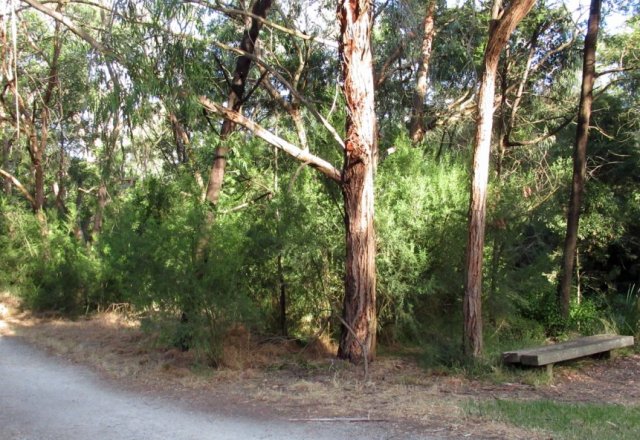
- Committee has decided that this year’s project work should focus on the south-west side of the Laurel Grove bridge. This will entail site preparation, weeding and planting up of the area between the creek and the path moving westwards. The upper storey there is good but the under and mid-storey there needs work – mainly clearing weedy grasses such as cock’s-foot before planting up.
- Our plant orders have been made with the local indigenous nurseries:
- In choosing between working the north or south side of the creek, Committee felt the southern side of the creek has the advantages of a little easier site preparation (weedy grasses vs Wandering Trad), more open/flat terrain and, especially, low risk of conflict with the wetland project works on the other side of the creek.
New Little Wetland!
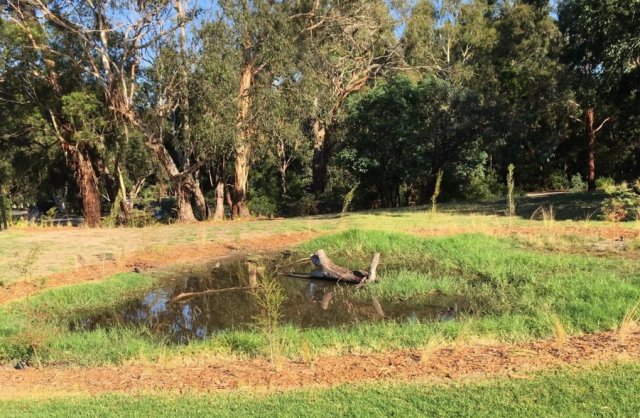
- Speaking of wetlands, Council has presented our park with a new small wetland area adjacent to the new cricket nets at the bottom of Kalang Oval. It takes advantage of ponding that naturally occurs in a depression created during development of the new cricket nets.
- Some time ago, one of our group suggested to Council it could be planted up with suitable plants. Frankly, we didn’t expect the idea would go anywhere – but, to our pleasant surprise, Council has gone ahead and done just that!
- There is the problem that pools of water and cricket balls don’t mix. We have assured the cricketers that the Eucalypt and Melaleuca plantings will quickly absorb the water – at least over the Summer months.
- As Megan’s photo shows, the little wetlands has been delineated with Melaleuca and other plants plus mulch and even has a log in the centre for birds to perch on.
- Council has also extensively planted and mulched up behind the nets so the area is looking quite impressive.
Mary Crouch is Leaving Blackburn!
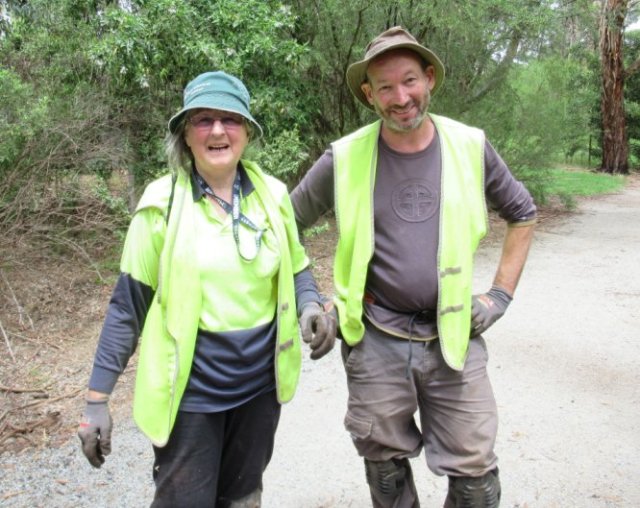
- Mary has been a long serving Committee member, including holding the position of Secretary for many years, and has organised our Working Bees “forever”. Mary is not one to pose for photos. Our picture clearly catches her by surprise and is the last known photo of Mary “in uniform” and literally “on track” in the Creeklands (with Tom, another volunteer).
- Actually, she’s not only worked tirelessly for us – but also the Whitehorse community more generally. The broader connections include an executive role on the Blackburn and District Tree Preservation Society, work with remnant vegetation at the Esplanade Reserve in Mitcham, weeding and other contributions at Blackburn Lake, regeneration at 1 Lake Road-McCubbin Park near Blackburn Lake/Regis Blackburn, weeding and planting at Below the Lake and at Yarran Dheran.
- Anyway, she’s bought a property much closer to town, grandchildren and Geelong where her beloved Cats dwell – that’s a Cats lanyard around her neck in the photo.
- We thank Mary for her huge contributions to the park and to the BCAC Committee over many years – with the outstanding results we can all see in the park now. The park cannot be the same without her. We shall miss her terribly – not least every dog who visits the park who knows there’s a treat in store in that little pink box! Our loss will, no doubt, be Kensington’s gain. Her last advice to us all was:
- Keep weeding!
- Keep planting!
Items for your 2019 Calendar
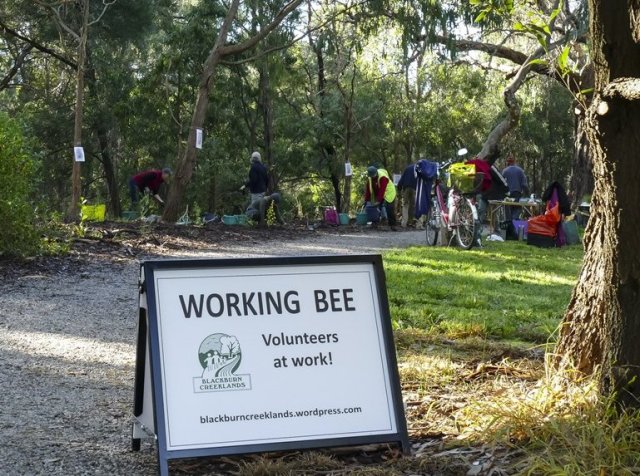
- Community Working Bees
- One way you can “keep weeding, keep planting” is to participate in one or more of the six community working bees for the year. The dates are planned to be:
- Saturday, 30th March
- Saturday, 4th May
- Sunday, 2nd June
- Saturday, 6th July
- Sunday, 4th August
- Sunday, 8th September.
- We usually work in the mornings starting at 09:00 – but may trial a Saturday afternoon session this year thinking that may suit young families better.
- Another way you can “keep weeding, keep planting” would be to participate in our Maintenance Team on Monday mornings.
- One way you can “keep weeding, keep planting” is to participate in one or more of the six community working bees for the year. The dates are planned to be:
- Autumn and Spring Bird Surveys
- Our premier events – the Autumn and Spring Bird Surveys – are planned for the following dates:
- Saturday, 13th April
- October – possibly Saturday, 19th October – to be confirmed closer to the day.
- Survey walks, in two groups, usually start at 07:30 and finish at about 09:00. The correlation of results from the two groups follows over a cuppa.
- Our premier events – the Autumn and Spring Bird Surveys – are planned for the following dates:
- NEW ♥ “Thank You” to Volunteers ♥ NEW
- A new event is planned for his year to thank our Creeklands volunteers. This is a great idea Mary Crouch proposed to thank the unsung volunteers who participate in our community and maintenance team working bees and who volunteer for the park in other ways such as collecting rubbish.
- This event will also be held on Saturday, 13th April – a morning tea starting at 10:00 – after the Bird Survey has completed. This will allow our volunteer Group Leaders – Pat and Ian – to be included in our vote of thanks. All of our volunteers are invited – and are more than welcome to attend the prior Bird Survey event as well if they wish.
- BCAC Committee meetings are held at 7:30 PM on the 4th Tuesday of each month excluding December. Visitors are most welcome.
- Meeting dates for 2019 are: February 26th, March 26th, April 23rd, May 28th, June 25th, July 23rd (with AGM), August 27th, September 24th, October 22nd and November 26th.
- Venue: Kalang Oval Pavilion, Kalang Street, Blackburn.
Stencilled Signs
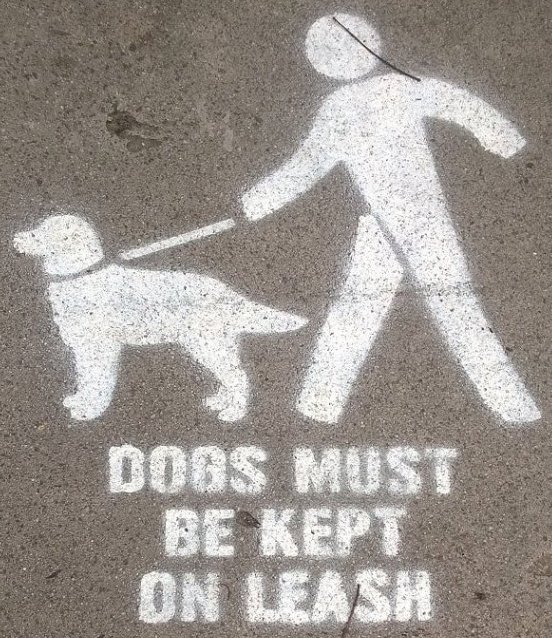
- Council has stencilled signs on paths near park entrances to remind dog owners that all of the Creeklands parks are designated “on-leash” for dogs.
- This helps protect small developing plants, helps owners pick up their pet’s droppings and also prevents wildlife being frightened away (or, dare we say it… being eaten, killed or maimed). It also helps prevent conflicts with children, bike riders, walkers and other dogs.
- The nearest off-leash park is the RHL Sparks Reserve just over Middleborough Road from the Creeklands.
Are there Snakes in the Creeklands ?
- It is well known that snakes are occasionally seen at the Blackburn Lake Sanctuary. At this time of year, people often ask whether there are snakes in the Creeklands – given that the Lake is less than a kilometre upstream of our creek.
- Well, our newshound has interviewed some locals who’ve spent a lot of time in the park and this is what they say:
- Mary (our former working bee coordinator) – “Snakes -never sighted one – but boy would like to, then I would believe we have done our job in the revegetation of the Creeklands”.
- Alan (Blacks Walk neighbour for 57 years and veteran Maintenance Team contributor) – “spending many a day alone removing blackberry in days of old, I have never seen a snake there [Blacks Walk]. I have heard of others who have. [Wife] Dympna’s sighting of a snake at our front door some twenty years ago can go down as a very credible event. On my returning home, the urgency of the command to replace the flywire at the front door that had a hole in it and hence not snake proof, still rings in my ears”.
- Megan (Kalang Park neighbour for 39 years) – “I’ve never seen a snake along the Creeklands … However I have seen 2-3 at Blackburn Lake. The closest reptile was years ago we had a blue-tongue lizard appear briefly in our back garden (our dog Jack was most puzzled)”.
- Nicola (veteran working bee contributor) – “Always good to err on the side of caution. Personally I’ve never seen a snake in the 28 years I’ve been in Blackburn”.
- So – the jury is out. Occasional sightings have been reported – but not from the people you’d expect. Although the presence of snakes indicates a healthy environment ecologically speaking, some species are dangerously venomous to both people and animals. Please take care of yourselves, children and pets (another good reason to keep your dog on a leash)!
Vale Sally Brentnall
- We were saddened to hear that our much loved former committee person Sally Brentnall died peacefully in early January surrounded by family.
- Sally was an active member of our committee from 1999 to 2005, joining the committee shortly after moving to live in Blackburn.
- Our sincere condolences to her family and friends – especially to her husband Philip who also served on our committee.
Sightings
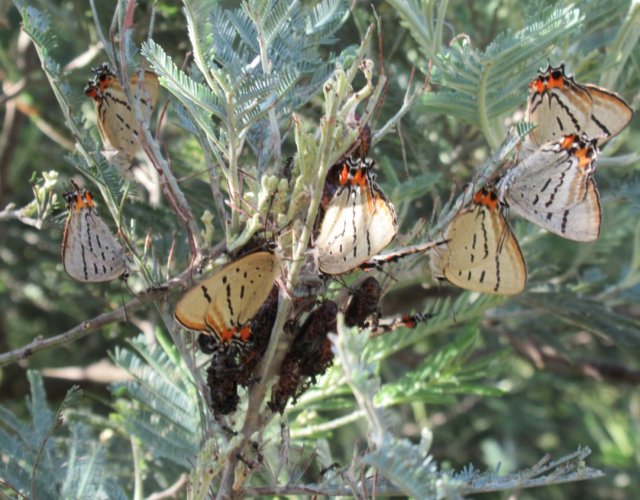
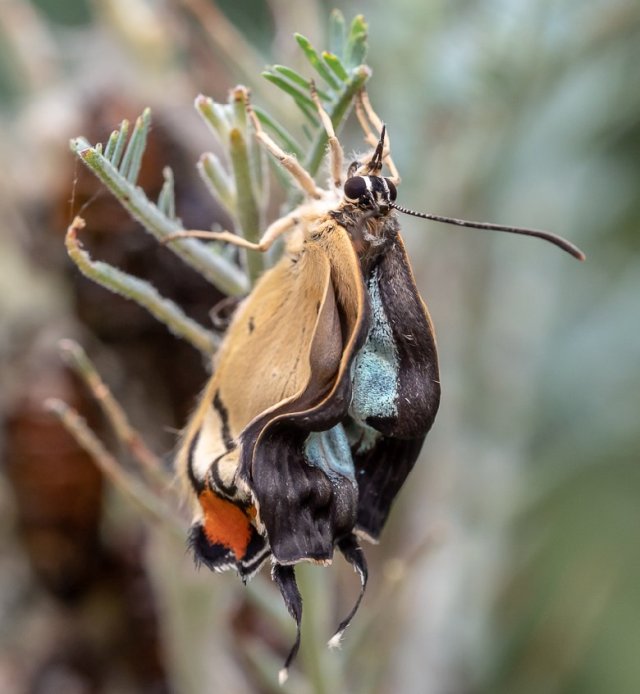
- Imperial Blue butterflies were seen metamorphosing into butterflies early this month in Kalang Park. Their black caterpillars are usually found feeding on Black Wattles in Spring before transforming into pupae. In an interesting symbiotic relationship, ants swarm over the butterfly pupae collecting “honeydew” secretions as food. In return, the growing butterflies receive protection from predators and parasites.
- Why are they called “Blue”? In the photo above, we can only see the pale yellow/buff underside of the emerging butterflies. As Ken’s photo below shows, the top side is quite different – dark black-grey-brown surrounding a sky blue centre. They also have a “tail” on the base of each hind wing with orange patches. While resting, the tails blow in the wind and look rather like antennae. This is believed to fool predators into attacking the more dispensable tails – rather than the head of the butterfly.
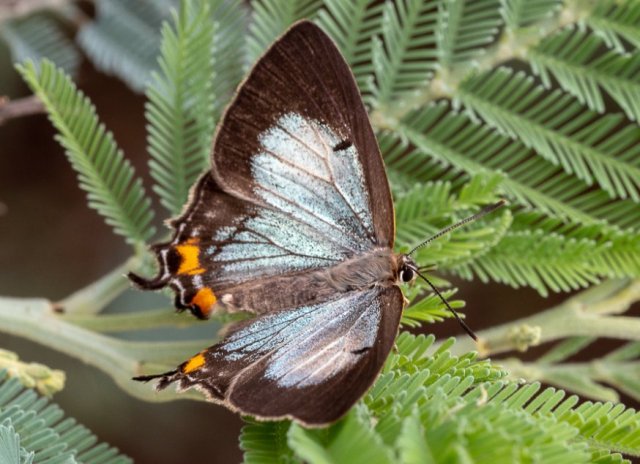
- For good measure, this incredible close-up from Ken shows both the under and top sides of a newly emerged butterfly as its wings are flattening out:
Plant of the Month
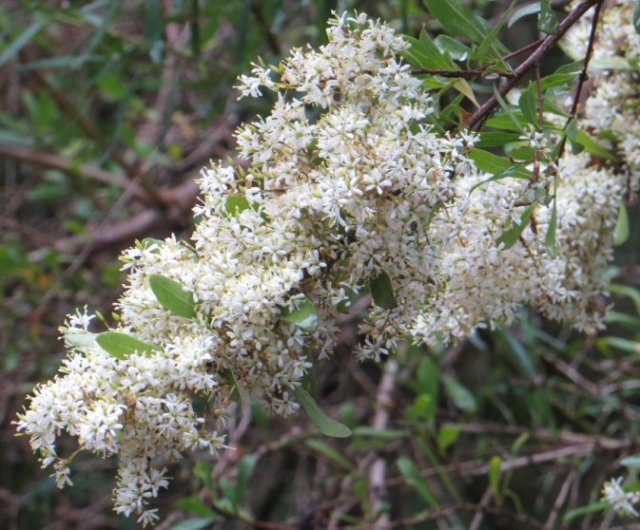
- Plant of the Month is the Sweet Bursaria (Bursaria spinosa). This medium sized shrub/small tree has been looking beautiful again this year with its prolific display of small white flowers. Unlike some of our shrubs and mid-storey plants, it seems to be and coping well with our hot and dry spells.
Weed of the Month
- Weed of the Month is Umbrella Sedge or Drain Flat Sedge (Cyperus eragrostis).
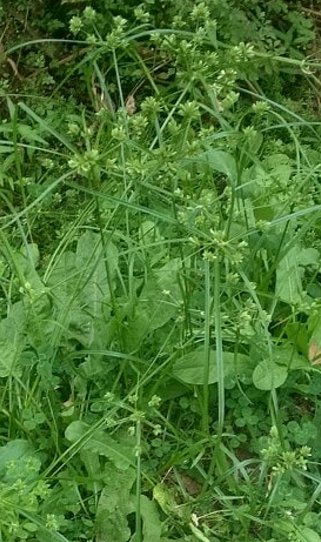
- Drain Flat Sedge is a species of sedge native to the West Coast of North America as well as to parts of South America. It is found in riparian areas (river or creek banks), roadside ditches, drains, damp grasslands and other moist habitats. It loves to invade spaces such as our billabong ponds where water sits impermanently.
- The weed of the month is the weed looking like an umbrella without its cover. The seed heads turn from green to brown when ripe and its roots often have a reddish colour.
- Generally, it is easy to pull the weed out by hand from its base.
 Blackburn Creeklands
Pingback: Park News – March, 2020 | The Blackburn Creeklands