Climate Worries
- Welcome to Autumn! – but you’d be forgiven thinking we are still at the height of summer.
- News reports have it that we have just had our hottest summer on record. We also understand that the long-range forecast for Autumn is for continued dryness (and heat). Inflows to our city’s dams are only 5% higher than they were during the prolonged “Millennium Drought” 1997-2009.
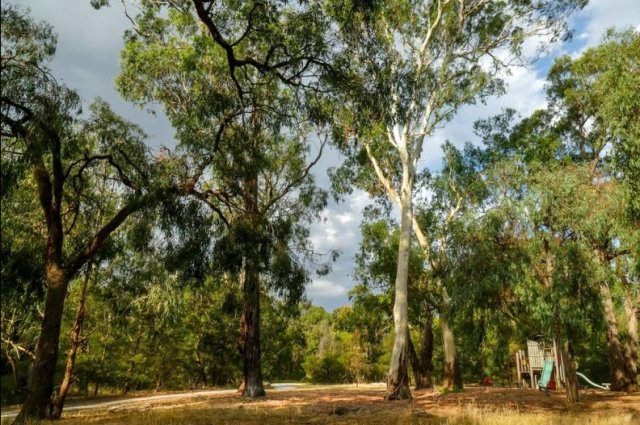
- Even though our canopy trees in the above photo seem to be OK for now, younger and smaller plants are suffering. January and February have been so dry, we’ve become very concerned about our younger plants surviving. What can we do ? Provided there is enough water in the creek, we have authority from Melbourne Water to take water for plants (we check via a website).
- Actually, we already started a watering program at our regular weekly working bees to try to save young plants in early November last year – before the good November/December rains resulted in our little pump going back into storage!
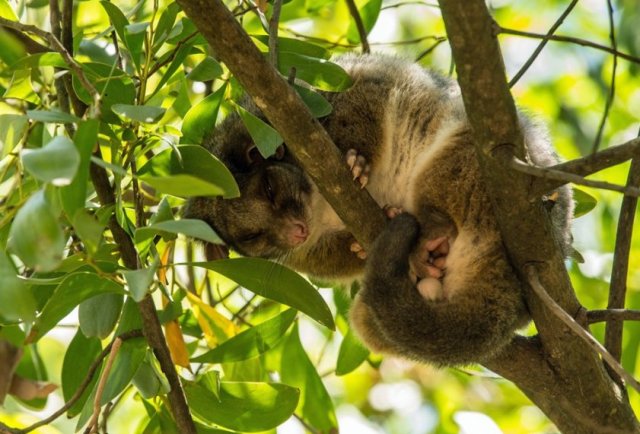
- Here’s someone below who would probably prefer not to be wearing his thick fur coat at the moment…
 Refurbishment of the Laurel Grove Pedestrian Bridge
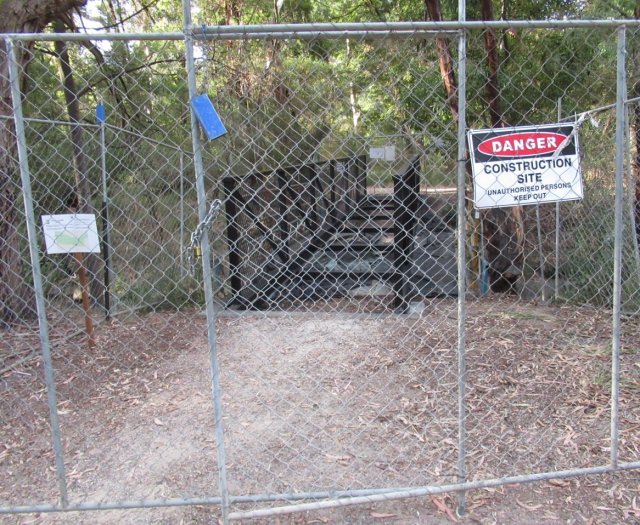
- The refurbishment of the Laurel Grove pedestrian bridge has commenced with scaffolding having been erected and then the old deck, joists and flaking paint were removed. The bridge has changed colour and the new joists are going in.
- Council expects the bridge works to be completed within another 2 weeks.
Corridor Action
- Various forms of local wildlife are water-dependent just like we are. The creek’s flow and water quality have often been quite low lately.
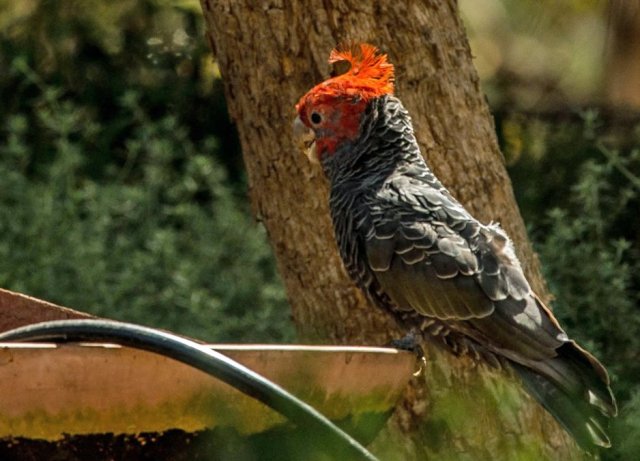
- One thing you can do in your part of “the corridor” is to put out tap water for birds and other animals to drink. Our photo shows a very appreciative juvenile(?) male Gang Gang cockatoo (the males have the bright red head…) enjoying a local’s bird bath.
Fauna and Flora Sightings
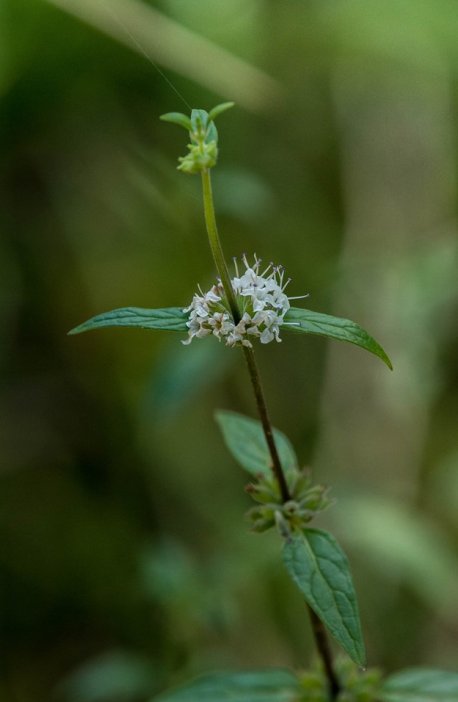
- Ruth’s photo highlights the delicate flower of River Mint (Mentha australis) which likes moist, shady areas such as our Frog Bog.
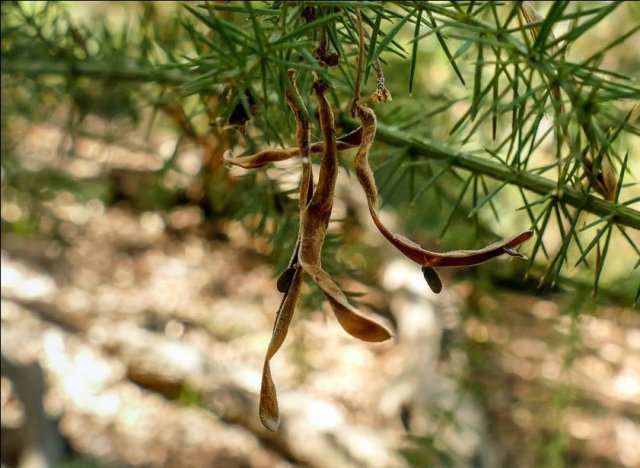
- Ruth’s shot below shows some twisted Acacia pods having dried out and in the process of dropping seed for the next generation.
Bird Sightings
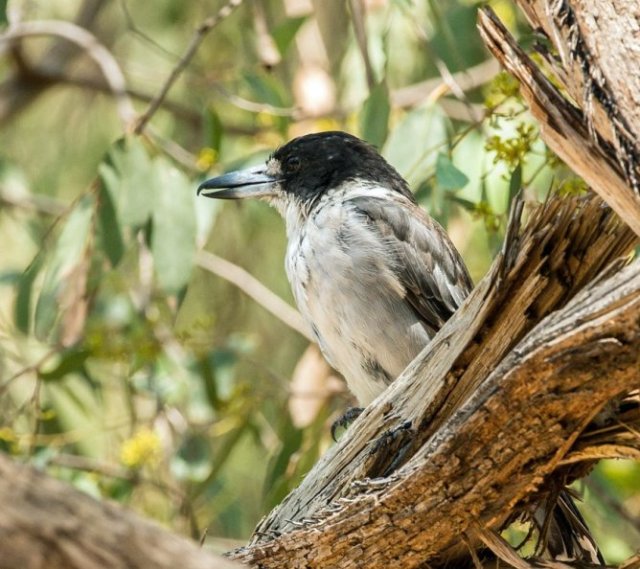
- Our photo shows a Grey Butcherbird – these are fairly commonly seen in the park at this time of year. Quite a few other interesting bird sightings have been reported in the park and in the surrounding corridor:
- Yellow-tailed Black-Cockatoos have been seen near Main Street (thanks Richard) and we’ve noticed several flyovers over Monday morning working bees.
- We’ve seen Gang Gangs too – also in the Corridor as reported earlier.
- Nicky, one of our friends, has had a visit from a Nankeen Night Heron to her garden pond. Alan has seen it in the creek too.
- White-faced Herons which typically nest in the Corridor and feed in our creek have regularly been seen with a squadron of Noisy Miners in attendance making life difficult!
- Finally, the Little Pied Cormorant has been spotted fishing at the Blacks Walk Bridge – must be too noisy at his/her usual spot at the Laurel Grove bridge!
- Ruth took this interesting shot of what she thinks is a Brown Goshawk which was flying quite high above the park near Pakenham Street- perhaps after a lower flyover.
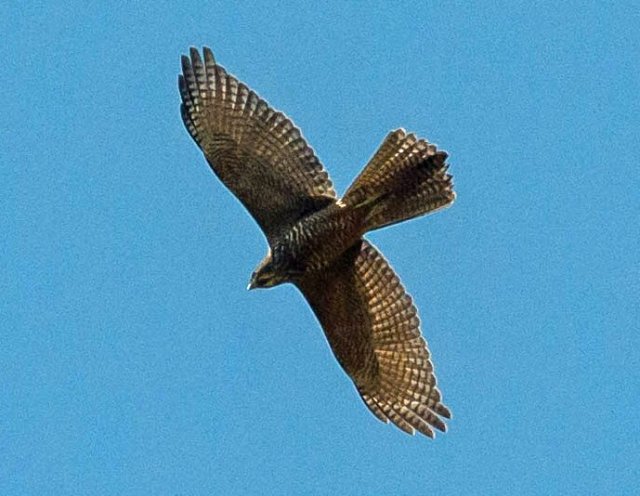
- She was alerted to its presence by “alert calling” from the local birds which made her check what was worrying them. If you suddenly hear a lot of racket from birds like the Noisy Miners, Mudlarks and so on – it is often a very good indication that something interesting, like this Goshawk, is disturbing the peace. Usually, its a White-faced Heron or a Pied Cormorant – but you never know!
Blackburn Nightlife
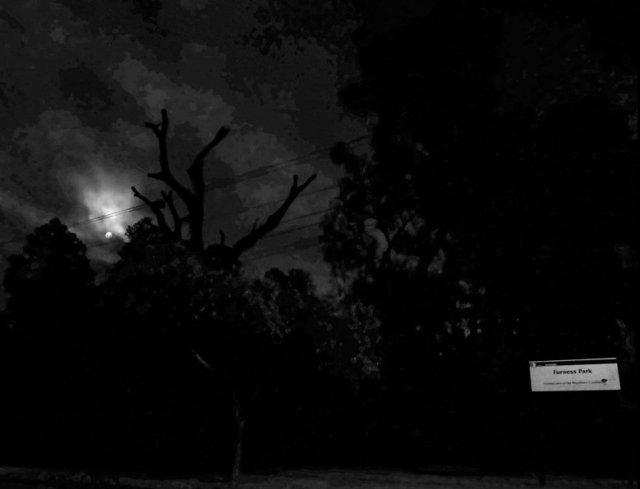
- Our photo shows another dimension of our park that most of us do not experience – the rising moon highlighting a ghostly stag in Furness Park.
- If you look very carefully, you might see our moths, other insects , insect feeders like Tawny Frogmouths and our microbats – even larger predators such as owls.
Maintenance Team Report
- Our maintenance team seems to be ticking over quite well at present. We’re getting 5 or 6 people along, males and females – averaging about 20 person hours per week. At this stage, we are working Mondays only instead of the Monday/Thursday we worked last year. We’re pleased we’ve had interest from new volunteers and many of our stalwarts are back on deck.
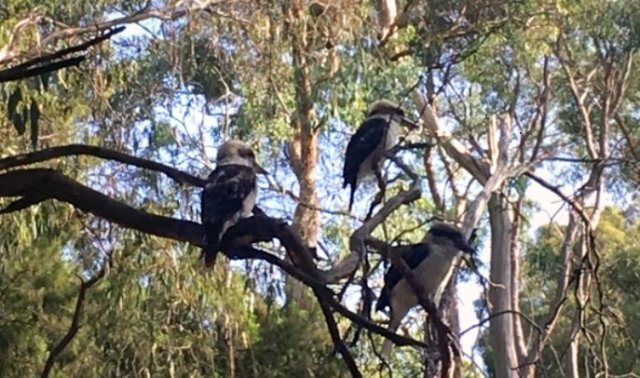
- Naturally, we’re always on the look-out for new recruits. Nicola’s mobile-phone photo of these three spectators at last Monday’s working bee weren’t quite sure whether or not to commit – but were certainly very focused on our activities:
- It’s been far too dry to plant. Recent work has been weeding adjacent the Bowling Club car park, alongside/behind the Scout Hall and in two areas further west, north of the path – the area planted up in working bees last year and along the “flat” down the bank.
- Our former working bee coordinator, Mary Crouch, was extremely generous with her time, equipment and her resources. In former times, Mary would load up her car with working bee tools, a barrow, buckets etc etc and park as close as possible to the work site.
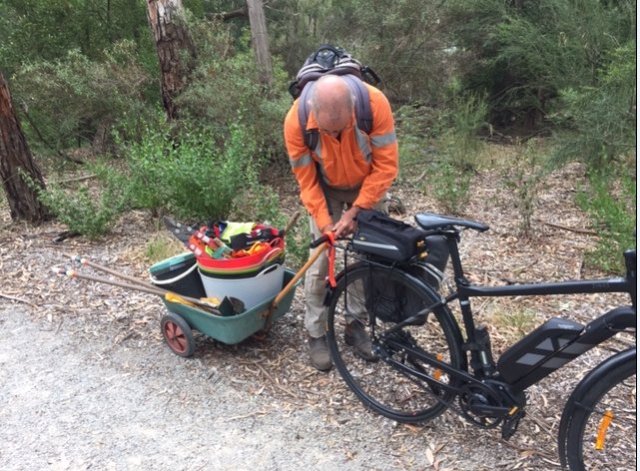
- These days, John has assumed the mantle of “tools provider” so has adapted his bike to drag the weed barrow as a trailer full of the requisites to our work sites using a Velcro strap as Nicky’s photo shows. This confers special benefits – the tools can be taken off-road anywhere the paths go and the fuel is “free” because he can charge his bike’s battery when the sun is shining! So far, most passers-by and spectators have had the good grace not to laugh as well!
Seat Maintenance
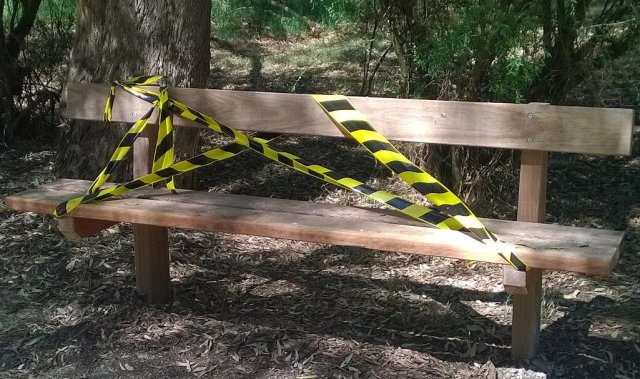
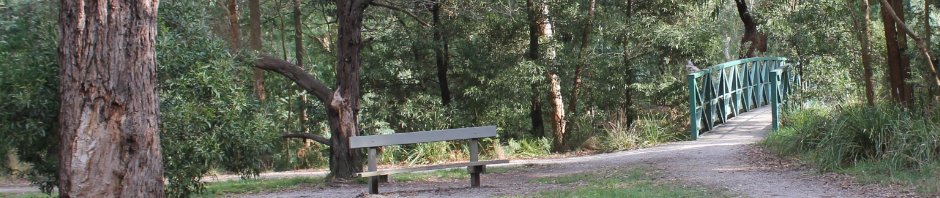
- Council has replaced another couple of the old sleeper seats in the park over the past month. The seat in our photo is on the south side of the creek to the east of the Laurel Grove bridge. Another, to the west of the bridge, has also been updated.
- Many of the old sleeper seats are at the end of their useful life and several are too low for the comfort of older visitors and members of the community.
Plant of the Month
- This month, Plant of the Month has been awarded to Purslane (Portulaca leracea).
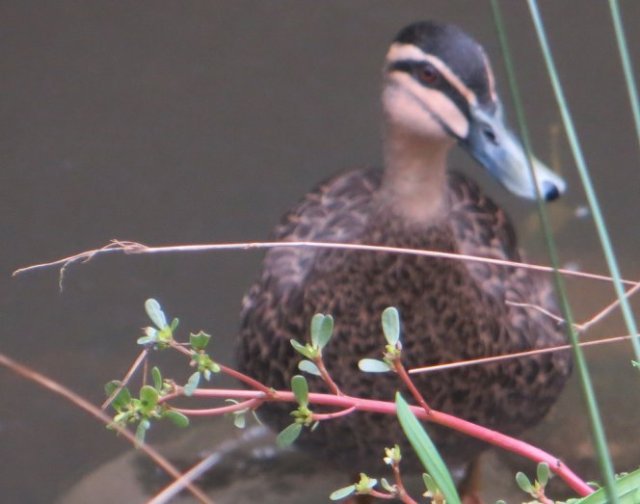
Do Pacific Black Ducks eat Purslane?
- Purslane aka “Pigweed” or “Water weed” is widely known as a pesty weed – yet it is an indigenous plant. It has succulent green leaves, red stems and yellow flowers.
- Interestingly, it is world-wide (probably spread by man) and is used for culinary purposes in many cultures including the Greek. Also, Aboriginals used its seed to make seed-cake and damper. It’s one of the few and best plant sources of healthy Omega-3 essential fatty acids and has other goodies built-in! In some cultures, the plant is treasured for its anti-diabetic properties too.
- It is likely to be indigenous to the Creeklands – though is more prolific nowadays and the local species is likely to be genetically polluted with introduced varieties.
Weed of the Month
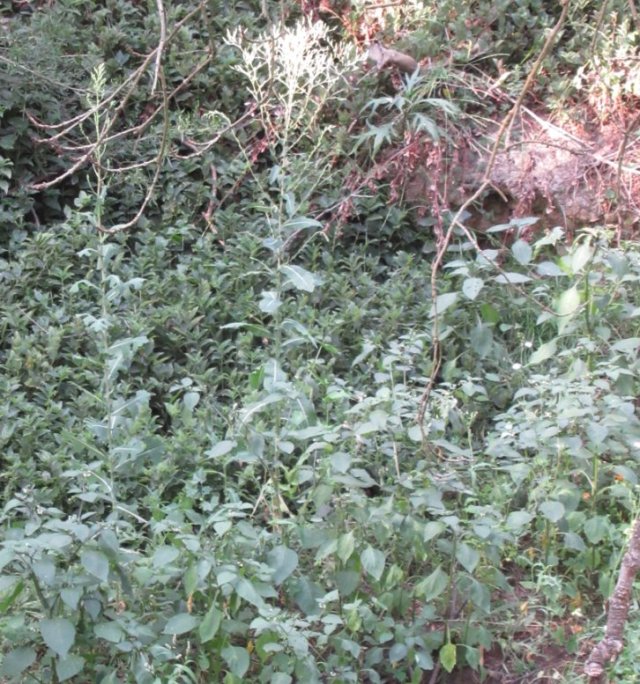
- Our Weed of the Month is Flaxleaf Fleabane (Conyza bonariensis). The weed is a blue-green annual herb growing to 1m tall with grey, stiff, bristle-like hairs. Its stems are densely hairy and unbranched below its flower-heads. Leaves are narrow, oblong and toothed along the edges.
- Its flower-heads form a pyramid like shape with each head formed from many individual flowers. The plant flowers (and seeds) prolifically from late spring to autumn.
- It is thought to be native to South or Central America though now is naturalised in North America, the Mediterranean and Australia.
- Our strategy has been on driving down the weed seedbank by taking off its seed heads and leaving the rest of the plant when it is performing a useful function such as stabilising a creek bank.
Agies – Off with Their Heads!
- Just a reminder also to please dead-head your Agapanthus plants to prevent seed entering our park via the storm-water system…
- For those interested in removing their Agapanthus completely, here is a link to a very welcome and interesting article from the from the Southern Dandenongs Landcare Group about removing the pests – without herbicides, machinery or hard labour.
For Your Calendar
- Some interesting events are coming up:
- Our first Community Working Bee for 2019 is planned for Saturday, March 30th. Because it is likely to be too dry to plant, we’ll probably be doing site preparation activities such as mulching and weeding ahead of later planting bees. Work will start from 09:00 onwards. We also extend a warm invitation to everyone who cannot work on the day to join us for morning tea.
- Our Autumn Bird Survey is planned for Saturday, 13th April starting at 07:30 aiming to finish at about 09:00. Many stay for the correlation of survey results from the teams immediately afterwards.
 Blackburn Creeklands