Autumn Bird Survey Report
- Our bird survey was very well attended by both people and birds to count – 29 of each! The only negative for the morning was the dull light which made it difficult to see the brighter colours on our birds and harder for the photographers to exercise their skills.
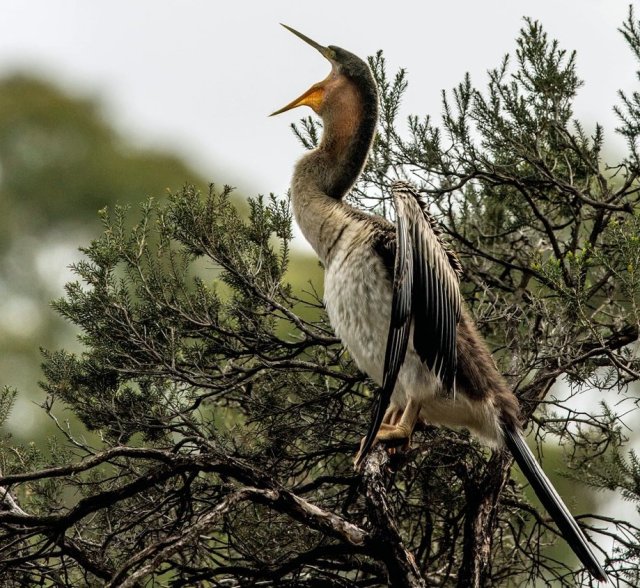
- The highlight for one group was spotting an Australasian Darter – a species which has never been recorded in the park before. Actually, it has been seen before – but somehow missed being included in our records.
- The poor bird was being harassed by several Noisy Miners – so the first viewing (near the Laurel Grove bridge) was only fleeting – but sufficient for Pat, the group leader, to identify it. When the group returned to the bridge after looping back from Furness Park, the bird reappeared and everyone in the group got a much clearer sighting. Our photo above shows a bird similar to, if not the same bird – Ruth snapped at Blackburn Lake on the same day. The bird’s yawn indicates what size meal it might consume… There are more photos of the bird below in our new Bird of the Month feature.
- So this sighting had to be added to our record books. For a complete list of the birds seen in the park over roughly the past forty years, please click this link to our Birds by Scientific Name which shows that ninety-seven different species have visited or live in the Creeklands. Our Autumn and Spring bird surveys have been running since 2012 – so far, we’ve only seen forty-seven of them in a survey – less than half!
- Naturally, our Tawny Frogmouths were welcomed sightings as usual – the pair below was spotted in Kalang Park virtually at the start of the walk.
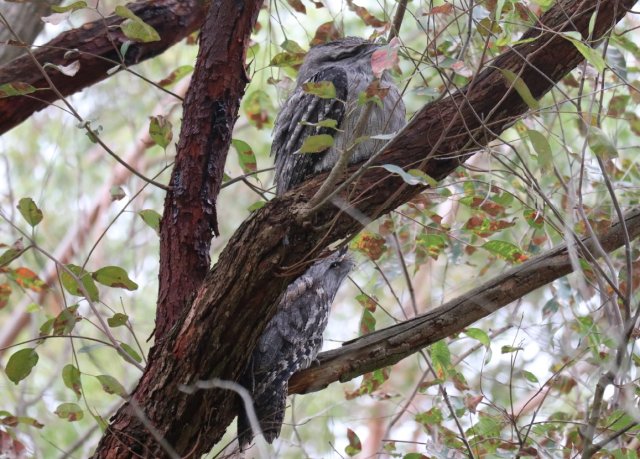
- Note the lower bird has gone into “nothing to see – I’m a branch” mode – jutting out, not “fluffed up” enjoying the sun. This is a defence strategy and indicates that the bird is alarmed. If you see a bird like this, please move back to alleviate its fears.
- Here are some other photos from the day:
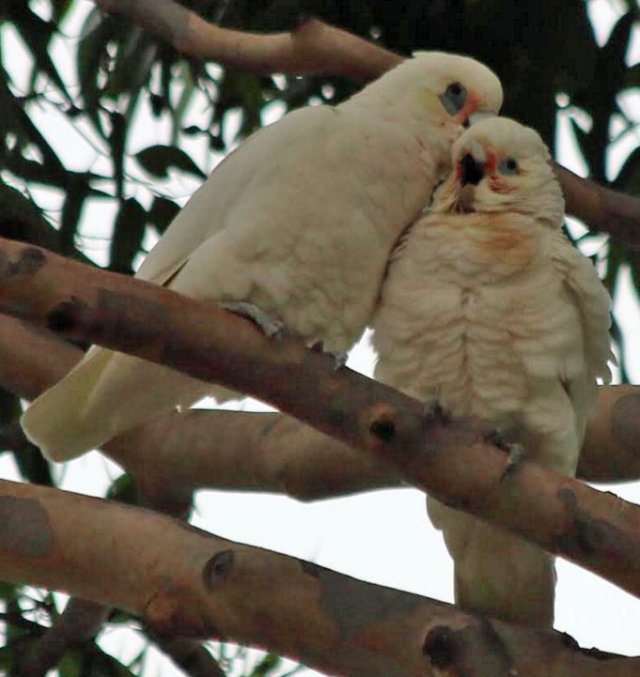
Little (or short-billed) corellas – whispering secrets? (thanks Julie)
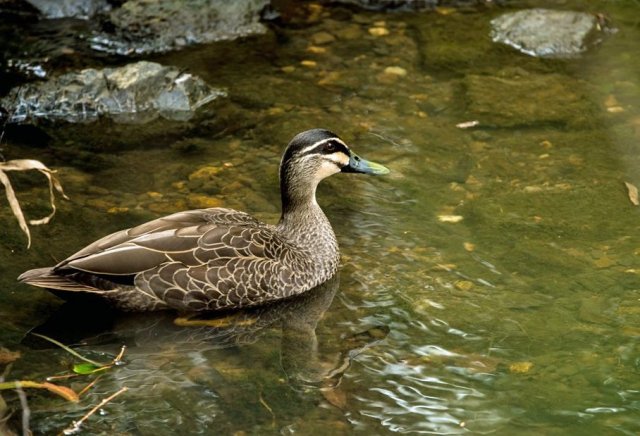
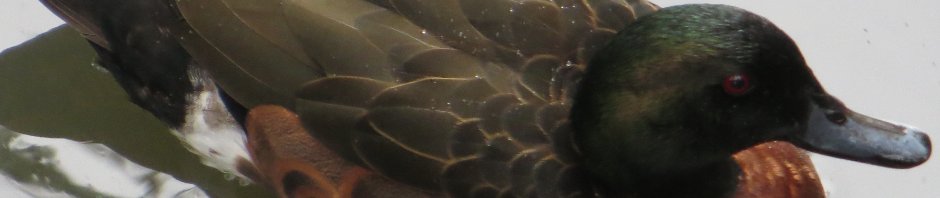
Pacific Black Duck in clear water – something to reflect on? (thanks Ruth)
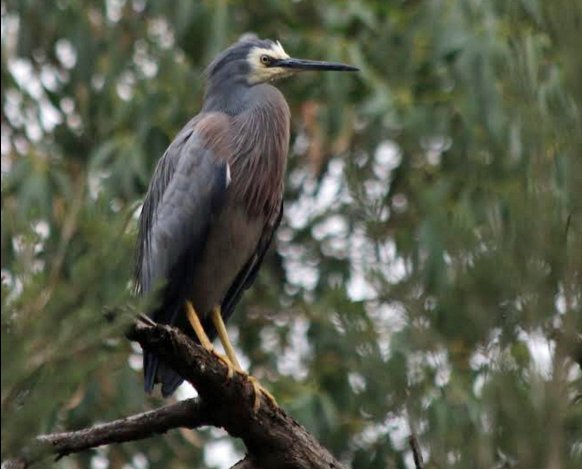
White-faced heron fish watching (thanks Julie)
- As a trial, we changed the venue for the survey to the Kalang Pavilion instead of the Scout Hall. This change of venue proved to work well. However, we don’t know about its availability for future events – there may well be clashes with Auskick and cricket depending on our dates and the sporting seasons.
Victoria Walks – Blackburn Creeklands walk
- “Victoria Walks” has let us know that staff have recently updated its Blackburn Creeklands walk. Their walk in our park has been chosen as a “Staff Pick” and is also one their “Walks of the Month” this month – clearly, they appreciate our park’s features – particularly our majestic eucalypts and the ability to walk a circuit on either side of the creek.
- If you’d like to have a look at their walk or try it out, please visit: https://walkingmaps.com.au/walk/3905
- Don’t forget we have our own walk too – the “Secrets of the Creeklands”. Our walk is superficially similar – but emphasises historical aspects of the park. You can find it here: https://blackburncreeklands.wordpress.com/activities/secrets-of-the-creeklands/
Protecting and Extending our Park
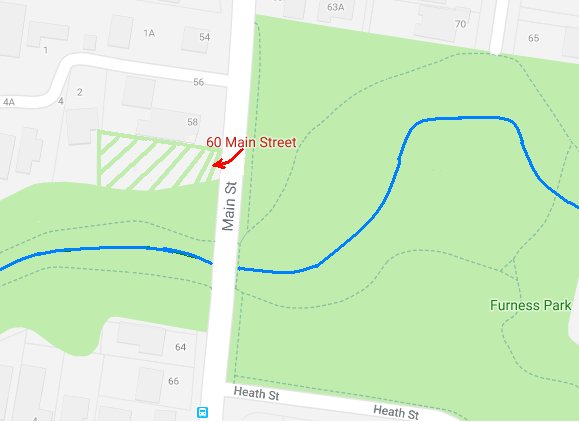
- The Bellbird Residents Advocacy Group (BRAG) and others have initiated a campaign for the City of Whitehorse to acquire vacant land at 60 Main Street – to add it to the Blackburn Creeklands park. Many will know that the property has been for sale without success for about twelve months.
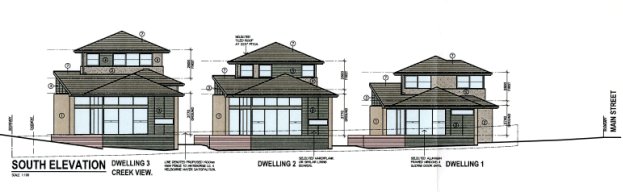
- Actually, the saga of that property development has been running for more than seven years (!) – including several visits to VCAT following community objections. The development shown in our picture was eventually approved by VCAT in February, 2016 – but construction has not commenced and the land lies vacant. Please see https://blackburncreeklands.wordpress.com/2014/12/21/another-development-application-for-the-land-adjacent-to-60-main-street/ for a summary of the key events.
- There would be significant benefits if the park were to be extended by including the land at 60 main Street:
- As most park users know, the park is too narrow on the northern side of the creek between Laurel Grove and Main Street. A little more depth would considerably assist in providing fauna and flora an improved corridor for movement through the park as well as vastly improve its visual aspects.
- The block has a steep slope to the north-west – so the approved housing development of the land would have enormous adverse visual impact on the park.
- The park would be completely alienated by the presence of buildings so close with negative impacts of lights and noise, and shadowing, as well as the visual impact of the built structures on people walking along the path – as well as wildlife. If the current, VCAT approved, building plans were to proceed, they would also dominate the south side of the creek.
- The narrowness of the park towards Main Street means there is little potential to augment the canopy as it is too narrow to plant up – especially as potential future townhouse owners at 60 Main Street would likely object to having canopy over their houses, and the necessity of a firebreak would mean less opportunity for screening planting.
- The block has other considerable challenges:
- Mature trees must be retained due to their protection by a Significant Landscape Overlay. These would be far better protected as part of the park.
- There is a Special Building Overlay in place due to the possibility of the creek flooding. Solid fencing (as approved by VCAT) would interfere with overland flows in flooding events – which will inevitably become more common in future.
- Council has a substantial fund for the acquisition of property for parks said to be of the order of $50M. Committee supports the proposal to incorporate the property into the park. We would dearly love to rescue the existing remnant vegetation and to build upon it to improve the park, complementing Furness Park on the other side of Main Street.
- The Blackburn Creeklands Advisory Committee feels Council now has a once only opportunity to ensure that a very valuable asset retains and improves its recreational value for the burgeoning Box Hill and Blackburn communities as well as strengthening the wildlife corridor that extends through Blackburn and into Box Hill. We understand the current owner is keen to sell and has reduced his asking price.
- One problem is that Council’s criteria for property acquisitions are not a good fit for this specific property. However, the need is urgent – once the property is developed, the opportunity for improving the park would be irretrievably lost! This is the reason BRAG has initiated a petition to encourage Council to take exceptional action – as Council and other arms of Government did in relation to the land at 1 Lake Road near Blackburn Lake – today’s McCubbin Park.
- If you would like further information – or to sign the petition, please see BRAG’s newsletter: BRAG Update 2019 Autumn – or sign the copy on display outside 27 Myrtle Grove, Blackburn. If you sign another printed copy, post or deliver by hand to 27 Myrtle Grove, Blackburn no later than 20th May 2019.
Maintenance Group Report
- The Maintenance Team is a group of volunteers who work in the park on Monday mornings. Main activities are weeding, planting, some mulching and occasional rubbish removal.
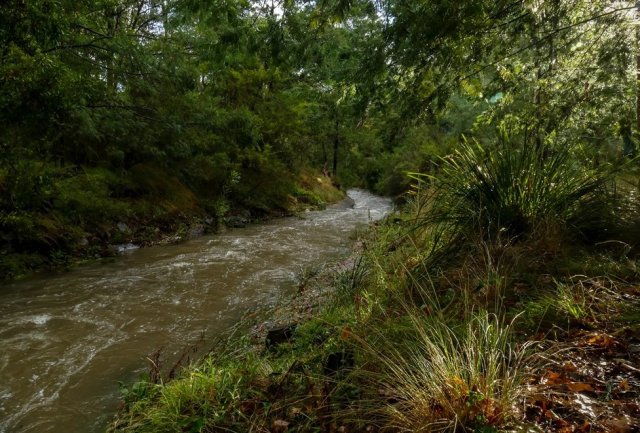
- Now that there’s a bit of water around, we’ve started in-fill planting – though only in the damp area just east of the entrance from Laurel Grove North.
- Otherwise, we’ve mostly been weeding around the Laurel Grove bridge, along the main track leading up to Main Street on the south side of the creek and in our project area ahead of our next working bee.
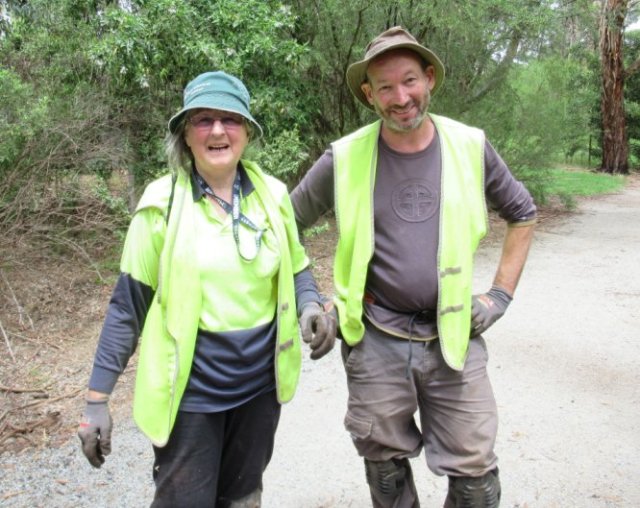
- You may remember this candid picture of Mary and Tom we published in our December/January news when we reported Mary Crouch was leaving Blackburn. Sadly, we’ve now lost Tom too – to a full-time job in the communications industry. We’re sure all our Friends of the park will join us in thanking Tom for his significant contributions to the park as well as his friendliness and wisdom as a colleague – and wishing him all the best for his career. Hopefully, we’ll see him at a community working bee or at Yarran Dheran where he volunteers once a month.
- On the positive side of the ledger, Ruth has recently joined our intrepid Monday morning band…
National Volunteer Week
- National Volunteer Week is being celebrated in the week May 20-26th – this is the 30th Anniversary of National Volunteer Week:
“Established in 1989, National Volunteer Week is the largest celebration of volunteers in Australia. It provides an opportunity to highlight the role of volunteers in our community and to say thank you to the 6 million Australians who volunteer”.
- We’re unsure whether Whitehorse Council is hosting any celebrations – but you can celebrate by coming to our next working bee!
Next Community Working Bee
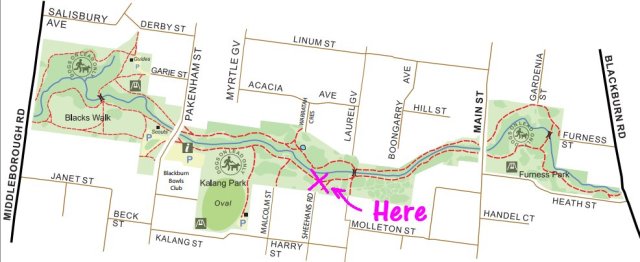
- Our next Community Working Bee is planned for this coming Saturday, 4th May 09:00-12:00 with morning tea provided at about 10:30. Everyone is welcome to work with us for all or part of the morning – or simply to join us for morning tea!
- We’ll be mulching and planting in our new project area as well as in-fill planting in nearby beds – here:
- Tools: are provided but you are welcome to bring your own to make ours go further or to suit your working preferences. Useful tools are weeding hoes, weed pullers, weed bins/buckets and garden gloves.
- Recommended Clothing: we recommend sensible clothes for the weather – long sleeved shirts, long trousers, gloves, hats and work boots. You might also like to consider kneelers or knee pads.
- In case you can’t make it, our June working bee is planned for SUNDAY, 2nd June.
Bird of the Month: Australasian Darter
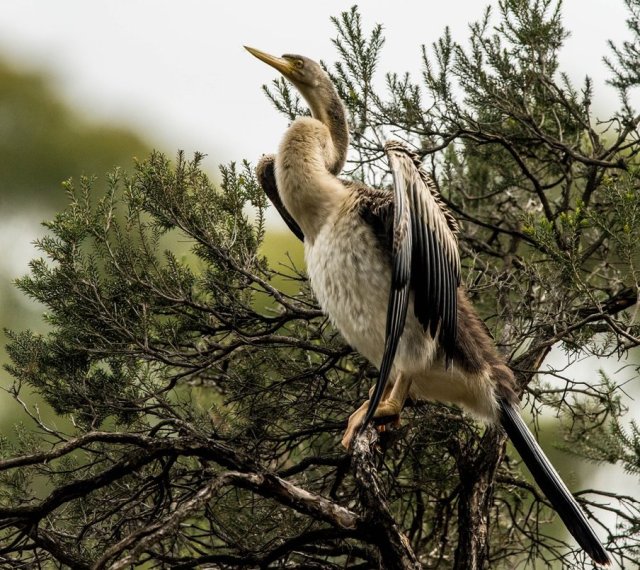
- The Australasian Darter (Anhinga novaehollandiae) is a species in the Darter family and is found in Australia and neighbouring Indonesia and Papua New Guinea. It is also closely related to its American (Anhinga anhinga), African (Anhinga rufa), and Oriental (Anhinga melanogaster) cousins. It is widespread in Australia – from the tropical north to western Victoria, most of Western Australia – not so common in South Australia.
- They prefer to forage in smooth inland waters. Locally, Darters often visit Blackburn Lake but are not on record as ever having been seen before in the Creeklands before as mentioned earlier. Incidentally, Ruth took all of our photos of the Darter at Blackburn Lake – not in the Creeklands. Our bird was vigorously pursued by Noisy Miners and could have well have been “down from the Lake”.
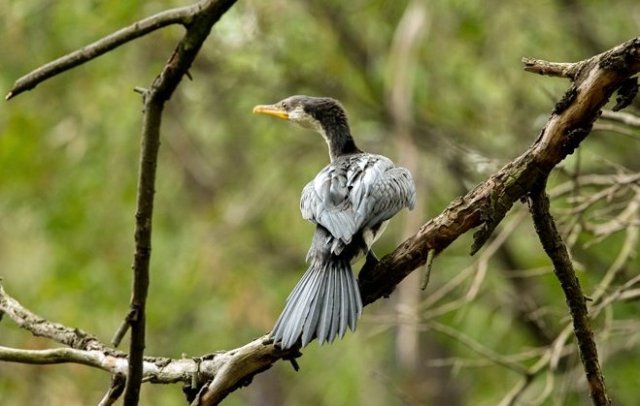
Little Pied Cormorant – also spotted in the Bird Survey (thanks Ruth)
- It superficially resembles our familiar Little Pied Cormorant – but is considerably larger – weighing at twice as much (2+ kg) and spans 86–94 cm in length. It also has a relatively long, thin and kinked neck with a straight and finely pointed bill (no hook at the end like the Cormorant).
- Otherwise, they perch on rocks or branches near the water to dry themselves like Cormorants do.
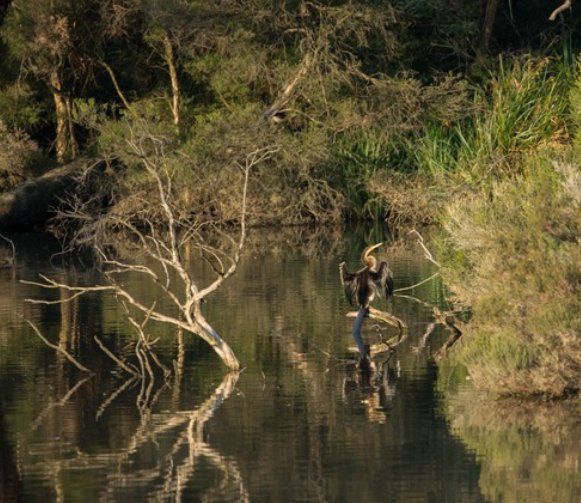
- The Darter forages in water, often swimming quite low in the water with only its head and neck exposed. This habit leads to another common name for the bird: “snake-bird”. They can swim underwater for long periods – so much so, they tend to stalk their prey rather than chase it.
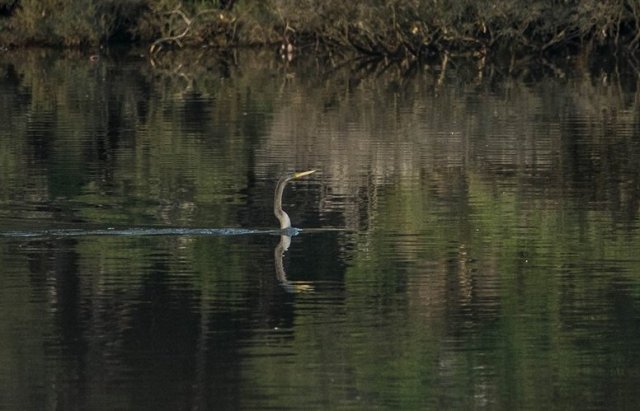
Up Periscope! – Darter swimming mostly below the water at Blackburn Lake
Plant of the Month
- Our Plant of the Month is Slender Knotweed (Persicaria decipiens). In the park, it grows in or close to the water. Our photo shows a clump growing with Juncus mid-stream in the creek in Kalang Park. it grows to about 30 cm high and has narrow lanceolate (spear-shaped) leaves which are 5–12 cm long and 0.5–1.5 cm wide. Its delicate pink flower spikes appear from November to June. The plant tends to die back in winter and regenerates in spring.
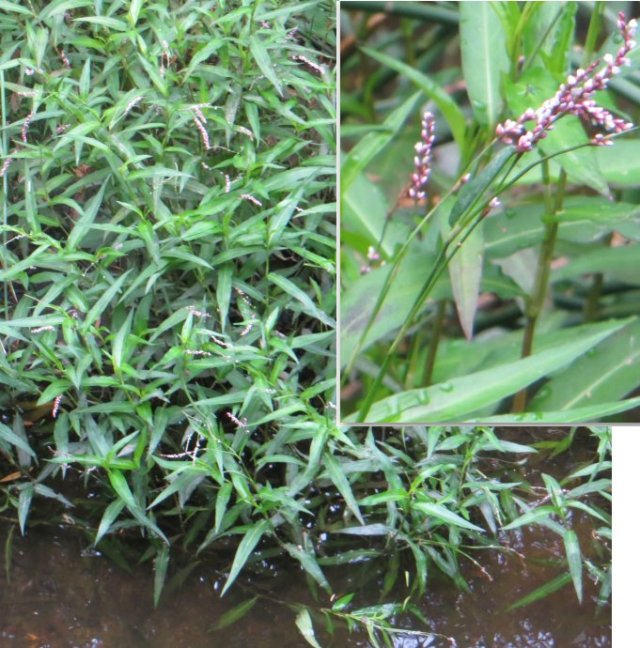
- Though the dark patches on its leaves make it look quite similar to Vietnamese or Hot Mint (Persicaria odorata), it is not the same plant and definitely does not work well in rice-paper rolls!
Weed of the Month
- Weed of the Month is Panic Veldt (grass).
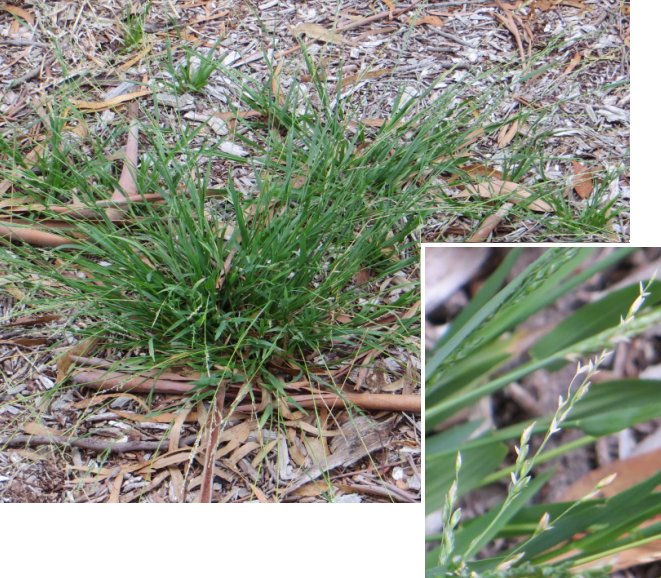
- Panic Veldt comes to us from Africa and is an invasive, perennial grass with both profuse and rapid seed production. With the increased moisture in the soil following recent rains, this weed is quickly re-establishing itself in the park. Obviously, it is great if it can be pulled out before it sets seed to break the cycle.
- The inset in the picture shows the tell-tale ‘inflorescences’ – the botanical term used for the flowering and seed-producing part of any flowering plant. As they dry out, they become white – a good way to identify the weed from good grasses. The main photo shows how the inflorescences dangle past the main plant – so its seeds fall a little away from the parent plant. In this way, a single plant quickly becomes a patch…
- It is opportunistic – quickly invading newly disturbed areas, seeds all year round and quite possibly rates as the Number One weed in the park. It usually grows 30-50 cm high and older plants can spread a metre or more. Unfortunately, it tends to out-compete indigenous ground covers in most soil conditions.
- The good news is that its roots are weak – so the pest is quite easily pulled out.
 Blackburn Creeklands