Community Working Bees – July 7th Report and Plans for August 4th
- The July 7th community working bee was very successful with a lot of weeding done and about 170 plants going in.
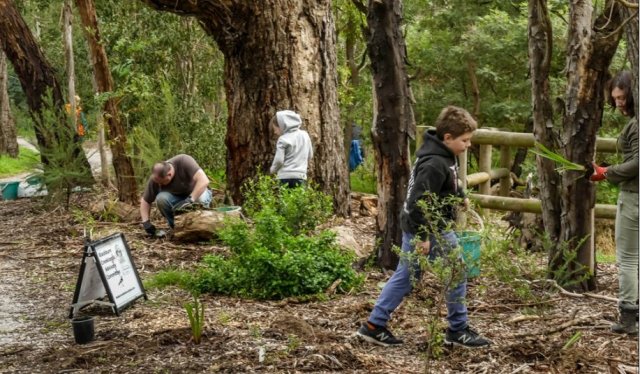
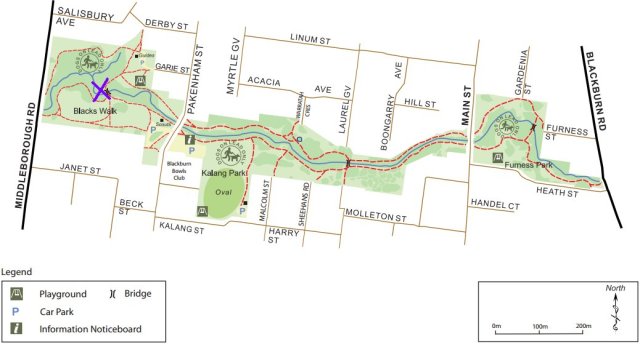
- For our next community working bee on Sunday, August 4th, the site will again be in Blacks Walk – meeting at the bridge and working westwards towards Middleborough Road with a combination of weeding and planting.
- We start at 09:00 with a briefing – working through to 12:00 (of course, you can work for a shorter period if you prefer). We break around 10:30 for morning tea and everyone is welcome to join us for a cuppa and chat even if you are unable to work with us on the day.
Maintenance Team Report
- The recent rains have been very good for the park and moisture is penetrating the soil. Nevertheless, it can still very dry 75mm+ down – but our plants seem very happy nonetheless.
- The maintenance team has been busy recently at the northwest of the Blacks Walk bridge including relocation of rescued Kangaroo Grass clumps.
- Other Monday working bees have continued weeding and some in-fill planting further along from last Community Working Bee westwards towards the Blacks Walk bridge. Earlier sessions comprised similar work adjacent to 60 Main Street in Kalang Park.
- We’ve been pleased to welcome two new starters – Vicki and Adela.
Our Future
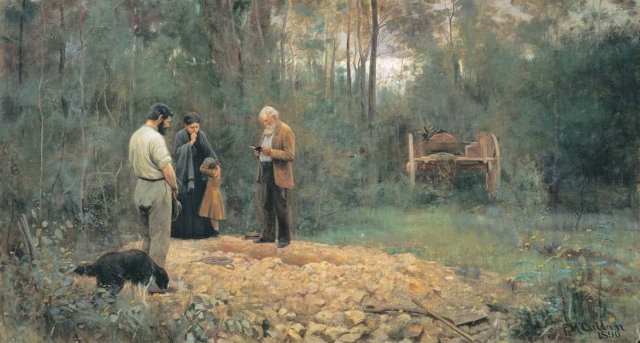
Frederick McCubbin – A bush burial (1890) – possibly painted in our area.
- In March, we reported that Nunawading’s R.E. Gray Reserve Advisory Committee was forced to fold last year and that our sister Advisory Committee for Cootamundra Walk was on the verge of folding due to a lack of new volunteers coming on board to replace older members on their Committee. Happily, some local families in Blackburn North stepped in to save the day and the Cootamundra Walk Advisory Committee survives.
- Council has been aware of these issues and appointed a consultant, Richard O’Byrne from the Public Land Consultancy, to analyse the situation. He reported feedback to the Advisory Committees (including ours) in late June.
- Richard reports that the trend affecting volunteering in Whitehorse is national – people’s attitudes to volunteering are changing across the country. For example – new volunteers tend to prefer one-off and/or major events rather than ongoing commitments.
- The dire long term message to us is “change or die”. New trends are emerging such as the increasing popularity of corporate philanthropy including volunteering in more enlightened companies. So, we need to be willing to experiment and to tap into new resources and approaches.
Our Past – The Creeklands Pre-1750
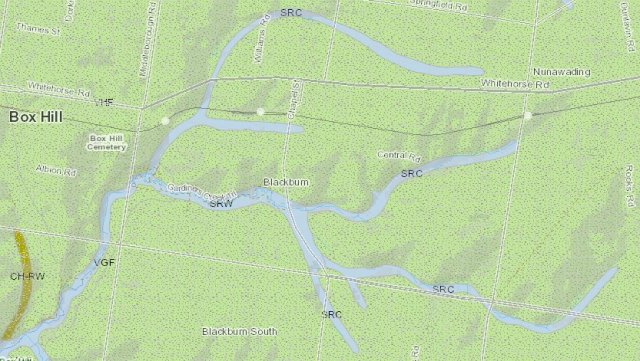
- Scientists have created the above benchmark of what our local vegetation and habitat would have been like before European settlement. Obviously the roads and rail were not there then – these have been added to the map lightly so you can get your bearings.
- The blue shaded areas (labelled SRC and SRW) trace the former stream lines of Gardiners Creek and several tributaries including the now mostly underground Blackburn Creek going north – which had one branch running along where the railway station is nowadays and the other going further north past the Blackburn Hotel site before arcing around towards Springvale Road. Interestingly, Blackburn Lake is not present – for a good reason, it was man-made in 1889 by the damming of Gardiners Creek.
- The letter based labels represent Ecological Vegetation Classes (EVCs) as follows:
SRC= Swampy Riparian Complex
SRW=Swampy Riparian Woodland
VGF=Valley Grassy Forest
VHF=Valley Heathy Forest
CH-RW= Creekline Herb Rich Woodland
- Nowadays, due to urbanisation, not very much of those types of vegetation remain – the Blackburn Lake and Wandinong Sanctuaries serve the area well and there are traces along our creek:
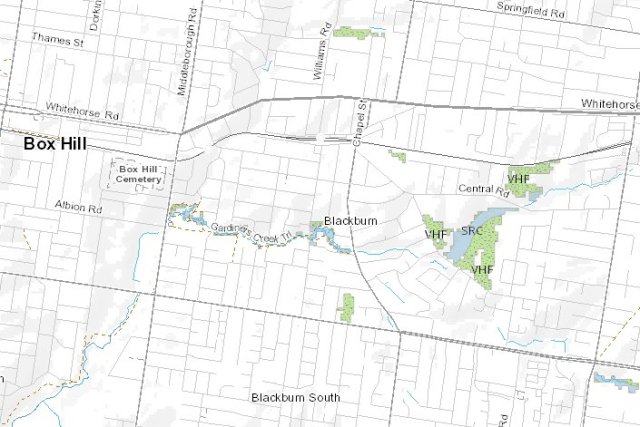
- If you would like to learn more, please visit the NatureKit site.
Our Present – Corridor Protections
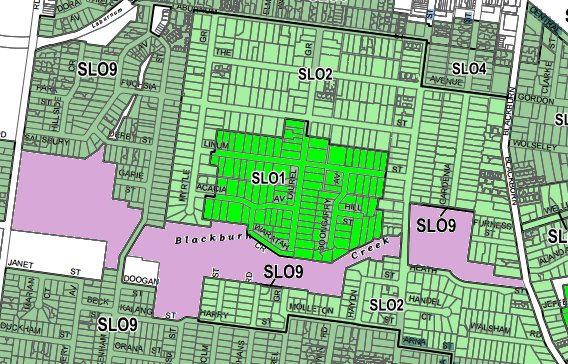
- Steps are being taken to preserve what we have left and also link into the “Urban Forest” concept – one of the key tree protection planning controls available is the application of Significant Landscape Overlays (SLOs).
- In the diagram above, our park is shown shaded in lilac. Most of our park’s interface with the private domain has been protected by Significant Landscape Overlay planning controls SLO1 and SLO2 since the 1990s. If you would like to know more about the history of our Corridor and the way the protections developed, local resident Tony Kjar has written a comprehensive history you can download here.
- A temporary control, SLO9, was introduced in 2018 to recognise that the treed character of municipalities such as Whitehorse provides an important ‘green corridor’ between Melbourne, the Yarra Valley and the Dandenongs and is a significant component of the subregion.
- Council was advised in late June that the Minister for Planning has authorised Council to prepare and exhibit a planning scheme amendment to apply SLO9 on a permanent basis. In addition, Council was also advised that the Minister would approve an extension of the former interim SLO9 control until 30 June 2020, to allow Council time to prepare the Amendment.
- In relation to the park itself, SLO9 mainly affects the northern boundary of Blacks Walk and the southern boundary of Kalang Oval (there are also some boundary anomalies also affecting properties at the end of Gardenia Street and between Sheehans Road and Laurel Grove South).
Annual Parkland Community Forum

- One of the advantages associated with being on a park Advisory Committee is that Whitehorse Council invites Committee members from all the Bushland parks and indigenous nurseries to an annual function called the Parkland Community Forum.
- It is a celebration of volunteering and also a networking opportunity where each committee shares its achievements and challenges for the year. We reported on the continuing success of our Autumn and Spring Bird Surveys and the challenges of getting along without Mary Crouch – who did so much for our community (and park in particular) but moved out of the area in the New Year.
- Council always engages an entertaining speaker. This year (on 9th July) we enjoyed a talk from Dr James Fitzsimons who is the Director of Conservation for the Australia Program of the Nature Conservancy. James proved to be a very topical choice of speaker – he featured in a major article in “The Age” of 13th July on pages 22-23.
- James’ talk looked at conservation starting from the national perspective drilling down to the local level. Serious in-roads have been made nationally in more recent times via programs such as the Trust for Nature and National Reserve System, where indigenous and private land holdings have effectively doubled the land held for conservation in the country – formerly, mostly in the form of National Parks.
- At the city level, James described the Resilient Melbourne project supported by almost all local Councils which broadly aims at (re)greening Melbourne. Melbourne is one of 100 cities worldwide participating in a program funded by the philanthropic Rockefeller Foundation.
- At the local level, the SLO9 control (see our above article) was discussed – as well as other interesting programs such as the Gardens for Wildlife program we reported in last October’s news.
- James was introduced by Mayor Bill Bennett who made the interesting point that Council’s target for Canopy Cover is at least 30% by 2030 under its Urban Forest Strategy. The current estimate of tree cover is 22.9% across Whitehorse. This is therefore an ambitious target when one considers our housing trends towards “McMansions” and multi-unit subdivisions which result in smaller garden areas and more limited opportunities for vegetation planting. James suggested possible solutions lie in planting shrubs and suitable planting on nature strips/road verges.
- This is enlightened thinking – the focus on canopy trees in SLO controls ignores that mid-storey and ground-level plantings also have very important roles in conservation and biodiversity.
Farewell Nicola!
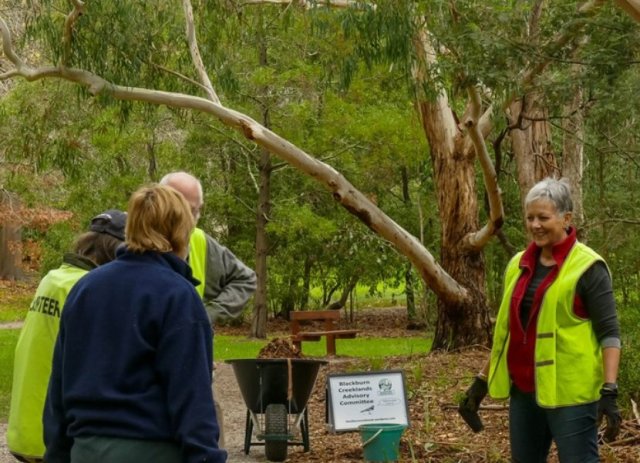
- We are a sad to farewell Committee member Nicola (R) who is moving to another part of Melbourne. Nicola joined our Committee way back in the year 2000 – many will be familiar with Nicola from her tireless efforts around the park and from her respectful leadership at working bees.
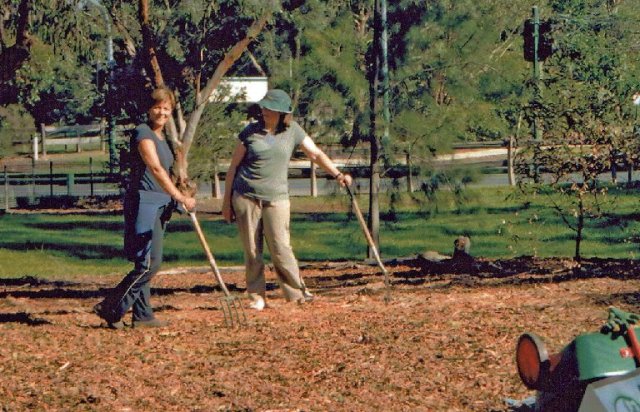
- Our photo from the archives shows Nicola (L) and Mary Crouch having a well earned rest after spreading a truck load of mulch near the Middleborough Road entrance in 2007. That area is now nicely bushed up in one of our most successful regeneration projects.
- The good news is that Nicola has promised to continue to work with us in working bees when she can!
In the “Nick” of time
- By coincidence, we have recruited a new Committee member, Nicky. Both Nicola and Nicky are trained horticulturists and share first names – so we do seem to have been very lucky with an excellent one-for-one replacement!
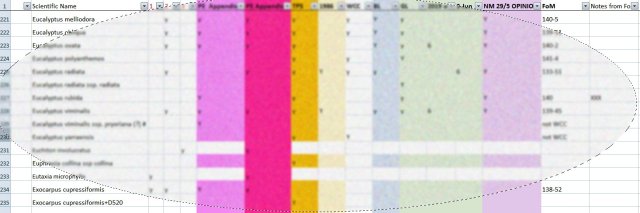
- In addition to preparing our plant stock for working bees, Nicky has been doing excellent and interesting work fundamentally directed at the question “what should we be planting in the Creeklands?“.
- Nicky has gathered information from many sources including our Master Plan and supporting studies, the authoritative Flora of Melbourne, the Blackburn and District Tree Preservation Society lists, stock lists from our nurseries and so on into one place. She has been able to pinpoint some strange anomalies in the lists and challenge some of our thinking. The aim is to create a core list of plants to form the basis of our annual orders on the nurseries – as well as subsidiary lists for specific purposes/sites which might vary with our planned projects.
- Nicky also volunteers with the Gardens for Wildlife program. Her work for us builds on techniques she developed for helping volunteers choose indigenous plants for local gardens for that program. We are very fortunate indeed to have Nicky on board with her analytical skills and scientific bent.
Committee Vacancies
- We still have Committee vacancies we’d like to fill. One of the strengths of our Committee is that we have people with quite a range of skills and experience.
- Please don’t think you need any special qualifications though – the only qualification you really need is the desire to protect and develop our park!

- If you are interested, please come along to a meeting and/or drop us a line at blackburncreeklands@gmail.com . Our next Advisory Committee meeting is at 7:30 PM on August 27th at the Kalang Oval Pavilion, Kalang Street, Blackburn.
In the Corridor
- Her Excellency, the Honourable Linda Dessau, Governor of Victoria visited the Greenlink nursery in June. From all accounts she was very impressed with the work of the volunteers there and was very pleased with the presentation of Epacris she received.
Plant of the Month
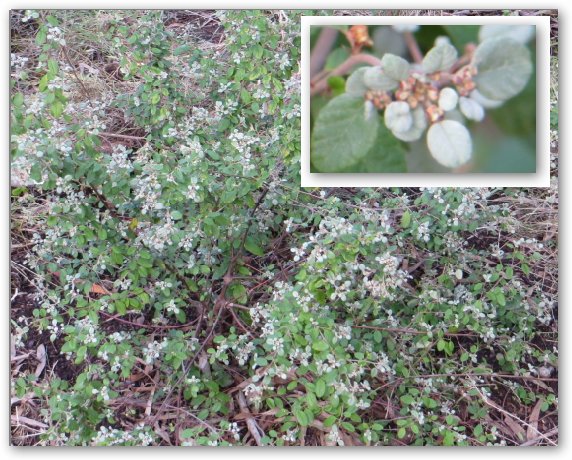
- Australian Dusty Miller (Spyridium parvifolium) is a fairly dense, smallish shrub with attractive creamy floral leaves with other leaves being green and hairy, though lighter underneath.
- It would be a good fit for many local gardens and flowers from July through to November. Our photo shows a specimen up on the hill of Furness Park – there are other good examples in the park’s boundary along Heath Street towards Blackburn Road.
Weed of the Month
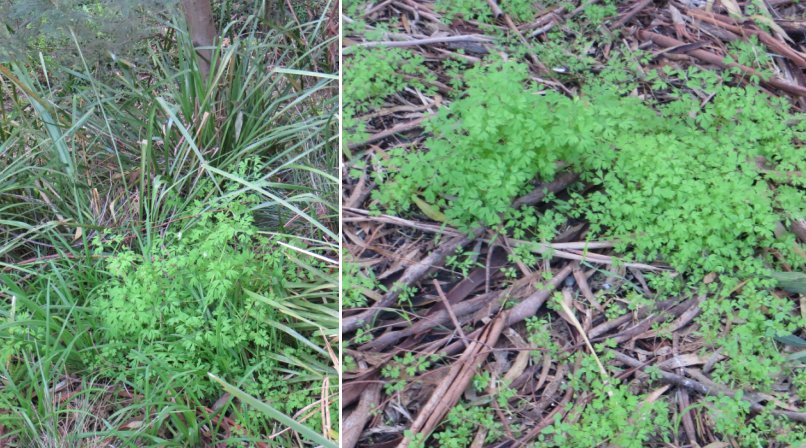
- Fumitory (Fumaria capreolata) is an herbaceous annual in the poppy family and is native to Europe, west Asia and north Africa. You may have noticed it in your garden – it comes up in late winter and spring. It is mainly a weed of riparian areas including creek banks and urban bushland – preferring partially shady, wetter habitats where it can form a dense ground cover and may also climb up over lower-growing vegetation smothering them.
- It has bright light green foliage and may have either white or pink and claret flowers. It seems to seed prolifically. The examples above (near the Billabong) show Fumitory beginning to smother a Lomandra at left and the density of seedlings coming up through leaf litter. The good news is that it pulls out quite easily having a disproportionately small root system.
Sightings
- Apart from the odd fox sighting, our birds are putting on quite a show at the moment as many are gearing up for the breeding season. We’ll let Ruth’s recent photos do the talking:
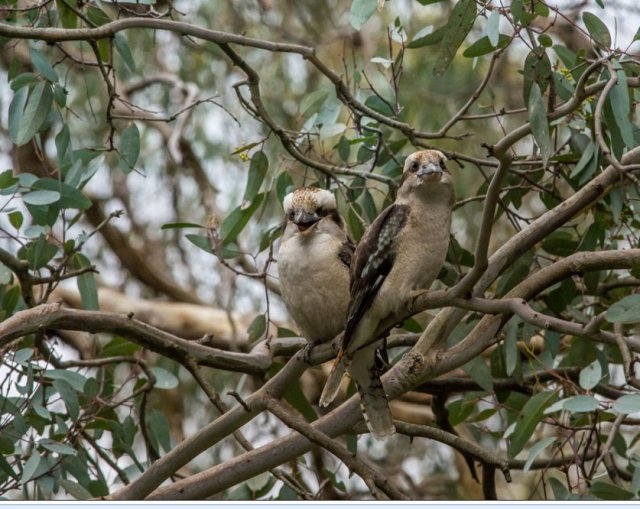
Pair of Happy Kookaburras
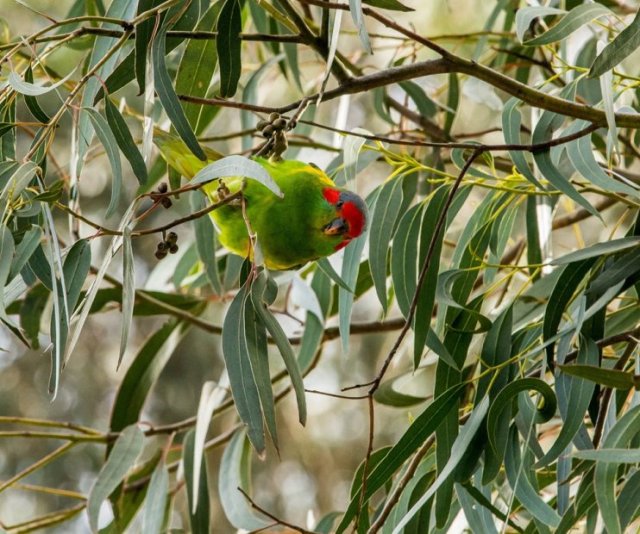
Inquisitive Musk Lorrikeet
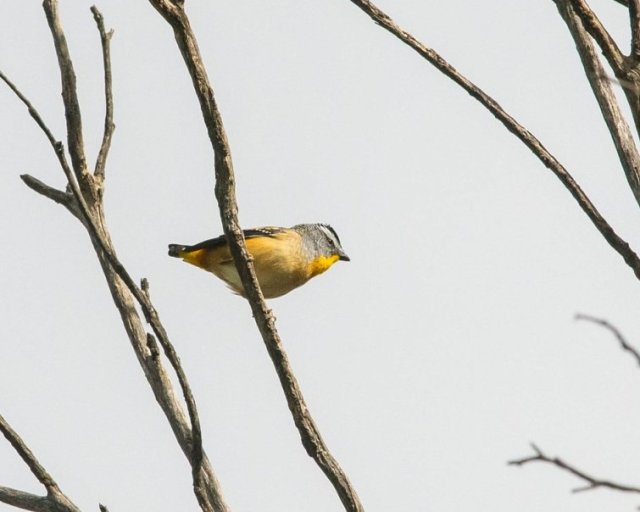
A Spotted Pardalote was spotted!
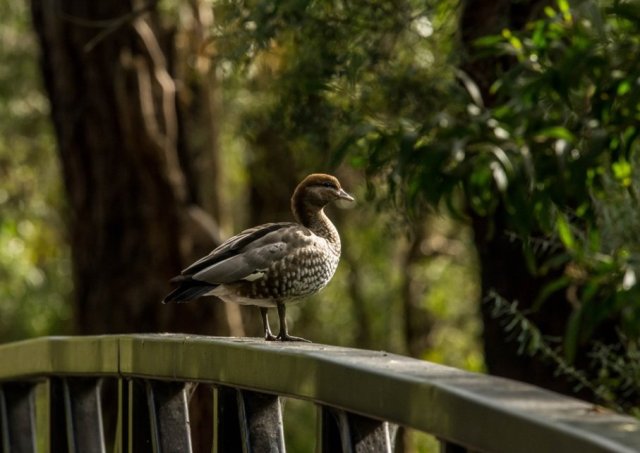
Wood Duck on Blacks Walk bridge
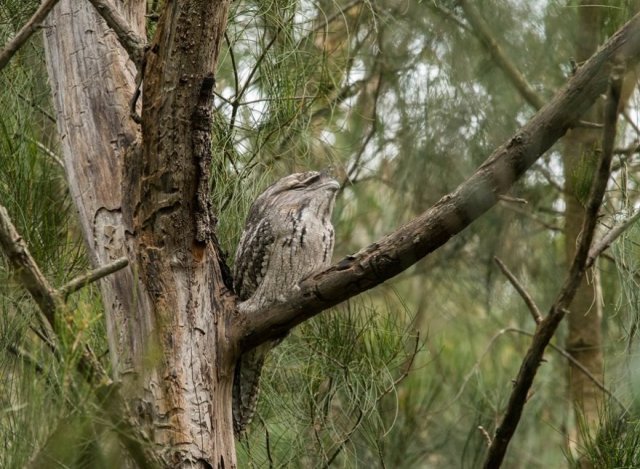
Stoic Tawny Frogmouth
 Blackburn Creeklands
Pingback: Park News – December, 2019 | The Blackburn Creeklands