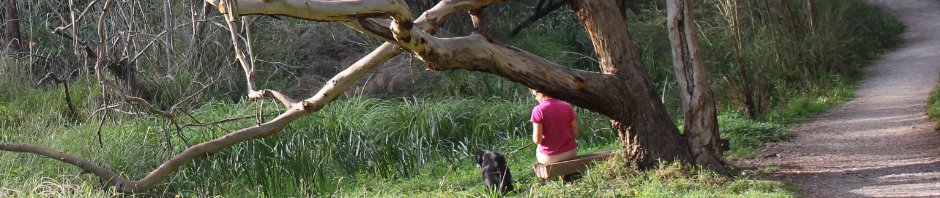
Going batty in isolation?
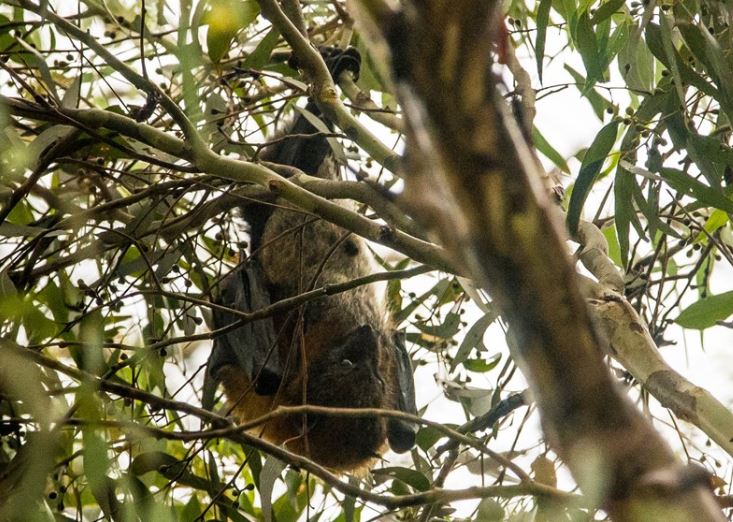
- If so, you are not alone – a Fruit Bat was seen hanging around in Kalang Park (alone):
- The park continues to be very popular with people too as they take their exercise walking, riding, dog-walking and jogging outdoors in the fresh air in our peaceful green surrounds.
- We have never seen the park so busy – so much so, it is starting to show some wear and tear with new tracks forming or widening in the park. Please be careful to avoid our revegetation areas – young plants are hard to see and easy to destroy by accident!
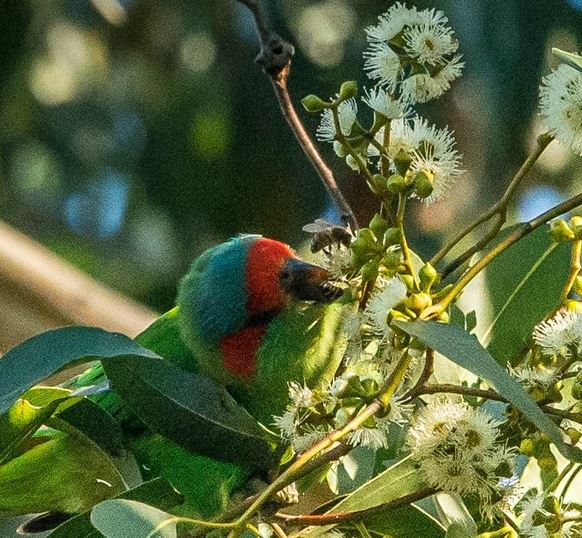
- In these strange times, remember to be kind to each other and share our park’s resources – like the Musk Lorikeet and the bee in Ruth’s photo below:
Do birds have ears?
- Well… why would they sing and call out to each other if they can’t hear?
- They do indeed have ears – but not like our fleshy funnels (pinnae) protruding from the sides of our heads – birds have small holes under the feathers on both sides of their heads. They may be small but they can hear high pitched sounds beyond our human range – as well as the soft rustlings of insects beneath the soil, under leaves and under the bark of trees.
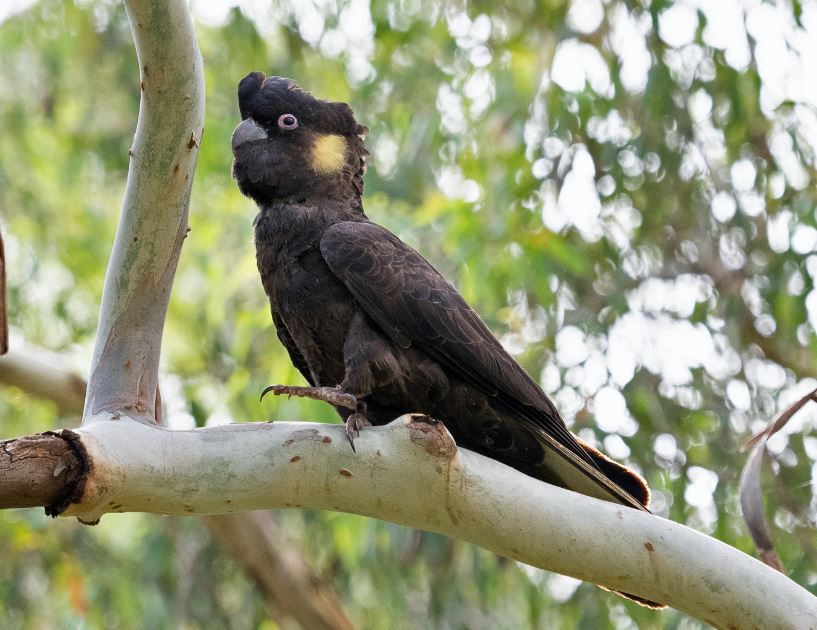
- Looking at Greg’s recent picture above of an adult male Yellow-tailed Black-cockatoo near the Laurel Grove bridge, the yellow patches are called “ear coverts”. These are small feathers which cover the ear opening and the surrounding area. Those feathers work in such a way that they enable the bird to still hear when in flight despite the air movement.
Bird of the Month
- As it happens, our Bird of the Month is the Yellow-tailed Black-cockatoo – they are beautiful, majestic birds that have been visiting our park often recently. As their name suggests, they have large pale yellow panels in their tails. They also have a yellow spot on what bird-people call their “ear coverts” – as shown in Greg’s photo above.
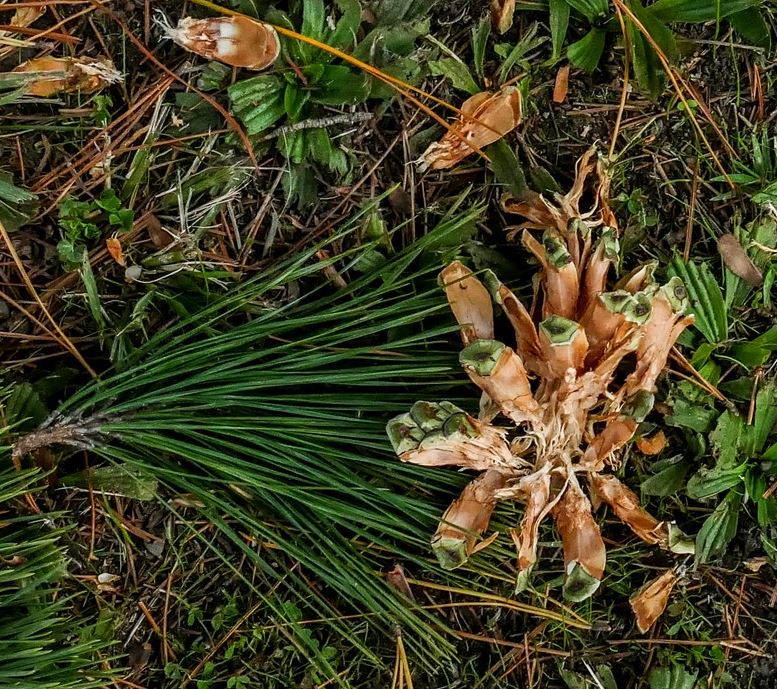
- These endangered cockatoos are seasonal visitors and feed on seeds and grubs. They are one of Australia’s largest cockatoos and have a strong beak for gouging wood to a depth of several centimetres to find grubs and can break green pine cones apart to find seeds to eat. Here’s what’s left of a closed green pine cone:
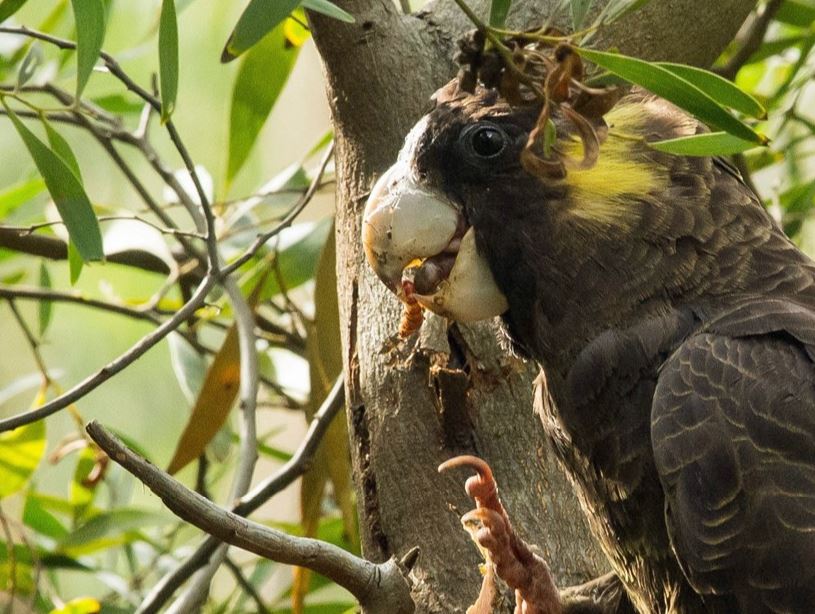
- They also love grubs to eat – they use their powerful beaks and claws to get at grubs under the bark of trees – or in the wood of dying trees. Pat Bingham, one of our regular Bird Survey guides , says:
They are the most amazing birds and it’s almost worthwhile having dying wattles [for grubs] to attract them in! The begging noise of the youngsters is really grating and, according to the Australian Bird Guide, it is that continual grumbling that most easily distinguishes [the] young from adult females.
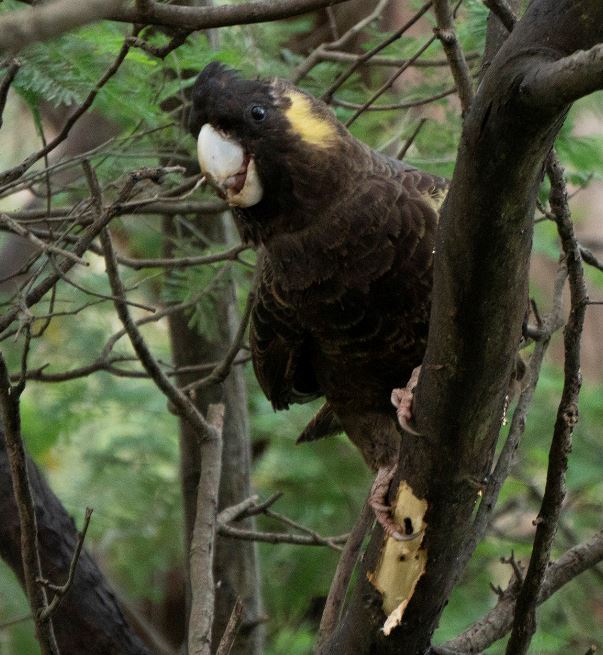
- Wendy’s photo below shows what they can do (see the grub hole ?).
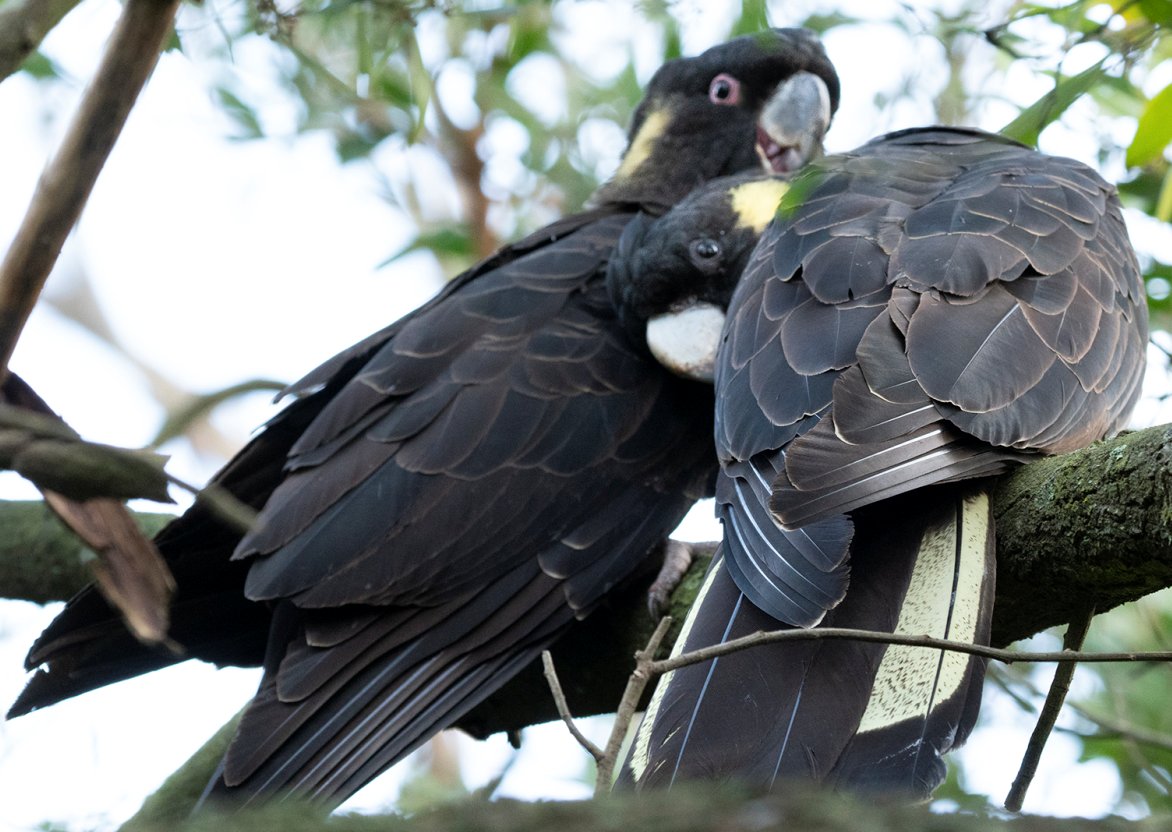
- So, how do you tell the boys from the girls easily? Juveniles and adult females have pale bills and darker eye-rings. Mature males have pinkish eye-rings and darker bills. All birds can have varying degrees of brownish tinge to their “black” feathers. Otherwise adults have a more “bouffant” look – feathers seemingly swept forward with a “bob” on the forehead rather than slicked back – as clearly shown in our first photo of the adult male. The yellow ear coverts tend to be brighter on the females.
Maintenance Team Report
- Sadly, our team has not been working in the park due to Council’s interpretations of the Covid-19 precautions. We are having to watch the weeds grow and trust that that Council will respond positively to the presumed State Government relaxation of its restrictions on May 11th.
- All working bees have been cancelled. In relation to our Melbourne Water community grant for this year’s projects, we have discussed our current working restrictions with Melbourne Water who tell us we are not alone and that Melbourne Water is very understanding of our position – so the timeline for our grant can be extended.
- We have also had to stop our project orders with the local nurseries. Fortunately, both nurseries have been doing well with other orders – so the loss of our business has not caused them major distress.
- Hopefully, we’ll have some better news in our May edition!
Who Lives Here?
- Have you noticed these strange holes with straw poking out in some of the park’s stags? Stags are dead trees – usually larger ones that are retained for habitat purposes in the park – as long as they remain safe.
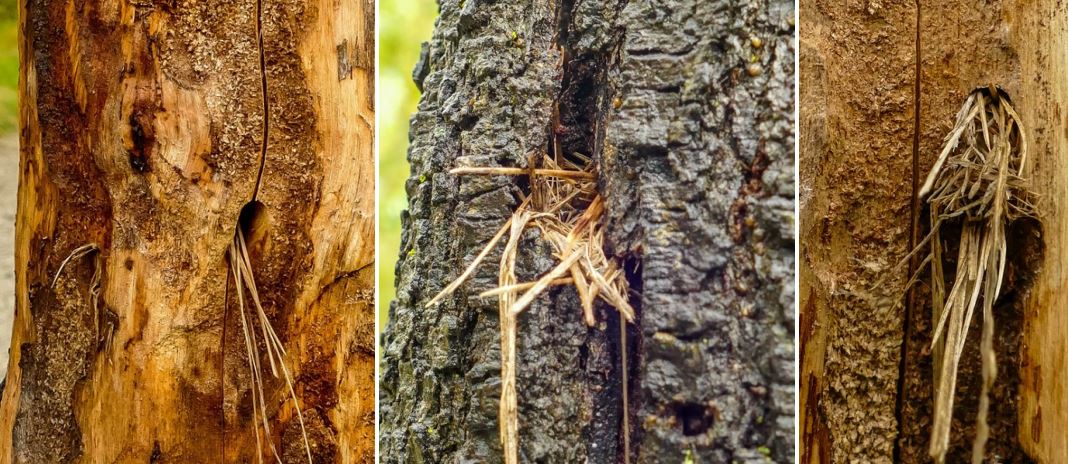
- Linda, one of our local experts, strongly suspects the culprit is a straw-carrying wasp in the genus (family) Isodontia. This youtube video shows how an American cousin in the same genus does it!
Council Works
- Work on the replacement playground in Furness Park is nearing completion – landscaping, seating and a replacement water fountain remain to be finalised.
- Council is planning several dead tree removals (a large eucalypt in Furness Park, 2x Black Wattles near Laurel Grove and another 2x adjacent to 60 Main Street). Committee has asked that the logs be retained where possible for habitat purposes. As luck would have it, two of the trees shown in the article above hosting Isodontia wasps are among those on the list underscoring the importance of retaining stags and logs in the park for habitat purposes. We trust that the straw carrying wasps will be happy with the new horizontal orientation of their homes.
- We notice Council has been busy mulching beds along the Laburnum Primary School fence in Blacks Walk.
- Council is waiting for the rain to slow up before removing yet another illegal mulch dumping in Furness Park near the new playground. Those cowboy tree fellers never give up!
- In relation to the Scout Hall renovation project, small trees in the way have been removed and some infrastructure has been put in place. We are expecting construction proper to start shortly (during May).
- As far as we know, there have been no further developments on the new wetland (Laurel Grove North Drainage Treatment Project) following the tree removals a couple of months ago.
Snap Send Solve App
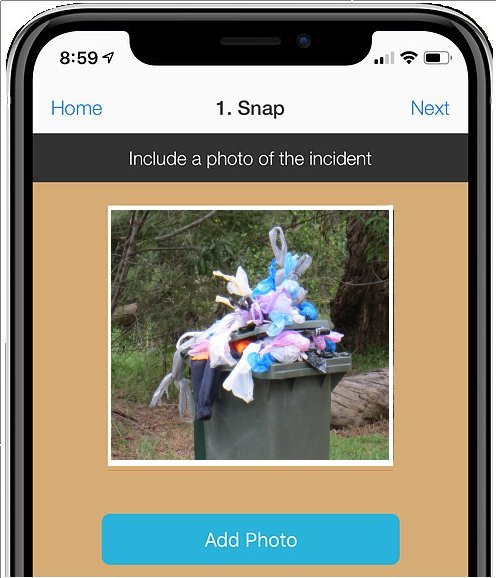
- Whitehorse City Council endorsed the Snap Send Solve app about eighteen months ago for the community to efficiently report problems such as issues in our park. Problems can also be reported to utility companies.
- Snap Send Solve uses the power of the Smartphone to efficiently combine the user’s location and a photo (via the phone’s GPS and camera) to report a problem to Council or other relevant authority. A report can also be made via the Snap Send Solve web-site.
- For further information, please refer to the Snap Send Solve web-site which has information for Apple and Google app downloads.
Illegal Removal of Logs and Wood from the Park
 Logs, fallen branches, twigs and leaf litter are needed in a bushland park like ours to provide habitat for wildlife such as birds, insects and lizards. They also mulch and rot down, returning important nutrients to the soil and contribute to the natural look and feel of the park. Council regularly assesses live and dead trees in the park for stability. If a tree has to be cut down, we usually recommend that the logs be retained in the vicinity for habitat purposes.
- There have been recent reports of people stealing logs and branches from the park for firewood – even using chainsaws! Others collect kindling for private use. Obviously, only Council staff and its contractors are permitted to use chainsaws in the park.
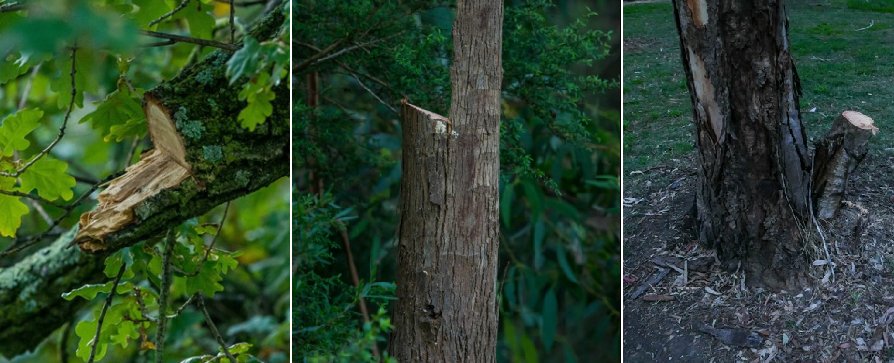
- Sadly, there have been four cases recently of trees and large branches being cut down by vandals in the park. Two completely destroyed eucalypts were well on their way to being canopy trees and bird habitat of the future. The branches and logs were simply dumped.
- Some of the attacks have been done in such a way that the tree victims may sustain further damage through disease. Council’s arborist has recently assessed the damage making remedial repairs where possible. One tree had to be completely removed because it had been made dangerous to park users by the vandals.
- Please note removal of logs and branches from the park for firewood or enhancing your back garden is illegal. Remember that it is YOUR park, paid for by YOUR rates, so please help to keep it a wonderful resource for both people and wildlife into the future. If any timber or kindling removal is noticed it should be reported to the City of Whitehorse on 9262 6333 (all hours) or alternatively use the Snap Send Solve App on your smart phone.
Arson in Furness Park
- Speaking of antisocial behaviours best kept distant, there was a surprising event in Furness Park towards the Blackburn Road end early in the month:
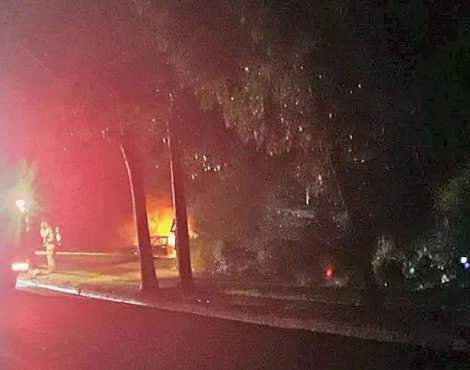
Heath St ~2:30AM 3/4/2020 – Emergency Services in Attendance
- Chris, our photojournalist on the spot, tells us a (presumably) stolen Toyota Hilux ute was dumped in the park and set alight.
- Luckily, the excellent rains on preceding days meant that the park vegetation was very damp so damage did not spread much further than the torched vehicle and the blackened ground beneath it.
Sightings
Powerful Owl (Ninox strenua)
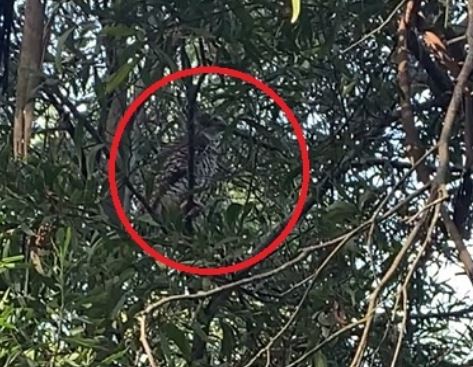
- This unusual sighting was made in the Creeklands about a week ago. Sharp-eyed 8 year old Bronwyn spotted the well-disguised big fellow and alerted her dad who took some photos via his mobile phone.
- We haven’t seen one in the park for about ten years. One expert believes it likely that the bird was simply on a stop-over while residing elsewhere (could be 5-6 Km away). On the other hand, we had a later sighting of two owls shortly afterwards in another Creeklands location…
- These are Australia’s largest owls – measuring up to 65 cm in length, with a wingspan up to 135 cm and weighing up to 2.2 kg. They are fearsome predators – possums (including the larger brushy-tailed) and birds like Magpies and Tawny Frogmouths are all fair game.
Cockatoos in flight
- Ruth has sent us some interesting photos of cockatoos flying in the park which give us some insight into the structure and geometry of birds’ wings:
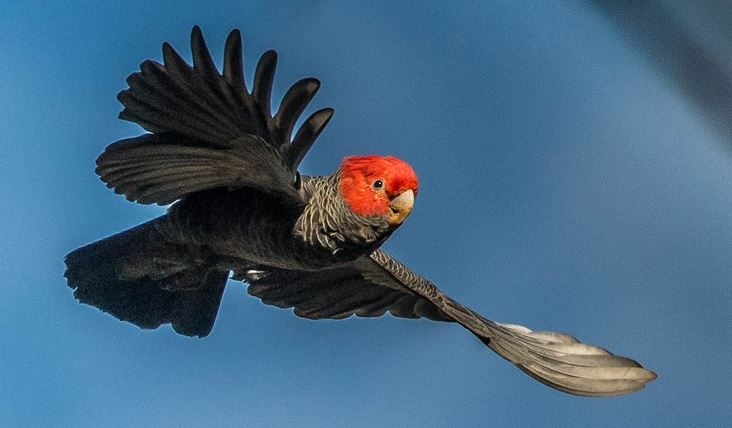
Male Gang-gang Cockatoo in flight
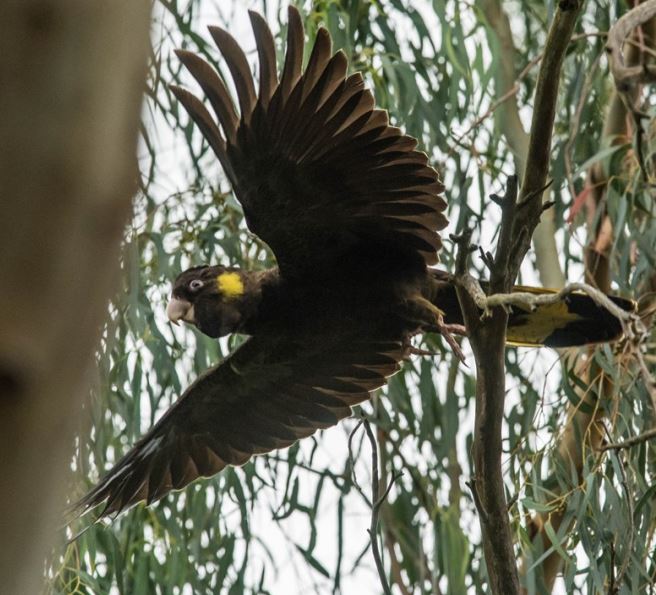
Yellow-tailed Black-cockatoo in flight
Smaller sightings…
- Here are some pictures of some of our smaller, perhaps less well-known, flying creatures in the park during the month:
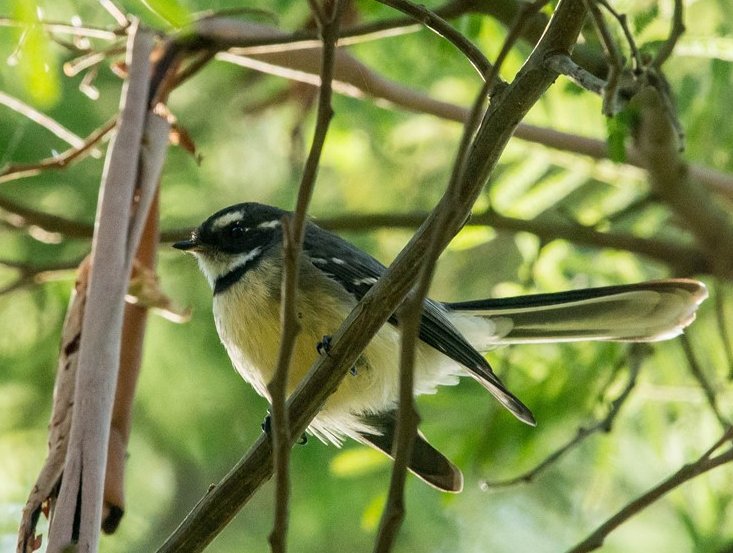
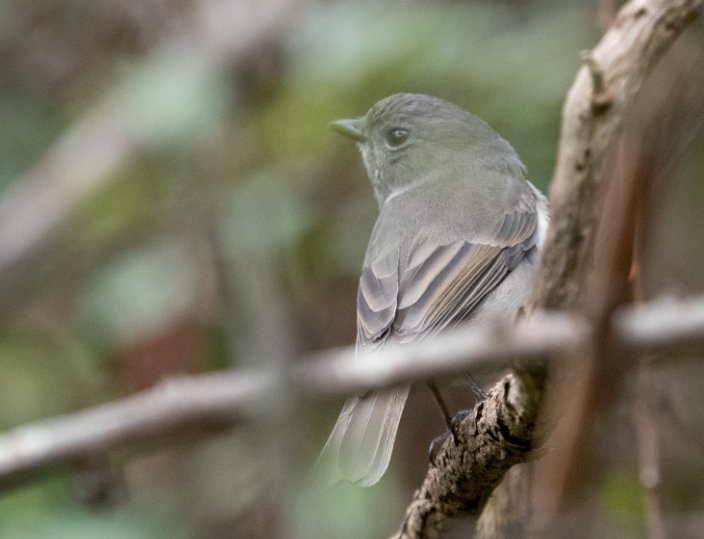
Grey Fantail in the Waratah Wetland (thanks Ruth)
Female Golden Whistler in Blacks Walk – unfortunately it’s the males who are golden! (thanks Greg)
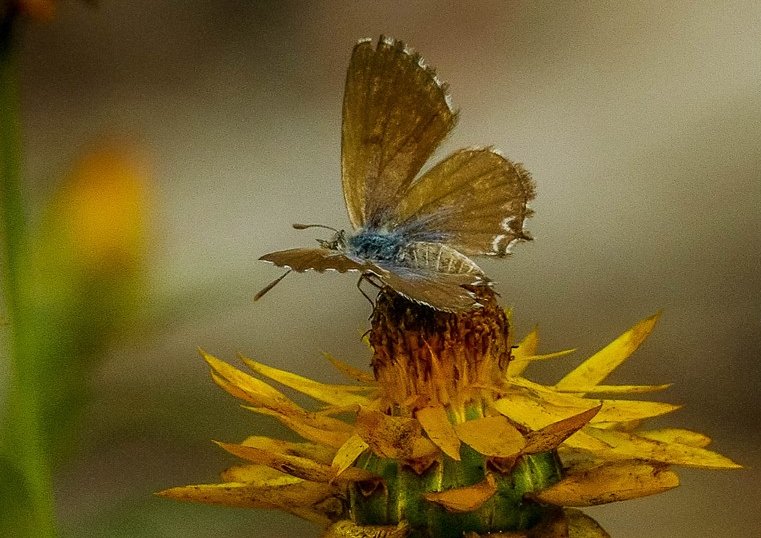
Quite possibly a new butterfly for the park’s list (Dusky Blue – thanks Ruth)
Plant of the Month
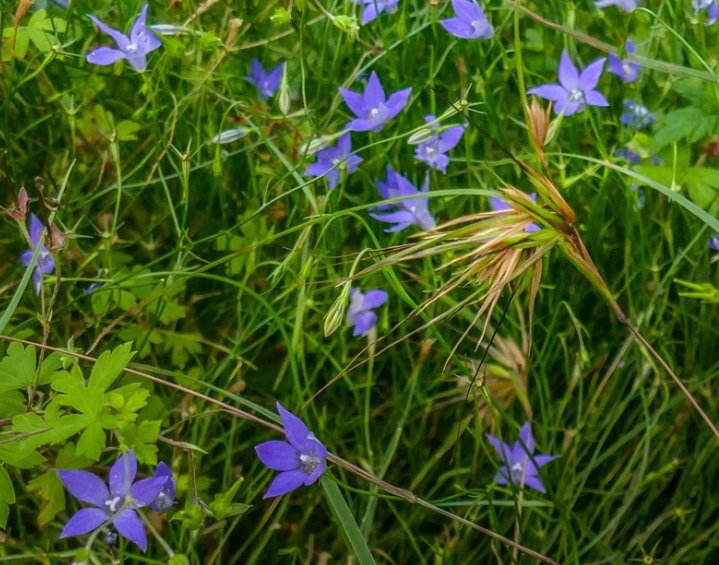
- Our Plant of the Month is Wahlenbergia (Wahlenbergia stricta)- a common Australian wildflower also known as the Australian /Austral Bluebell or Tall Bluebell. It is clearly enjoying this year’s damp conditions. It is found all over Australia except the Northern territory.
- Ruth’s photo was taken in Furness Park and also shows a Kangaroo Grass head on the right in the foreground and some wild geranium leaves on the left.
- The former City of Nunawading originally purchased Furness Park in 1941 so as to preserve land for indigenous plants and wildflowers.
Weed of the Month
- Weed of the Month is Angled Onion (Allium triquetrum).
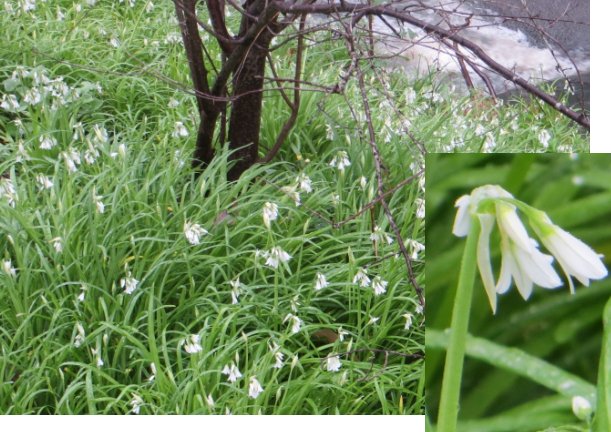
- At this time of year, it is just beginning to emerge from the soil – it appears as a green shoot and has a small bulb at its base when dug up. It then continues to grow looking like a leafy grass until it flowers in winter and spring with white bell flowers. Left unchecked, it can result in quite severe infestations as shown above on the creek bank in Kalang Park.
- On close inspection, its stems have three acute angles and it has a strong onion-like smell (hence the name). It spreads by both seed and bulb division.
 Blackburn Creeklands
Pingback: Park News – April, 2021 | The Blackburn Creeklands
Pingback: Park News – May, 2022 | The Blackburn Creeklands