Winter is well and truly upon us!
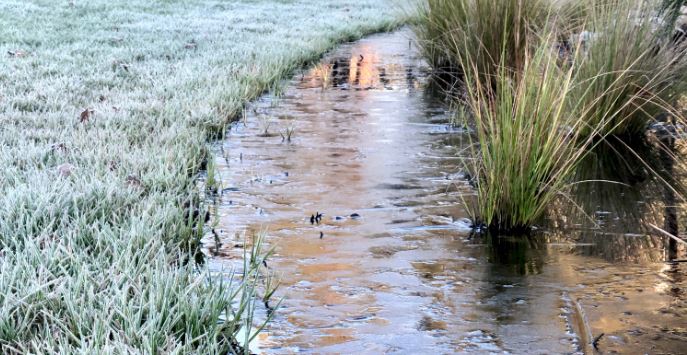
- There was ice on the little pond on the park side of Kalang Oval last Monday (29/6) as Lisa’s early bird photo shows! The good news is that we’ve passed the shortest day so things are now on the up…
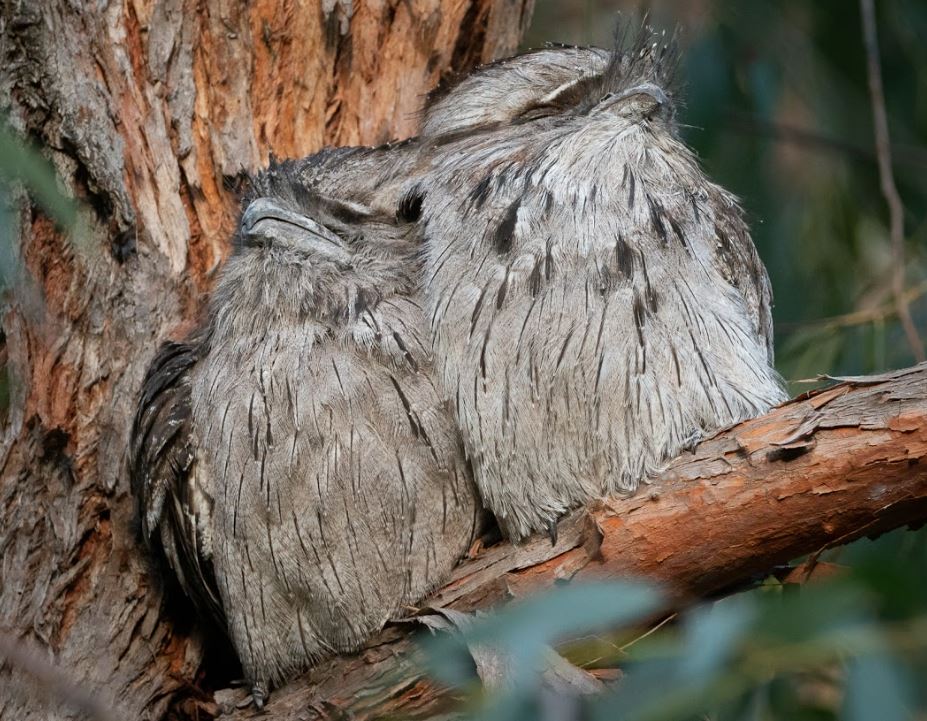
- With our recent frosty weather or the wind and rain combination we’ve sometimes seen lately, Greg’s photo proves it is definitely time to cosy up to one’s family members!
Wetland Works
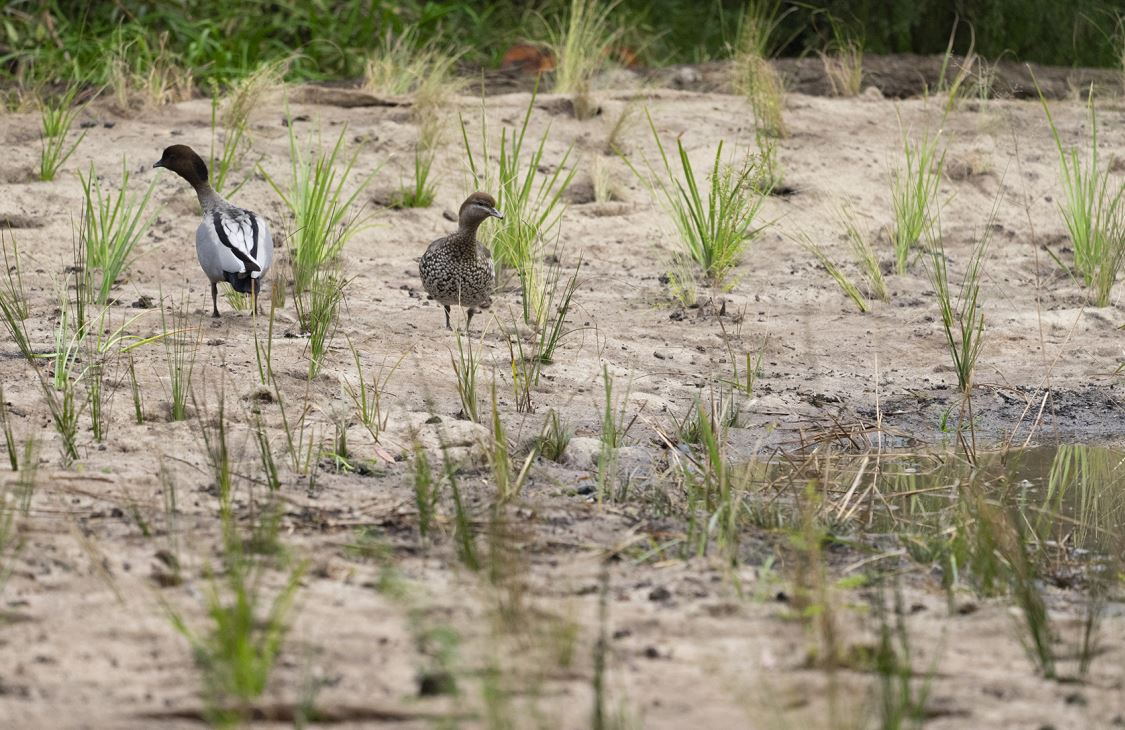
- Most of the new wetland works have been completed and the pond and surrounding area generally seem to be working as intended. Wendy’s photo above shows Mr and Mrs Wood Duck at the “open for inspection” shortly after work concluded. Wendy said they were “quite nervous but interested”.
- A few tasks remain including:
- A temporary interpretive sign is still to be erected. This will explain the purpose of the works and its benefits for water quality in particular.
- We are looking at ways to protect our tool box from the volume of water being directed immediately to the south from the sediment trap.
- the water level still needs to be raised via plinth(s) at the outlet.
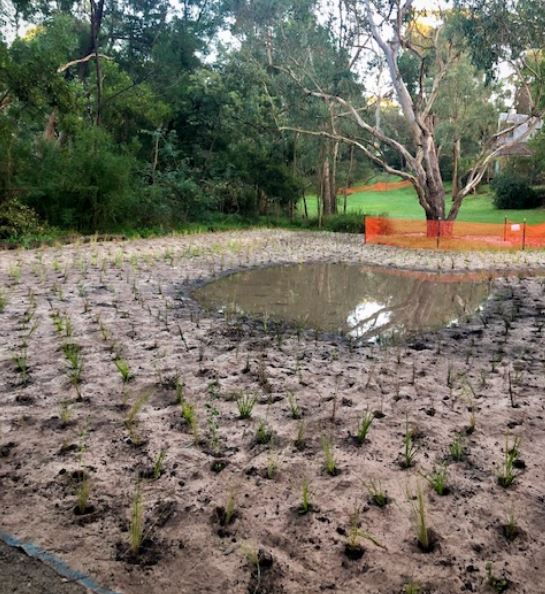
- The rather linear planting pattern (looking like a hair-transplant!) is due to the matting being machine-cut for planting. In time, the matting will disappear and differences in growing rates should make the area appear more natural.
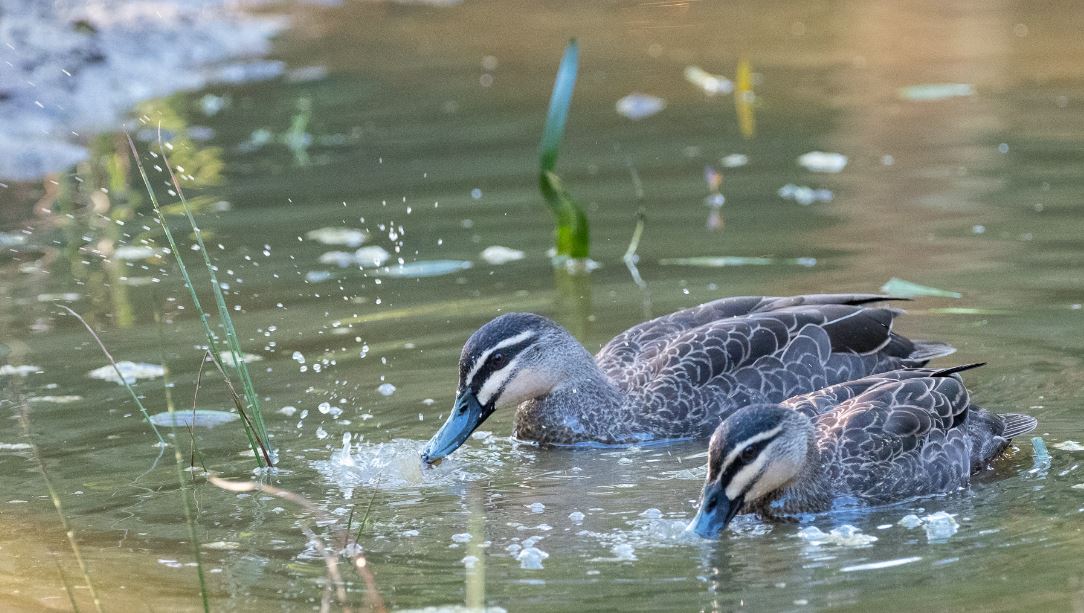
- In late breaking news, it seems a pair of Pacific Black Ducks has gazumped the Wood Ducks as Greg’s photo shows! Looks like the ducks approve of the new pond!
- In the other active Council project in the park, the developing framework of the Scout Hall extension is taking shape giving us a good idea of its final shape.
Habitat Pruning of Dead Tree
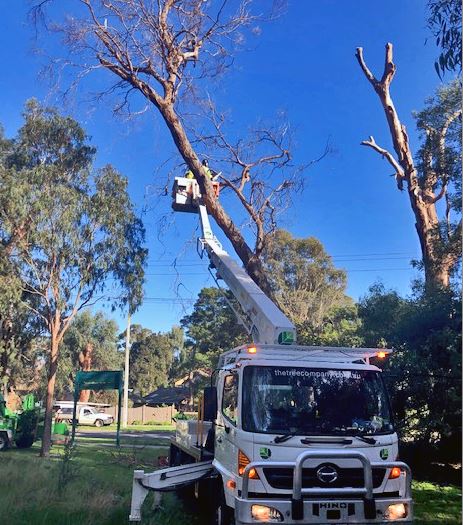
- A second significant, mature tree has died in Furness Park just south of the Main Street Bridge. The tree was “habitat pruned” by Council’s contractors in early June.
- “Habitat Pruning” means pruning back a dead or dying tree to the point that there is unlikely to be a risk to people or infrastructure (such as power lines) – but important habitat resources such as tree hollows and perching sites are retained.
- This treatment was also applied to the large tree closer to the creek that died in mid 2018 – to the right in Andrea’s photo above which shows an excellent before/after comparison. It is unfortunate to lose another tree in that prominent site. It could be chance – but it does make one wonder whether there’s something going wrong there…
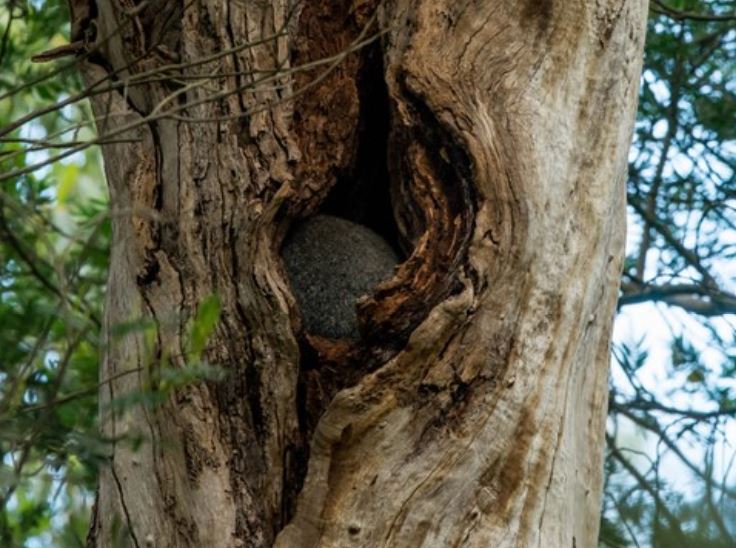
- More than 300 Australian species use hollows for nesting, shelter, as refuges from predators and even water sources after they trap rainwater. Ruth’s photo above shows a snug possum making good use of one hole. Please see our article on “stags” in our March news for further information.
Maintenance Team Report
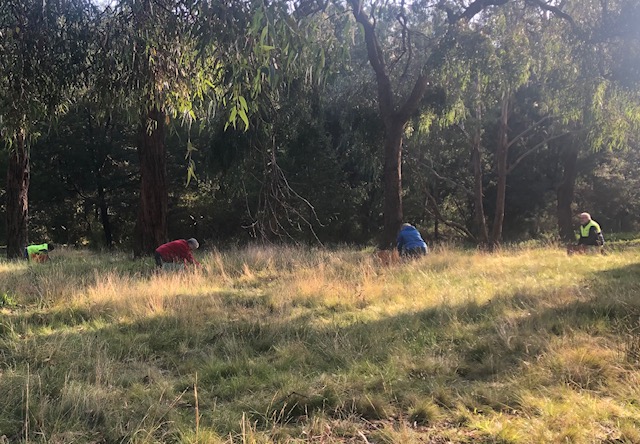
- The Maintenance Team is again active on Monday mornings – continuing in a socially distanced way as our photo shows. Although this dampens their social experience somewhat, they are pleased to have started planting again – albeit in a small way. This not only helps the park and us – it also helps our friends at the nurseries who have had many cancellations of normal orders – including ours.
- The team has also doing some mulching around the new plantings just west of the Billabong.
- Unfortunately, due to the continuing Covid-19 restrictions, we still cannot conduct Community Working Bees.
Committee’s Period of Tenure Extended
- At its last meeting, Whitehorse Council unanimously agreed to extend our Committee’s tenure again by 12 months to 30 June 2021.
- Council noted that its long-awaited review of the governance and functions of the Park Advisory Committees remains uncompleted due to the Covid-19 pandemic and is unachievable by the 30 June 2020 expiry of our current tenure.
Recognition of Parks by State Government during Pandemic
- A State Government announcement in late May recognised the contribution parks have made to society during the Covid-19 lockdown measures.
- The first part of a $150m [Suburban Parks] program was announced – 20 new pocket parks and off-leash dog parks will be developed across Melbourne – initially, all in the inner suburbs.
- Eventually, the program is expected to create 6,500 hectares of new parkland, walking trails, bike trails, pocket and off-lead dog parks. It would be nice if some of the money were to be spent on improving the linkages between our parks in Whitehorse and improving their narrowness at some points – thereby enhancing their function as wildlife corridors.
Web-site under Covid-19
- Following on from the previous article, our park seems to have had an important impact on our community too! We have seen a significant increase in usage in our park for recreation and exercise. This has manifest itself in different ways – for example, paths in the park have widened significantly due to the combination of higher traffic and social-distancing recommendations over the past few months.
- In terms of our web-site activity, for the last few years our stats have been fairly stable.
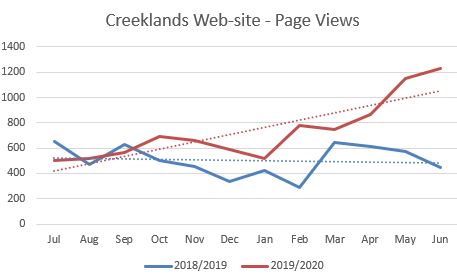
- Interestingly, the Covid-19 restrictions also seem to have resulted in a marked increased interest in the Creeklands web-site. The above graphs show web page-views this financial year compared to last. Our page-views more than doubled between January and May-June.
- We are pleased we have been able to contribute to the well-being of the community in our small way – despite our limited resources. We also especially thank the people who continue to contribute clever and fascinating photos which make our web-site and newsletter more interesting and popular.
Sightings
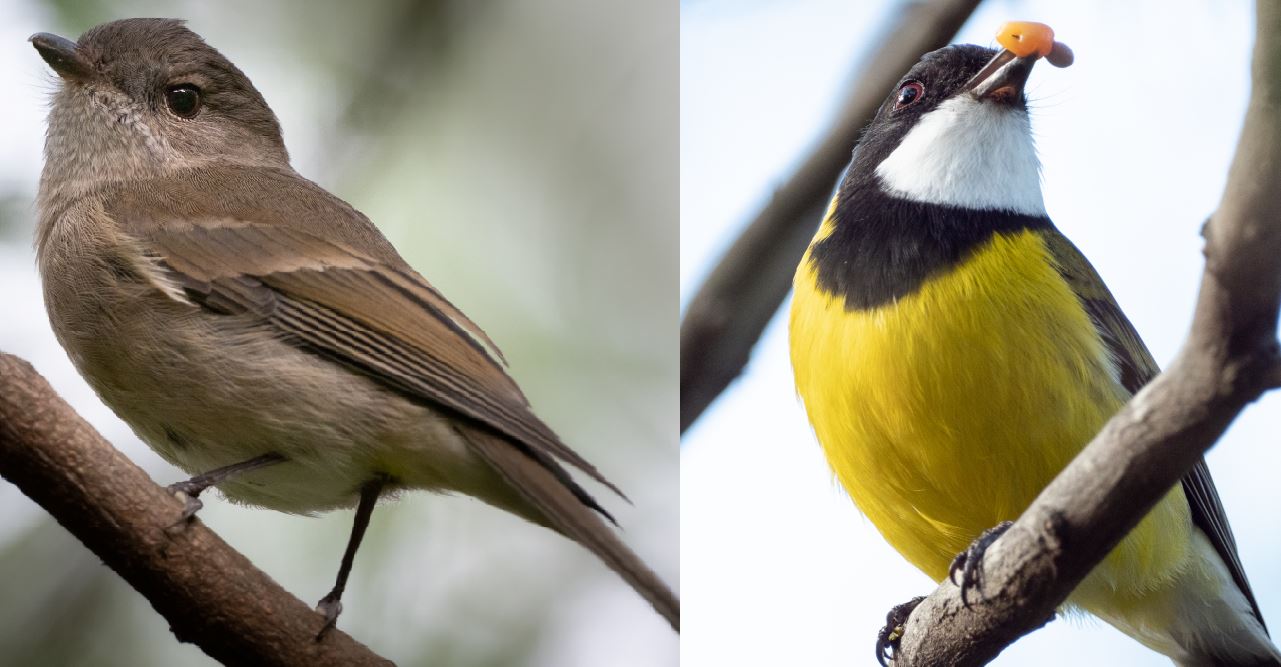
- The female Golden Whistler (on the left), that we reported seeing earlier this year, seems to have taken up residence in our park for the time being. Alas, she does not seem to have a partner yet. The name more aptly describes the male of the species (shown at right) – Greg snapped one with a food item at the Blackburn Lake Sanctuary for us.
- The species is strikingly “sexually dimorphic” – in other words, the males and females look quite different. We are hoping a mate will arrive for “our” female in time for the breeding season. In the bird world, females and juveniles are often less brightly coloured than the males. This helps them avoid predators – eg when females are vulnerable when nesting – and, on the other side of the coin, helps the males to be noticed by potential mates.
Corellas
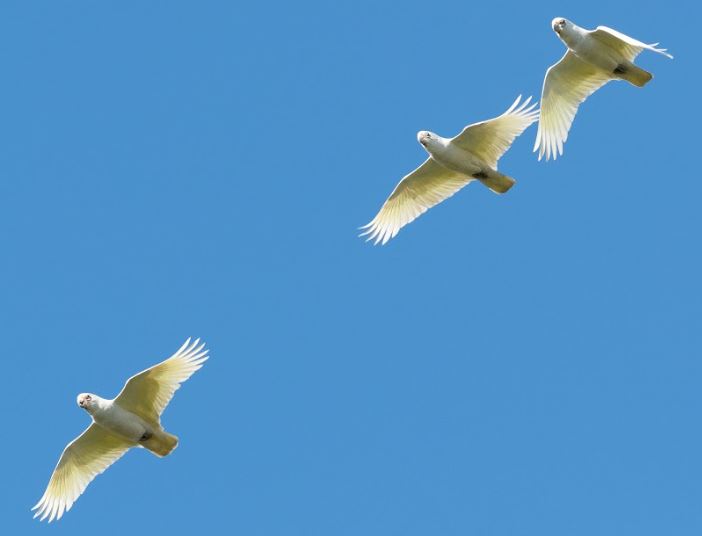
- Many would have noticed the large flocks of Corellas flying over the park morning and evening. These are (usually?) Short-billed Corellas.
- Young Luke and also Ruth have noticed that Long-billed Corellas have returned to the park this month after quite an absence.
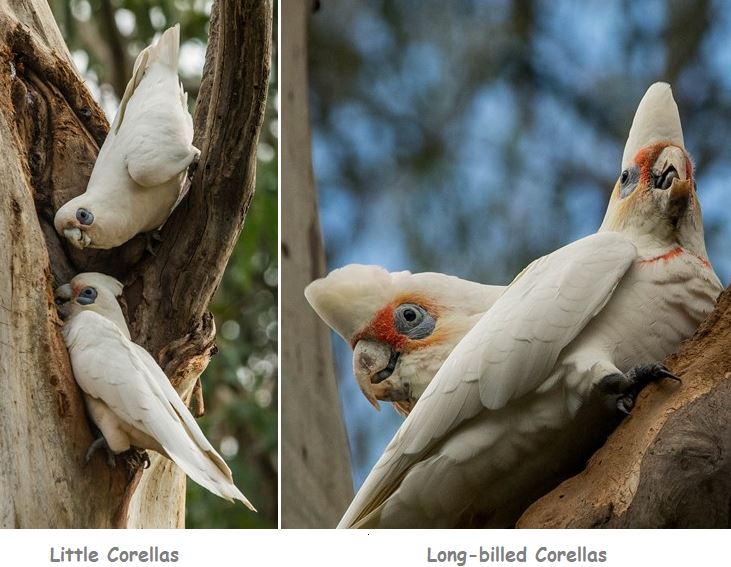
- To tell the difference between the species – other than by the relative length of their bills – the Little Corellas are not necessarily smaller in size but the Long-billed Corella is the heavier, stockier bird. It also has the red “cut-throat” at its neck and more red around the eyes (rather than the softer pink).
Do Birds Yawn?
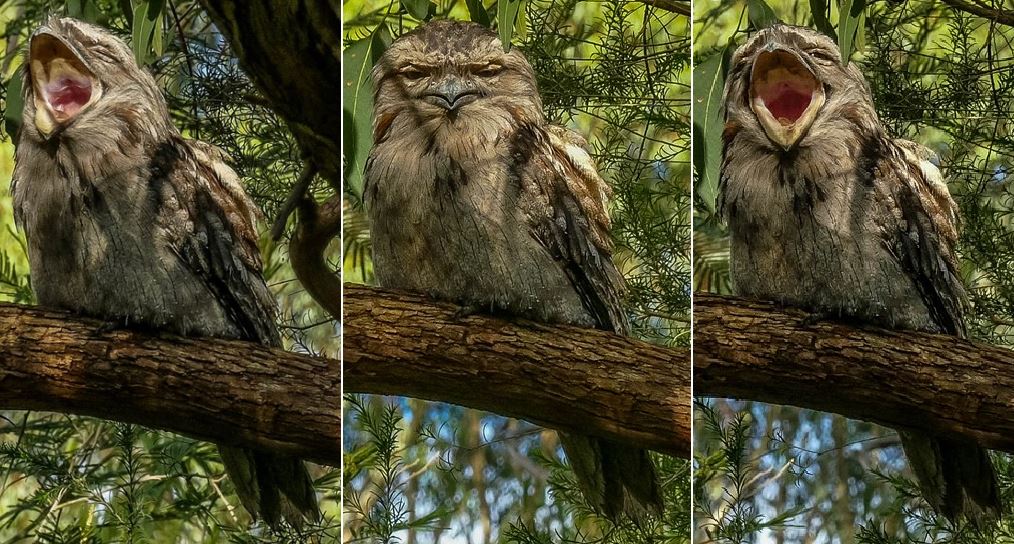
What?
- Ruth’s shots prove that Tawny Frogmouths definitely do – here the bird looks unconcernedly at the photographer in between two huge, gaping yawns ! There is even a YouTube video of one of them!
- Why do birds yawn? Good question… some think it is a way for them to manage their body temperature. Others think it’s a way of exercising their facial muscles and joints. Maybe they are just tired!
Other Sightings
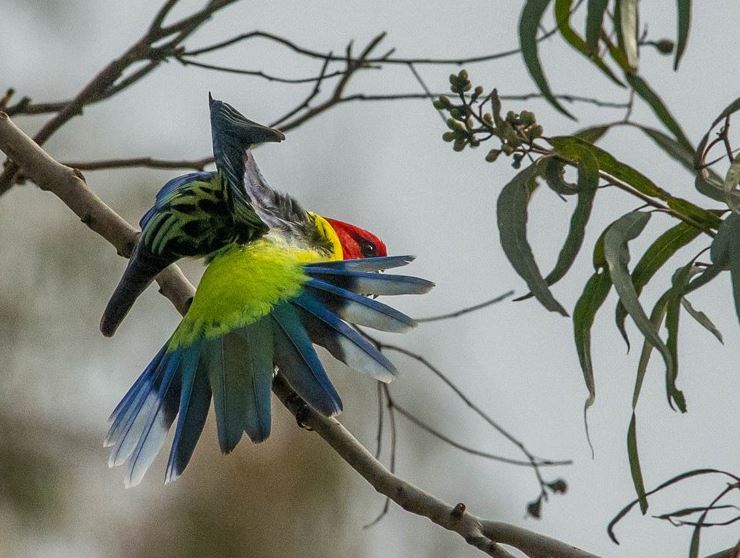
Birds like stretching too – an Eastern Rosella exercising (thanks Ruth)
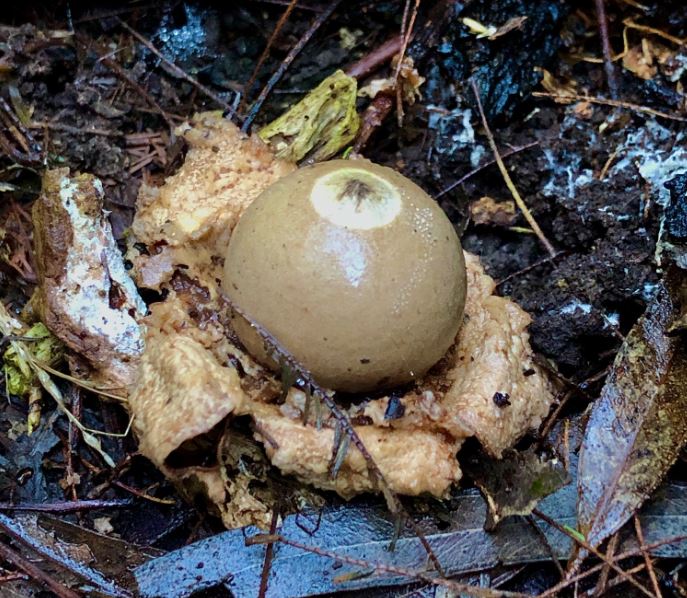
Earth Star fungus – lots around this year (normally rare in the park) – thanks Lisa
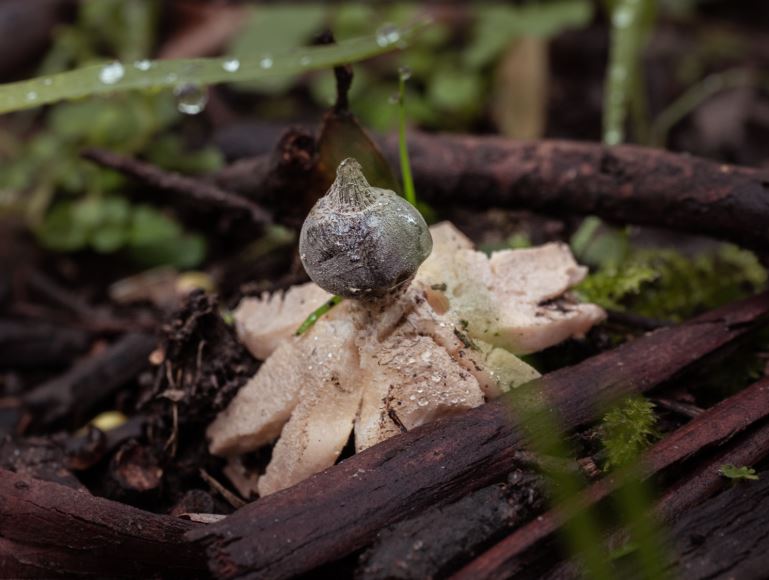
Another Earth Star – this time, a “younger” fruiting body (thanks Greg)
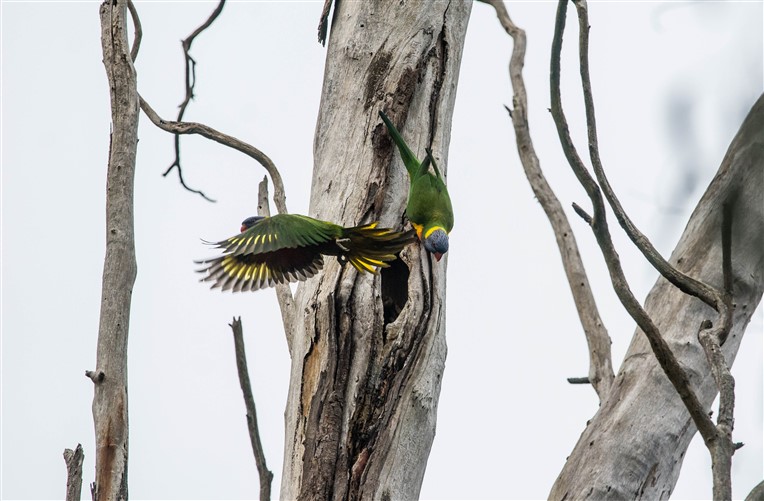
Time to find a nesting hole! – Lorikeets at work (thanks Ruth)
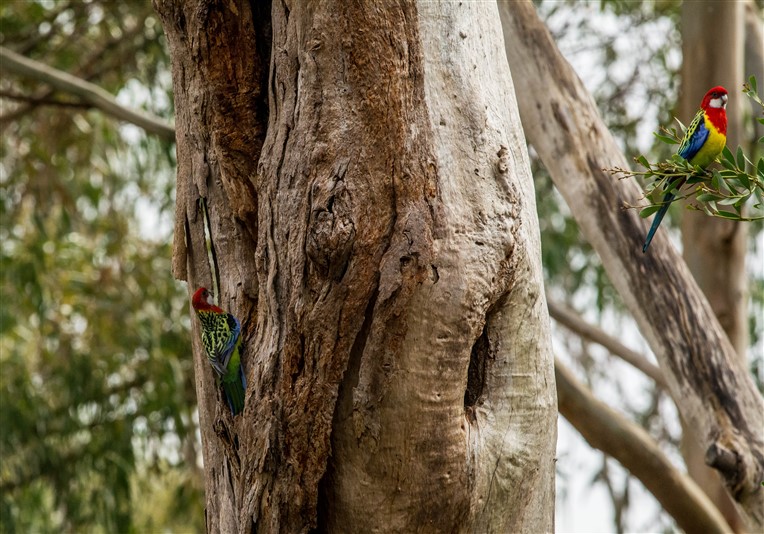
Eastern Rosellas also inspecting a possible site (thanks Ruth)
- Interestingly, Eastern Rosellas mate for life. The female’s role is to choose and prepare the nesting site – usually a hollow in a eucalypt. It seems the male’s job is security during the that process. The female incubates the eggs laid on a decayed wood bed while the male regularly feeds her.
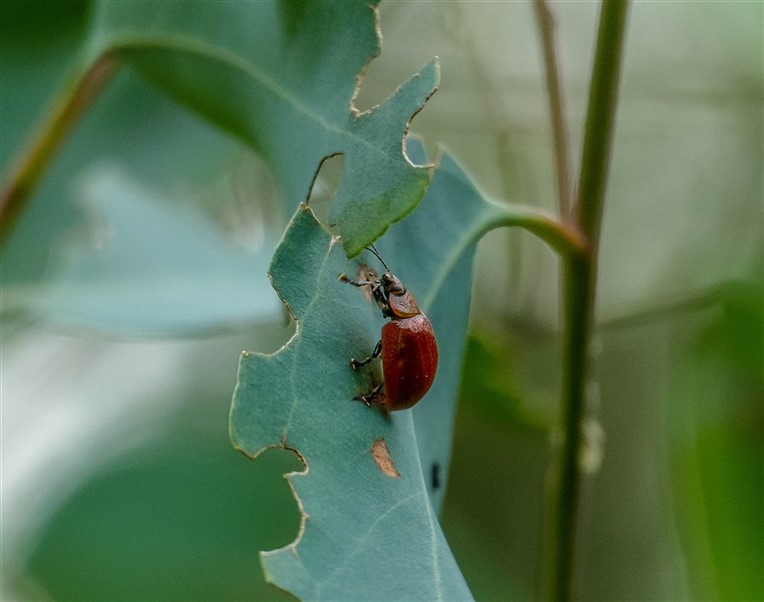
There are hungry beetles as well as caterpillars!
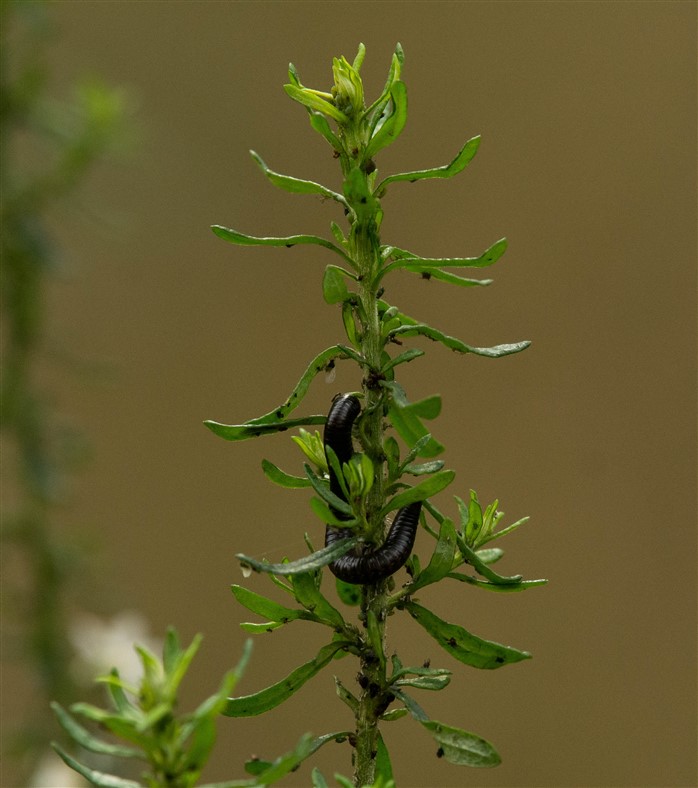
- A black Portuguese Millipede on a daisy bush – probably eating algae or possibly fungus on the leaves. Millipedes are mainly “detritivores” – normally finding their food in decaying leaves and bark (thanks Ruth and Megan).
- Those critters are a little more mobile than you might think – this foreign species was first imported into Port Lincoln, SA in 1953. Those little legs notwithstanding, it has since spread to other parts of South Australia, Victoria, Tasmania (they swim?), southern New South Wales/ACT and Western Australia. Although not generally dangerous to humans, the millipede secretes a pungent yellowish fluid which contains (toxic) hydrogen cyanide as a defence mechanism. The fluid is very irritating to the eyes and stains clothes permanently. No doubt, it makes them less palatable to birds and other potential predators too!
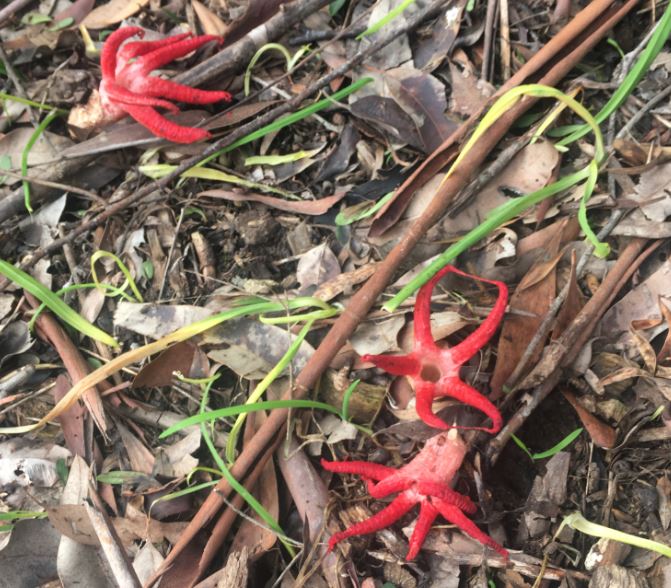
More Stinkhorns (see last month’s edition)
Community News
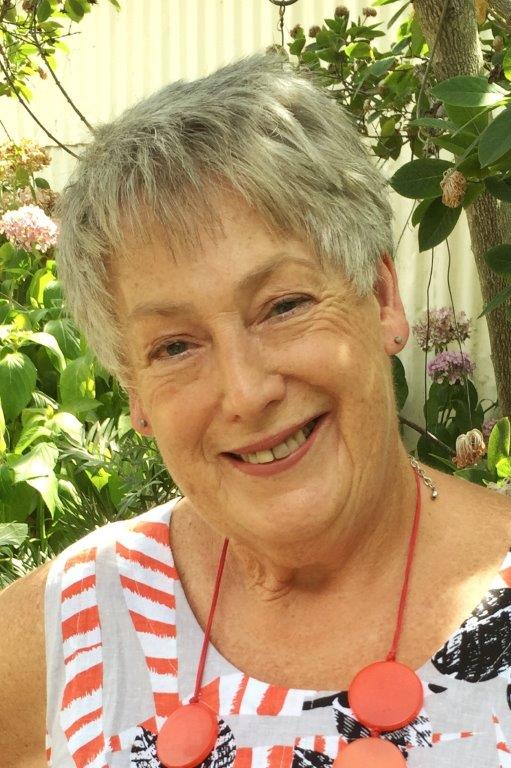
Anne Payne OAM
- In the absence of local press publicity, we thought we should let you know local community hero Anne Payne was awarded an OAM for service to the community of Blackburn in the Queen’s Birthday honours.
- We believe the award was so very well-deserved considering Anne’s tireless contributions to the community in many fields over such a considerable period of time. Amongst her many community roles, Anne is a member of our sister committee at the Blackburn Lake Sanctuary and often contributes to our activities such as working bees and bird surveys.
- Our hearty congratulations to Anne for that well-deserved recognition!
 Blackburn Creeklands
Pingback: Park News, July 2020 | The Blackburn Creeklands