Spring in the Park
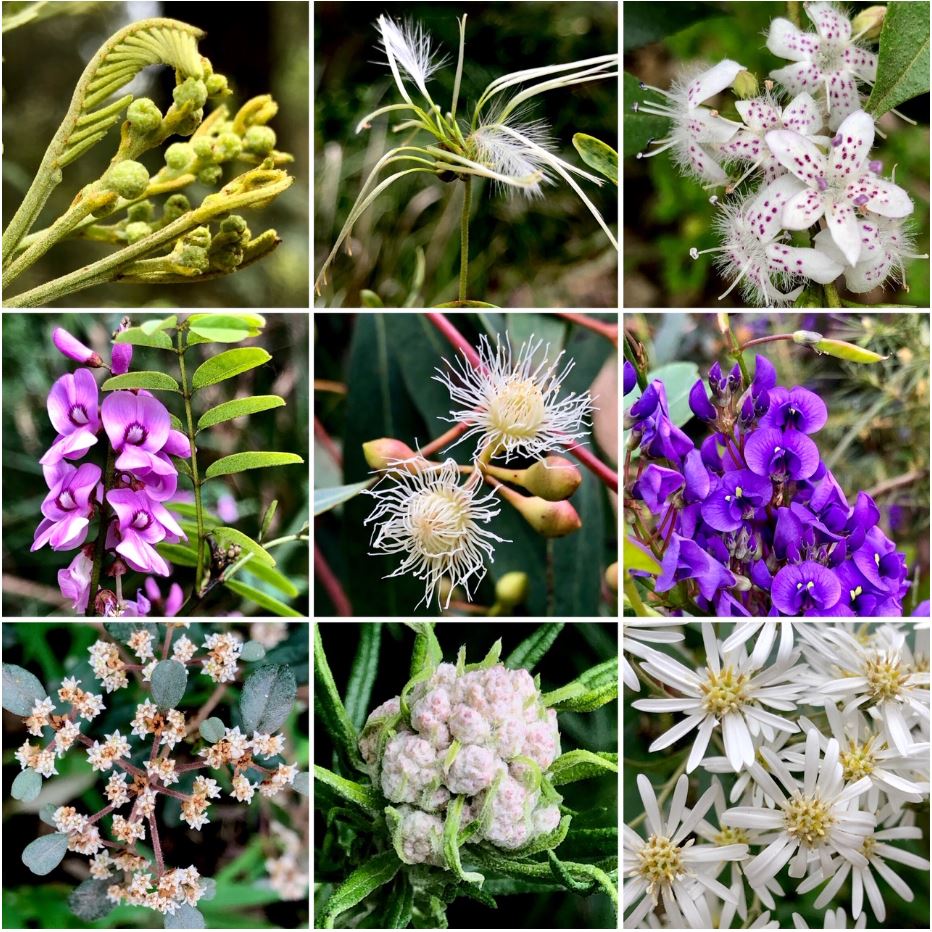
Lisa’s montage of beautiful Spring flowers seen in the park
- Left-to-right, top-to-bottom, Lisa tells us the species are:
- Acacia dealbata (Silver Wattle)
- Clematis microphylla (Small leafed Clematis)
- Myoporum petiolatum (Sticky Boobialla)
- Indigofera australis (Austral Indigo)
- Eucalyptus melliodora (Yellow Box)
- Hardenbergia violacea (Purple Coral Pea)
- Spyridium parvifolium (Australian Dusty Miller)
- Cassinia aculeata (Common Cassinia)
- Olearia lirata (Snowy Daisy Bush).
- In addition to Spring flowers, matchings and hatchings, Spring is well known for the variability of its weather and occasional strong winds. This September was no different with a cold spell badly aligned with the school holidays added for good measure.
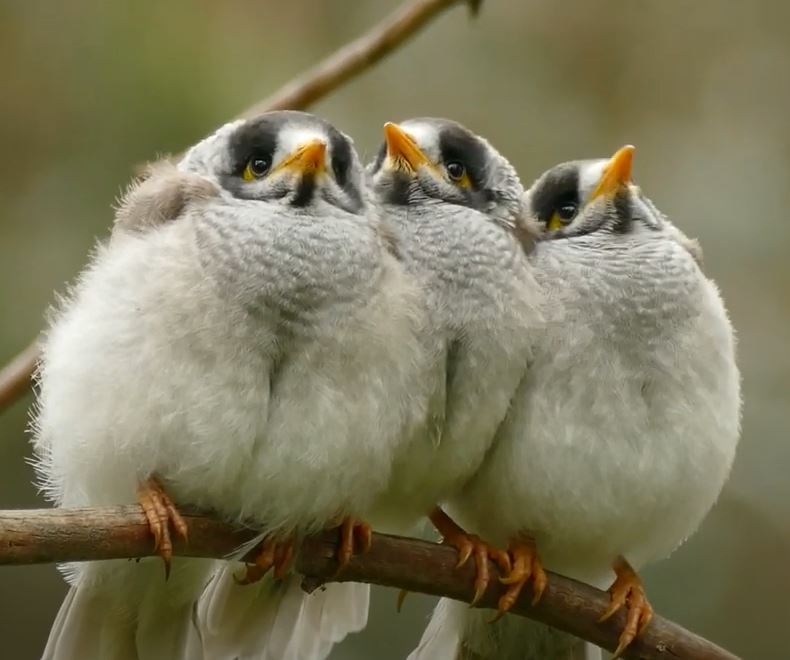
Even Noisy Miners can be cute!
- Our photo shows three fluffy Noisy Miner fledglings huddled up together against the cold a week or so ago in Blacks Walk – keeping a sharp eye out for the return of their parents and food. This photo is actually a clip from a one-minute film – please click here if you’d like to see more of the feeding process. It seems the strategy of being in the middle may be warmer – but not so good for getting fed!
Minors, Miners and Mynahs in the Park
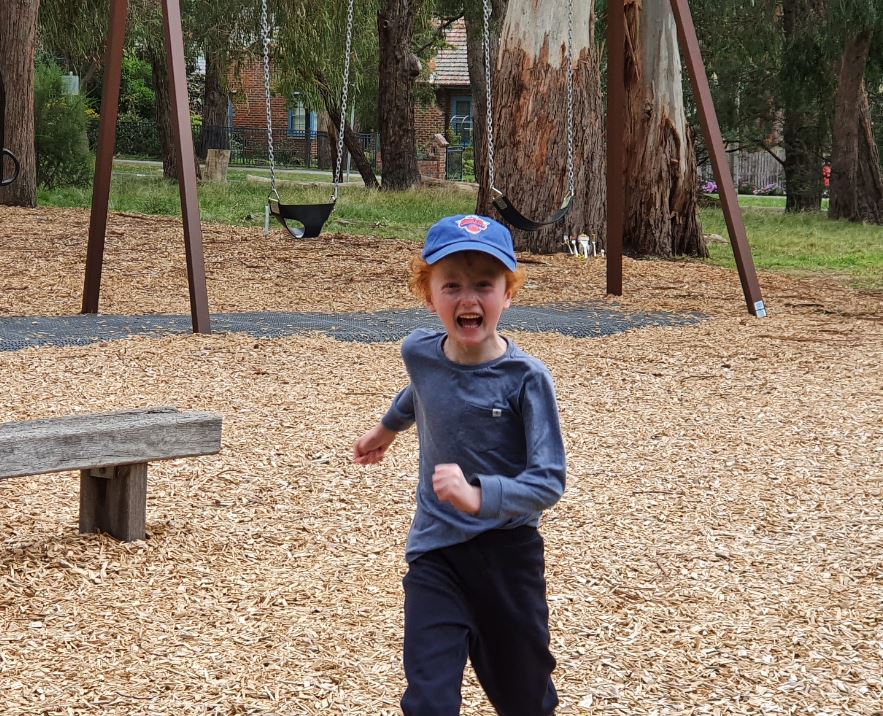
- So, what are the Minors, Miners and Mynahs in the park ? Well, the first one is easy – minors are the little people in the park who are now allowed to run around the playground again. Of course, they can be noisy minors too!
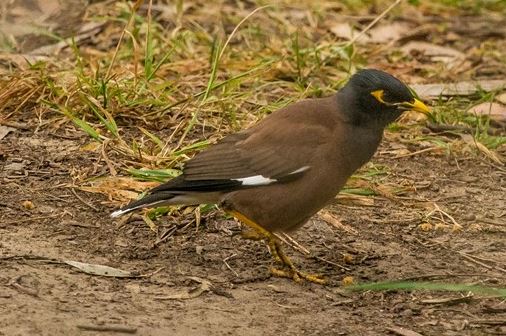
- Mynahs or Mynas are the well known pests more fully known as Common Mynahs or Indian Mynahs. They are the robust brown birds with yellow bill and eye patch well known to pet owners for their habit of availing themselves of pet food left unattended. They are native to Asia and possibly first reached Australia in the hold of a ship. They are common down the east coast of Australia south of the Tropic of Capricorn as well as an infestation between Mossman and Laura in far north Queensland. They are uncommon in most of the park – though one or two are often seen in Blacks Walk.
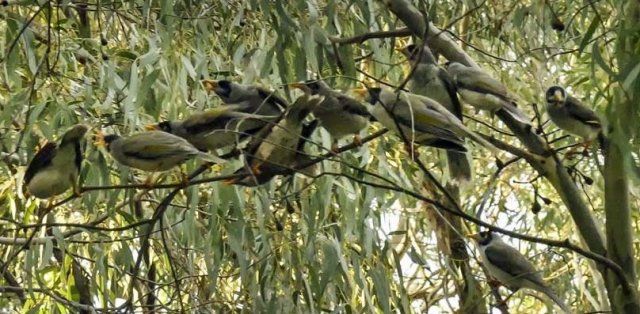
Branch Stacking by Noisy Miners in the Creeklands! (thanks Ruth)
- One of the reasons there are relatively few Mynahs around is that they are chased out by the aggressive and colonial Noisy Miners. These are indigenous birds – but can also become a nuisance driving out less aggressive species. They will tackle most other birds regardless of size. For example, they will relentlessly bully White-faced Herons (a much larger wading bird that does not share their food) and fruit bats – calling their colleagues to the fray in a gang-tackle.
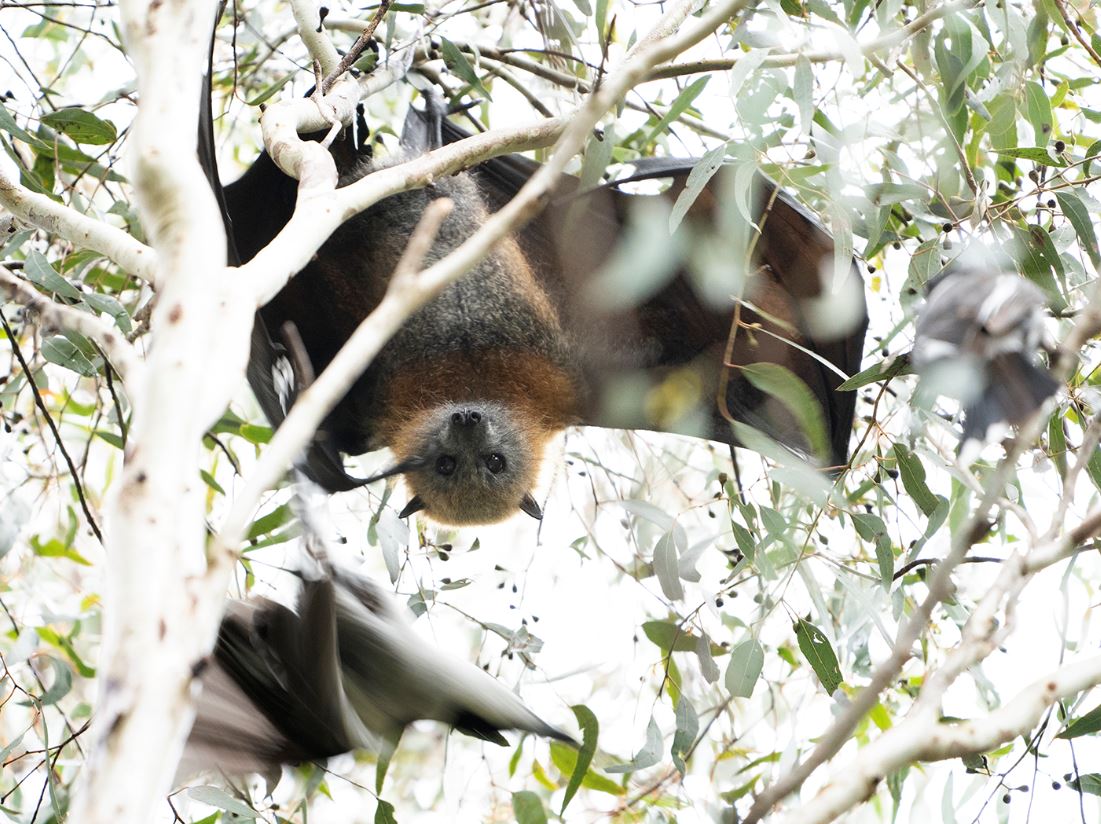
Fruit bat being mobbed by Noisy Miners – the grey flashes – (and a Butcherbird) in Blacks Walk
- Another Miner is the Bell Miner or Bellbird. Bellbirds used to be common around the park – leading to central Blackburn being called the “Bellbird Area”. This is largely a real-estate concept now – the bellbirds having migrated out of the area many years ago. There is a Bellbird Residents Action Group in the area devoted to preserving the significant treed area within central Blackburn. The Bell Miner makes a bell sound (a “ding”) as it’s name suggests.
For Whom the Bell Doesn’t Toll
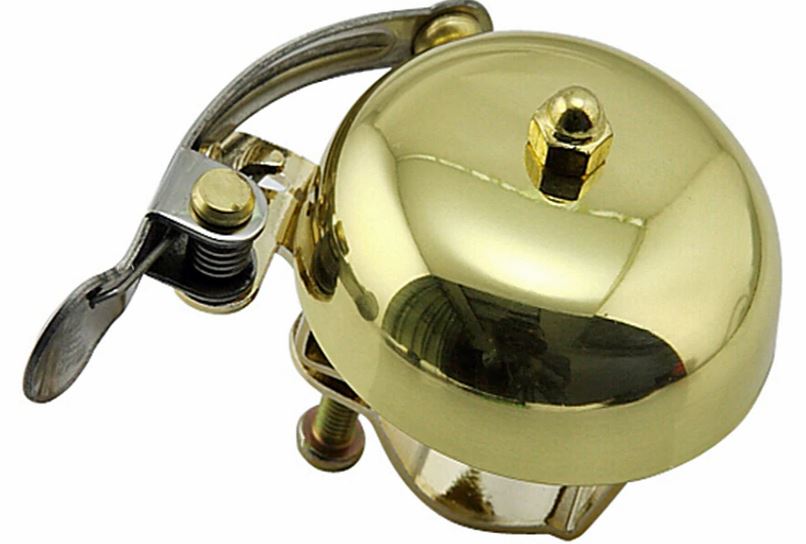
- Speaking of bell sounds, there are many cyclists, joggers, walkers and dogs sharing the Creeklands under our Covid-19 restrictions. We’ve heard reports that some cyclists are not using their bells when overtaking others and in other situations where a warning would be a good idea.
- Everyone should be patient and use commonsense. Cyclists should cycle on the wider tracks only and use their bells politely. The best thing is to hang back and only overtake where it is safe to do so. Cyclists without a working bell can simply call out ‘bike passing’ instead.
- Walkers or joggers should not take offence if they are “dinged” by a cyclist. This is merely a warning in the interest of everyone’s safety.
- The Creeklands tracks are not bike paths or shared paths – they are actually pedestrian paths – though cyclists are welcome to use them with care. Best practice is to ride a bit slower when in the Creeklands – there’s plenty of opportunity to speed up once you reach the Gardiners Creek shared trail where it starts at the southern corner of Middleborough and Albion Roads adjacent Sparks Reserve.
Corridor News
- We have previously published links to local resident Tony Kjar’s comprehensive document describing our Corridor and the way the its protections developed over time. Tony has recently expanded his document to include more on fauna, bird territories, habitat and soils. He has kindly provided us with a copy which you can download here.
- Michael, one of our Friends Group, has been tracking the progress of White-faced Heron chicks in Linum Street. Things have been progressing well…
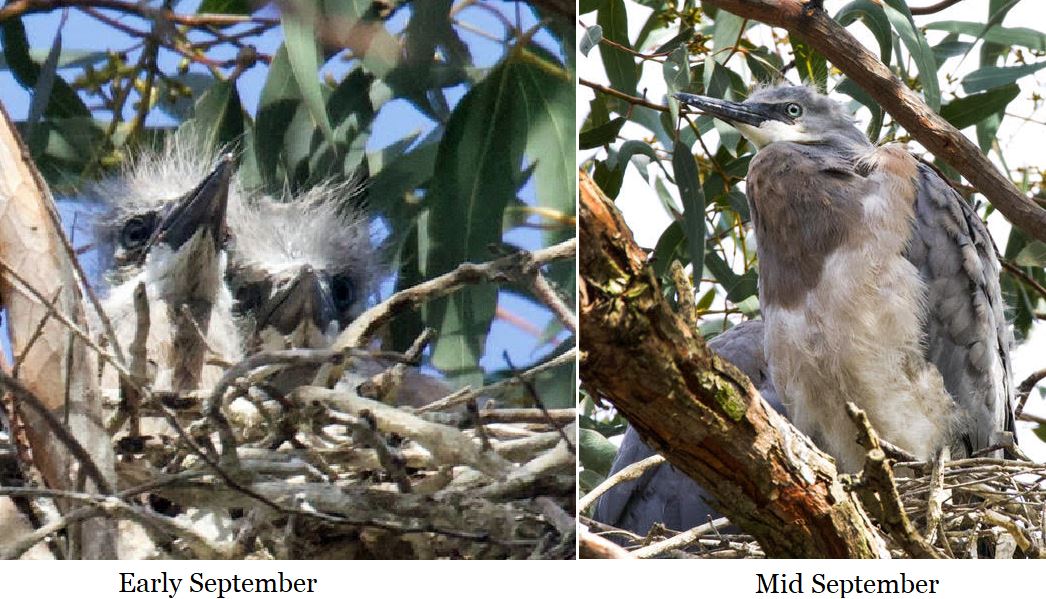
- His latest shot seems to suggest one has already grown up fast to become a young hippy:
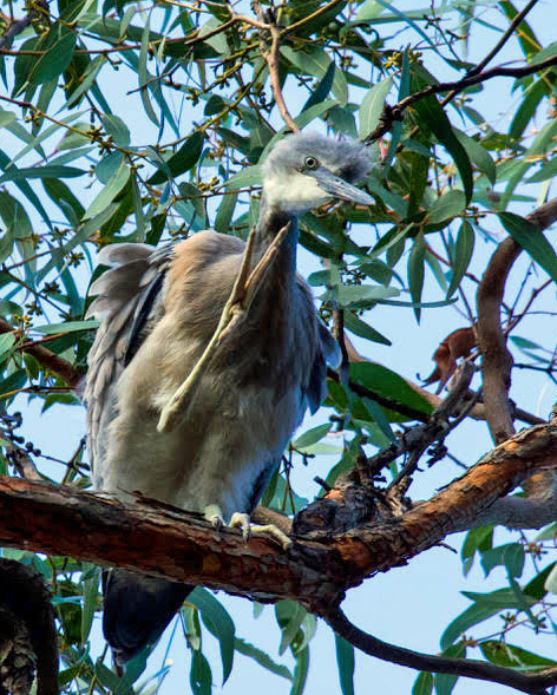
Peace Brother!
Dogs-off-Lead
- Following our note on Council’s new signage campaign around the park in last month’s edition of our newsletter, the latest Whitehorse News contains an article for dog owners regarding exercising their dogs in off-lead areas. This contains a link to a map of all off-lead parks in Whitehorse.
- No part of the Creeklands is designated “off-lead”. We reproduce an excerpt of the map centred around the park showing the nearest off-lead parks in the vicinity:
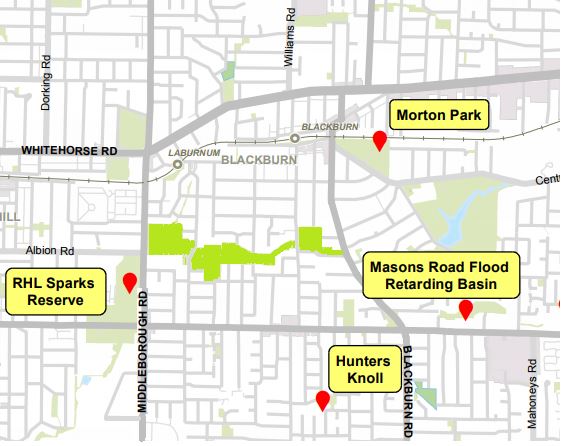
- The RHL Sparks Reserve is just over Middleborough Road from the Creeklands.
Foxes
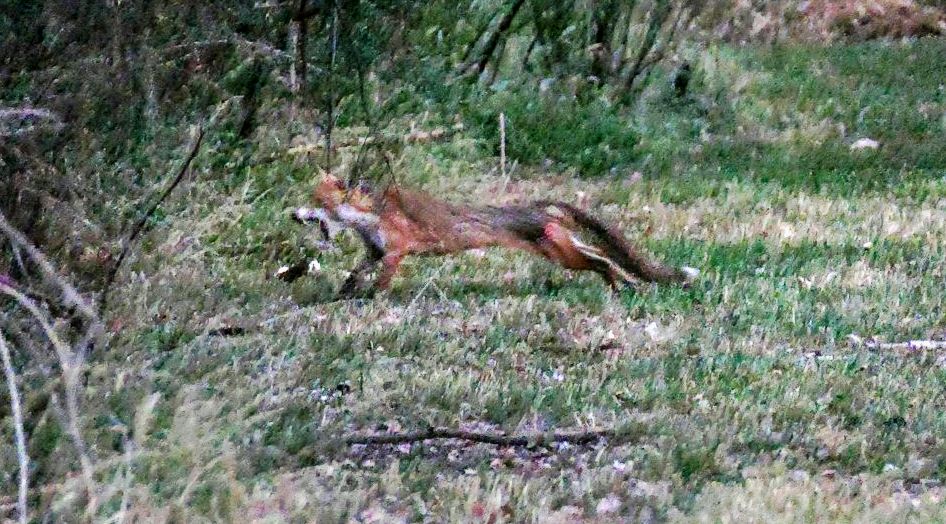
- Foxes are usually present in the park and are often spotted – commonly around dusk. Our enhanced photo from Ruth shows a feral red fox hunting at full stretch in low light – near the Laurel Grove bridge in December last year.
- Belinda McPhee, a TAFE Cert IV student, has graciously sent us her report on the management of two pests within the Creeklands – foxes and couch grass. This followed her contacting us earlier in the year requesting appropriate subjects for her study.
- Belinda reports:
- European red foxes are widespread in Victoria with some of the highest fox densities in the world. Wild populations of the red fox have been present in inner Melbourne since the 1930s and have adapted to become an established part of suburbia. Cities typically have higher densities where there can be up to 16
foxes per square kilometre. They are highly mobile and can travel up to 10 – 15 km per night. - Urban foxes are a nuisance with behaviour including harassing domestic animals, eating pet food, raiding rubbish bins, defecating or digging in gardens, and chewing infrastructure such as garden hoses and irrigation systems.
- Residential areas are an important food source for foxes. They prey on small mammals, with a mature fox capable of killing up to 3000 native animals a year. They also prey on domesticated animals including unprotected poultry, rabbits, guinea pigs and aviary birds and can spread parasites and diseases such as mange and distemper to domestic animals and pets.
- Foxes are nocturnal and most active during the evening and early morning. They usually rest during the day in many forms of shelter which may be under houses, sheds, outbuildings or in hollow logs, rock piles, drainpipes, car bodies, under blackberry patches. They have a number of dens or hiding places at different times in their lives. They also have multiple dens at any one time and may not regularly return to one particular den. Foxes are timid and will flee when disturbed.
- European red foxes are widespread in Victoria with some of the highest fox densities in the world. Wild populations of the red fox have been present in inner Melbourne since the 1930s and have adapted to become an established part of suburbia. Cities typically have higher densities where there can be up to 16
- We enjoyed reading her analysis and reporting of suitable control measures in the urban environment. One of her recommendations was that “there is also a role for Council and the BCAC to help to educate local residents in these control measures“.
- Baiting and shooting are prohibited in urban areas and trapping is cost-prohibitive. Council does undertake den fumigation when dens are active. So, what can we do ?
- Our best options are removal of places they can hide, property hygiene and good animal husbandry – exclusion fencing for domestic chickens, ducks, guinea pigs and rabbits.
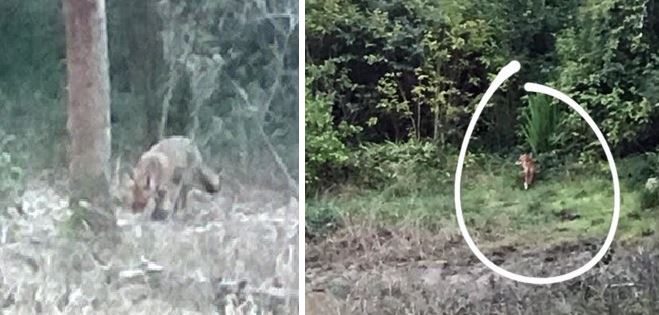
Mobile phone shots – foxes in the park
Removal of Refuges and Property Hygiene
- Within the urban setting, the best and safest option for fox control is to discourage them by making the area unsuitable for their survival.
- Foxes use a variety of shelter from the elements and predators such as rubbish heaps, rocky outcrops, patches of woody weeds, buildings and some forms of native vegetation. Actions that can be taken to discourage foxes:
- Remove rubbish lying around and secure bin lids.
- Clean up excess fruit dropped by fruit trees and berries – foxes are semi-vegetarian! Fox scats often contain large amounts of seed.
- Always cover compost heaps or use a compost bin.
- Don’t feed wildlife (including foxes of course).
- Remove prickly and woody weeds (such as gorse, boxthorn and blackberries).
- Fence off the underneath of buildings, water tanks and other places foxes may hide.
- Don’t leave objects for foxes to climb over into neighbouring properties.
- Remove animal carcasses, including those a fox might bring into your yard, to prevent foxes scavenging.
- Fence off rock piles, building materials, hay bales and woodpiles or store them in a manner that does not create a hiding place for foxes.
Maintenance Team Report
Training
- Several of our “Monday Morning” team and BCAC Committee members were fortunate to attend a “Weed Management Master Class” presented by Environmental Scientist Dr Graeme Lorimer. The class was an initiative of Council for the Gardens for Wildlife and Advisory Committee volunteers.
- Graeme has a special talent for organising knowledge and decision-making processes. He discussed frameworks he developed for prioritising work and assessing weeds. These were interesting and thought provoking – facilitating weed target prioritization and triaging of work plans.
- We were also struck by how location/habitat dependent certain weed threats are. We concluded we need to make our own Creeklands assessments using the frameworks – rather than blindly accept experience from other sites – even those fairly close to us!
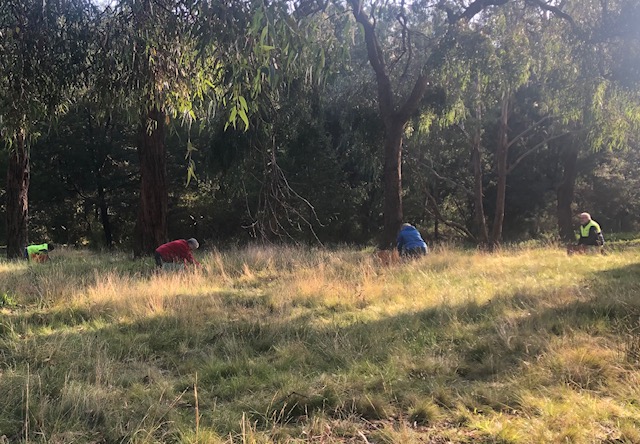
The way we were in June – as well distanced as the trees are!
Back-to-Work
- Mid-month, we received Council’s roadmap for back-to-weeding which gave the team a glimmer of hope that they can get back to work in about a month. They would likely be Covid-safe working bees like the ones after the first restrictions were lifted – socially distanced, no sharing tools or morning tea etc as our June photo shows.
- At our last (Zoom) meeting, Committee decided that we should indeed plan for our first working bee post-lockdown to be Tuesday 27/10 (which is the first day possible according to the roadmap – shows how keen we are!). This date might be brought forward depending on further relaxations of the Covid-19 restrictions.
- Naturally – the date still depends on the timing etc of the State Government’s rules. In the meantime, we’ll do some planning plus tool and brain rust removal. Perhaps the team can practise using the new triage framework they learned from Graeme Lorimer at the recent successful “master class” described above ?
Impacts of Covid-19 Restrictions Being Relaxed
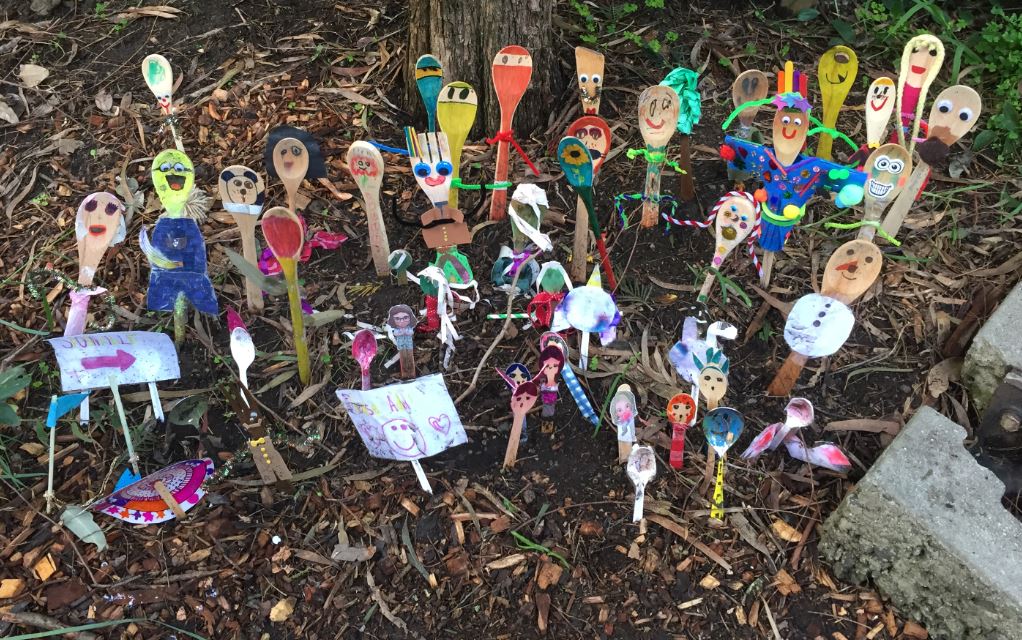
- We are concerned that the members of these groups cannot all be from the one family – so social distancing rules may not be being obeyed as Anthea’s photo shows!
- Nevertheless, the Premier’s announcements last Sunday give us all further hope that we may be able to resume working bees perhaps sooner than planned.
- However, due to the uncertainty, the difficulty to run a bird survey with social distancing and due to the likely requirement to strongly restrict numbers attending, we have decided not to run our community Spring Bird Survey this year. The Autumn survey also had to be cancelled. Hopefully, we’ll be able to run them both normally next year!
Council Works in the Park
New Light Poles
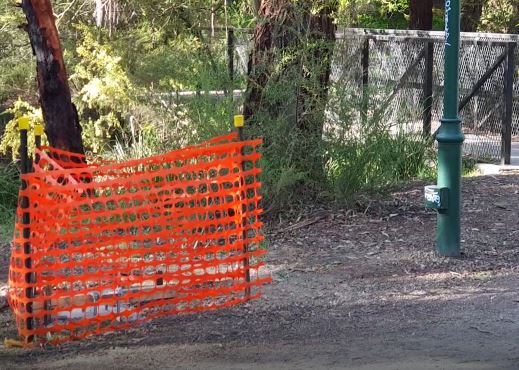
- Under a Council program affecting several parks, Council is installing new solar lights – replacing the existing lights near the Laurel Grove bridge. The latter were installed about 20 years ago and run under mains power given the effect of tree shadowing there.
- The new design is more elegant, and presumably more efficient, due to the technology advances in the past 20 years. They will be solar only – so the quality and duration of the lighting will depend on the energy stored during the day.
Plant Losses near the Bowls Club
- There have been two areas of plant loss in the new plantings in the Bowls Club Car Park renovation. One group has been removed in a central position and another 20 plants have been pulled out progressively at the eastern end.
- It is not certain whether the latter problems have been caused by human or perhaps animal action. We’ve let Council know.
Bee Removal from Furness Park
- We’ve noticed a beekeeper attempting to smoke out an active hive in Furness Park to relocate it to another hive.
- We prefer this approach to simply poisoning beehives with insecticide – hopefully, it proves to be successful.
Scout Hall Renovation
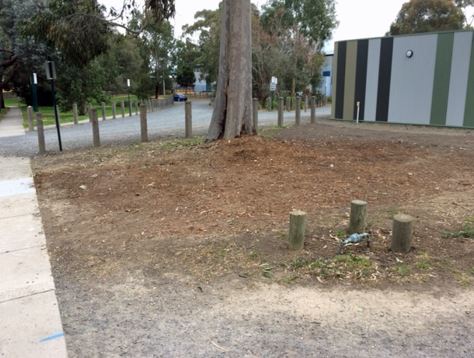
Barely part of the park! (thanks Nicky)
- Council has seeded non-indigenous grass into the area in front of the Scout Hall. This looks rather barren now after existing vegetation was removed ahead of the renovation project.
- We are looking at what can be done to further improve this space and will make a proposal for planting up with indigenous plants – bearing in mind the safety requirements to maintain sight lines for carpark access and road crossing.
A Prickly Customer
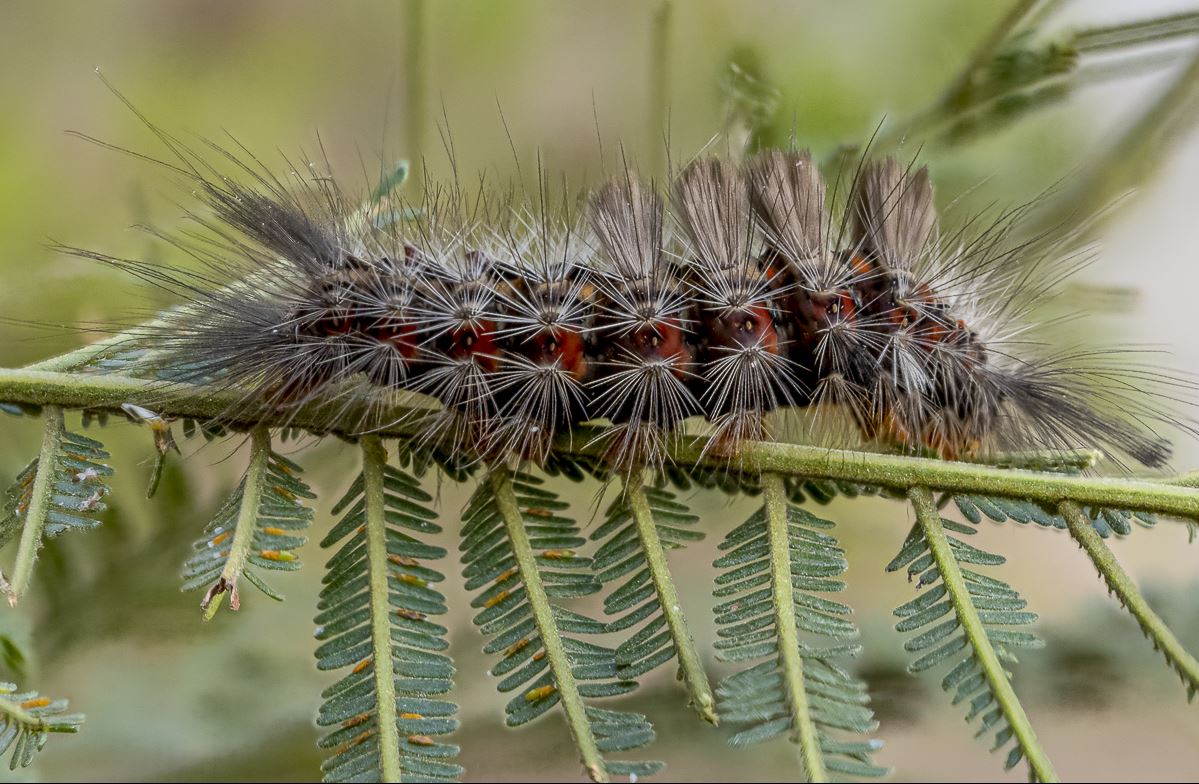
- Looking rather like one of those ornamental cacti tipped on its side, Ken’s photo shows a very hairy caterpillar feeding on an Acacia. It is actually the larva of a tussock moth – the Painted Apple Moth (Orgyia anartoides).
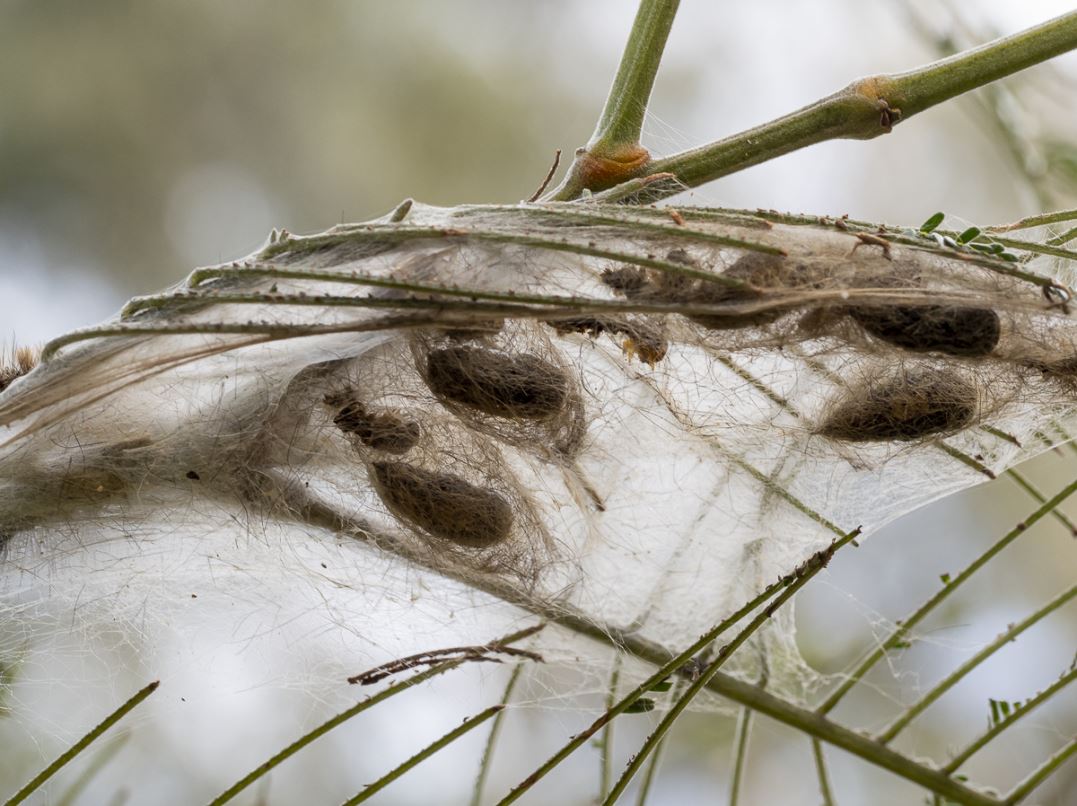
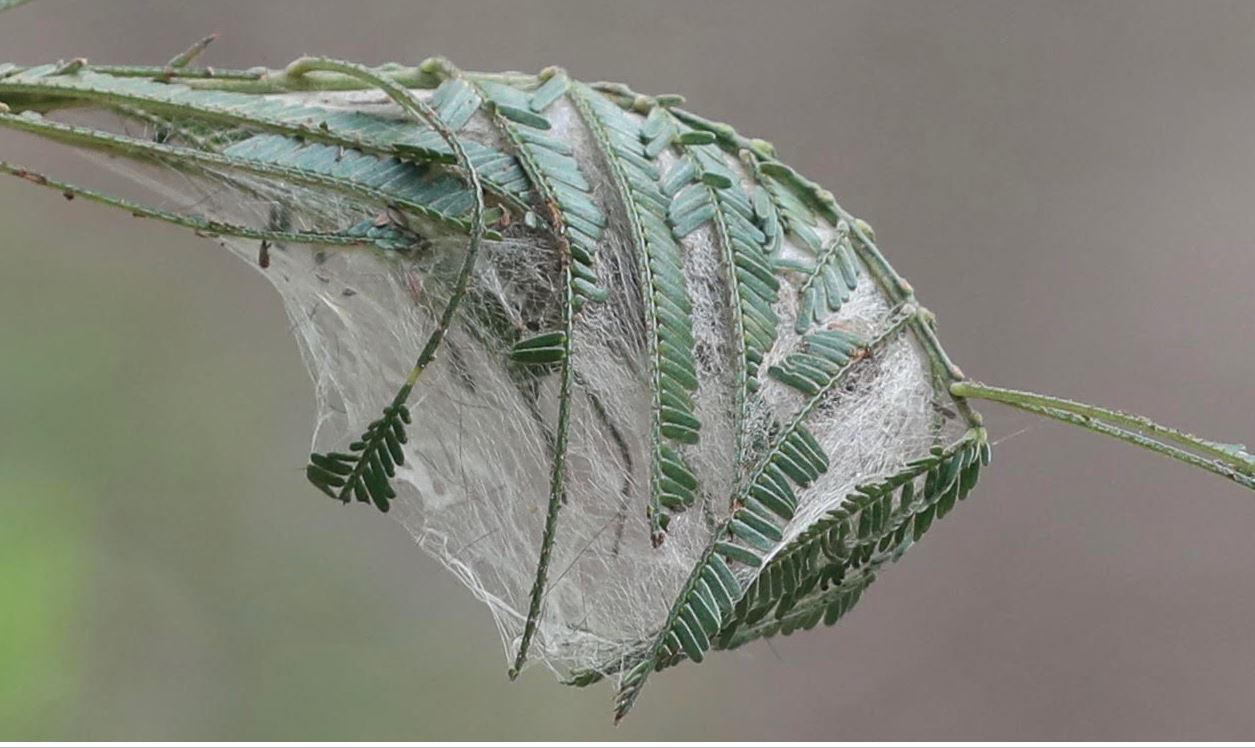
- About a week or so after Ken took our first photo, each constructed its cocoon – the so-called pupa. The moths start life as an egg (the embryonic stage), hatch to a larva (caterpillar), form a pupa and eventually metamorphose into a moth. Notice they have eaten just about every leaflet on the plant in their vicinity.
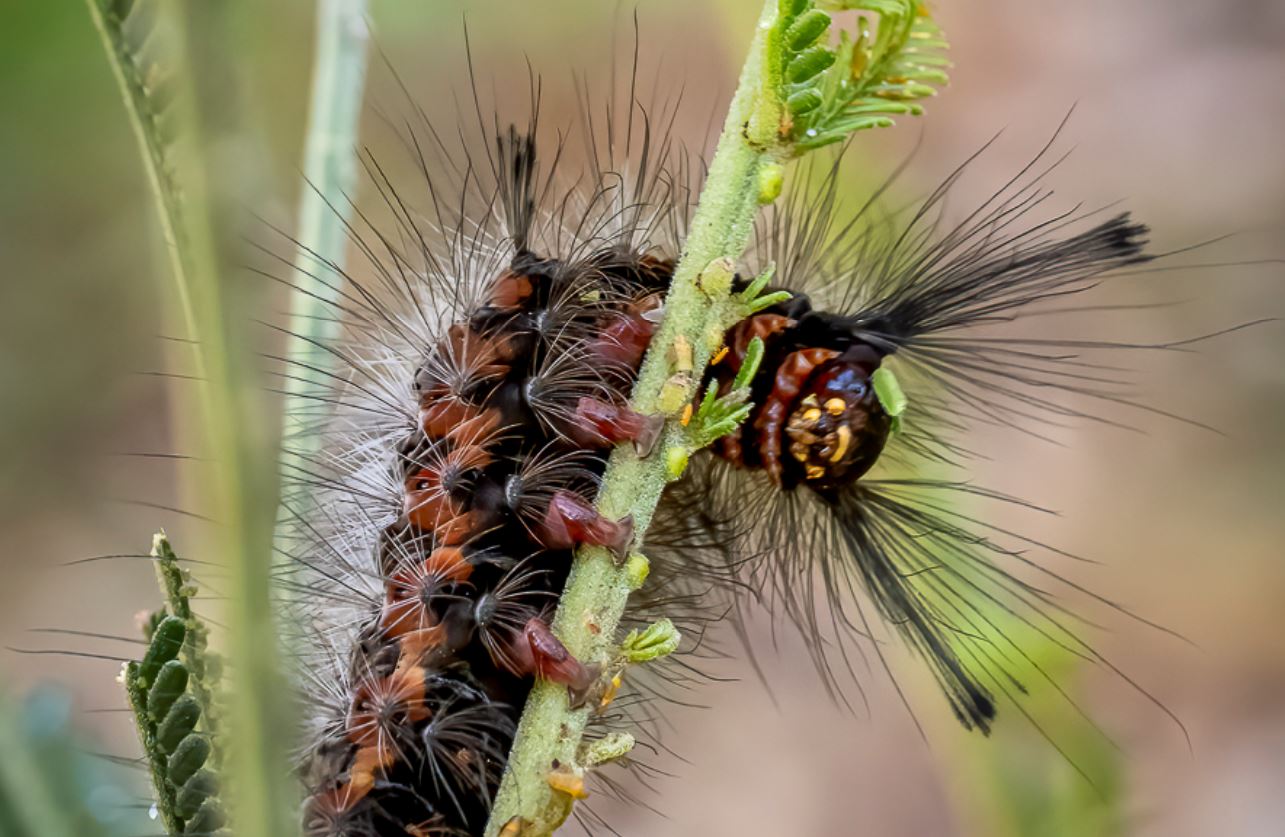
Smile for the camera!
- The moth itself is not particularly spectacular – but is another interesting inhabitant of our bushland. You may remember we have written about differences between the sexes of birds (“sexual dimorphism”) in recent editions – eg the Golden Whistler. This moth is a good example of the same thing in moths – the male looks like a typical small brown/mottled moth but the female is large, round, greyish and flightless!
- Ken sent us some spectacular photos presented in our January, 2018 newsletter of pupae transforming into Imperial Blue butterflies. Well it’s too soon for him to have photos of the moths doing the same thing – if you’d like to see what they look like on Wikipedia, please click here.
- Rita has provided a close-up shot of one of the pupa:
Sightings
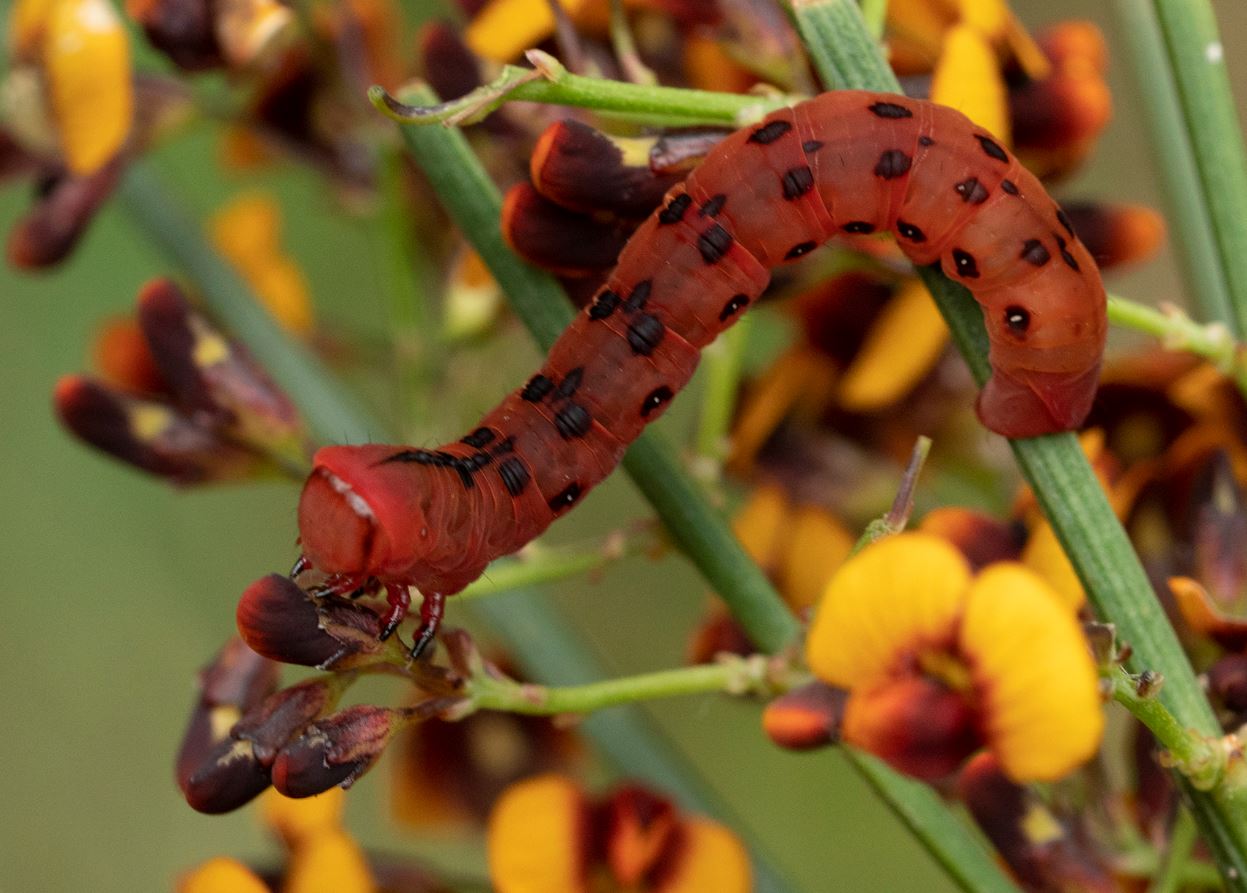
- Here’s another interesting caterpillar identified by Wendy as belonging to the
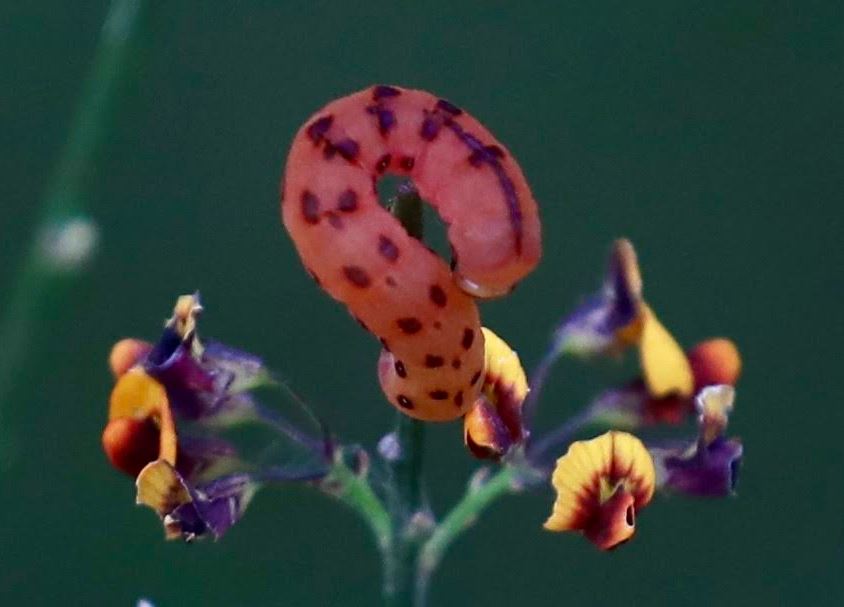
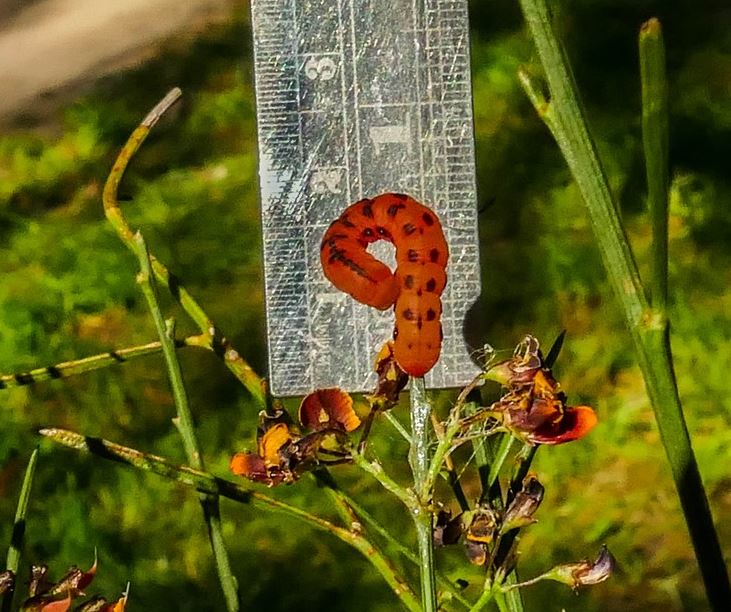
Capusa species in the family Geometridae. Wendy thinks it’s a Capusa senilis. Apparently, these start out life green, change to yellow and then turn red – just like a traffic light! Please see more here if you don’t believe us! Eventually, the caterpillar metamorphoses into a rather dull Wedge Moth despite its colourful intermediate stage in life.
- Here’s another shot of the same caterpillar from Rita in different light:
- And another from Ruth showing its length:
New Wetland and Frogs
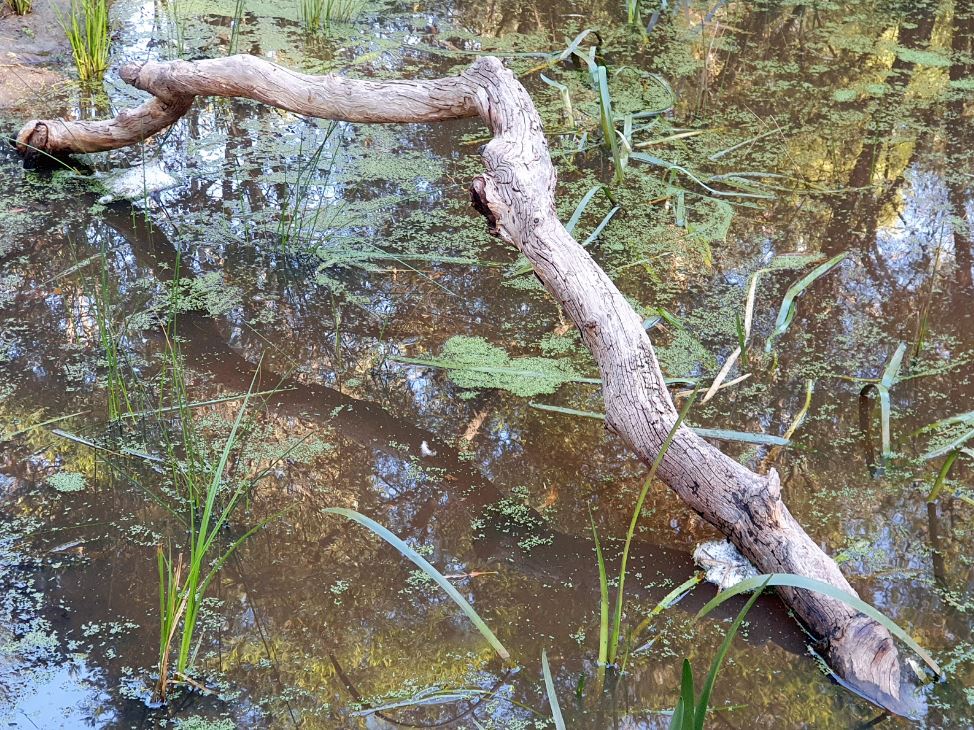
- It seems like frogs are already taking to the new wetland. Notice the egg rafts positioned under either end of the “habitat log” sitting in the pond. Clearly, shelter is important. Hopefully, tadpoles and frogs to follow…
(Going) Bats in the Creeklands
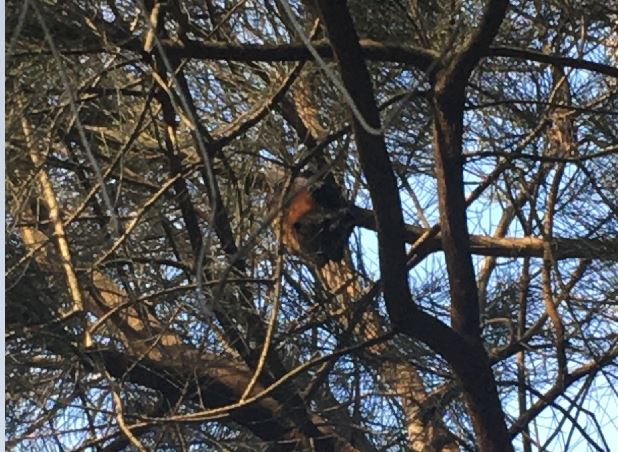
- Friend Mary sent us this photo taken on her mobile phone early in the month of a fruit bat in Blacks Walk – in the tall Allocasuarinas adjacent Pakenham Street on the northern side of the creek:
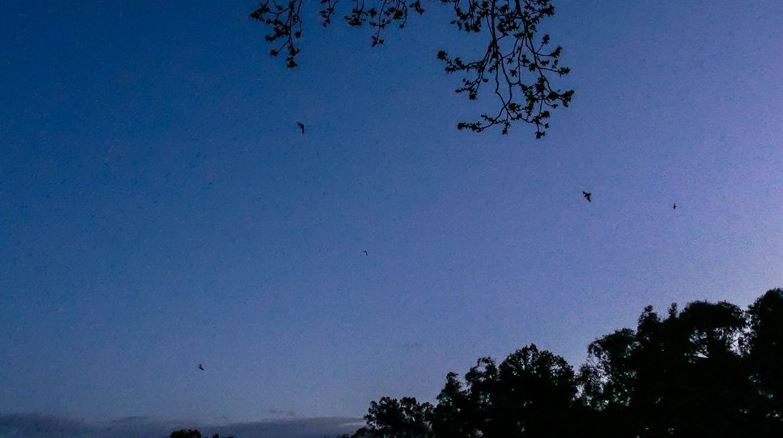
Ruth spotted these microbats feeding over Kalang Oval and the adjacent little wetland
More Nesting Activity
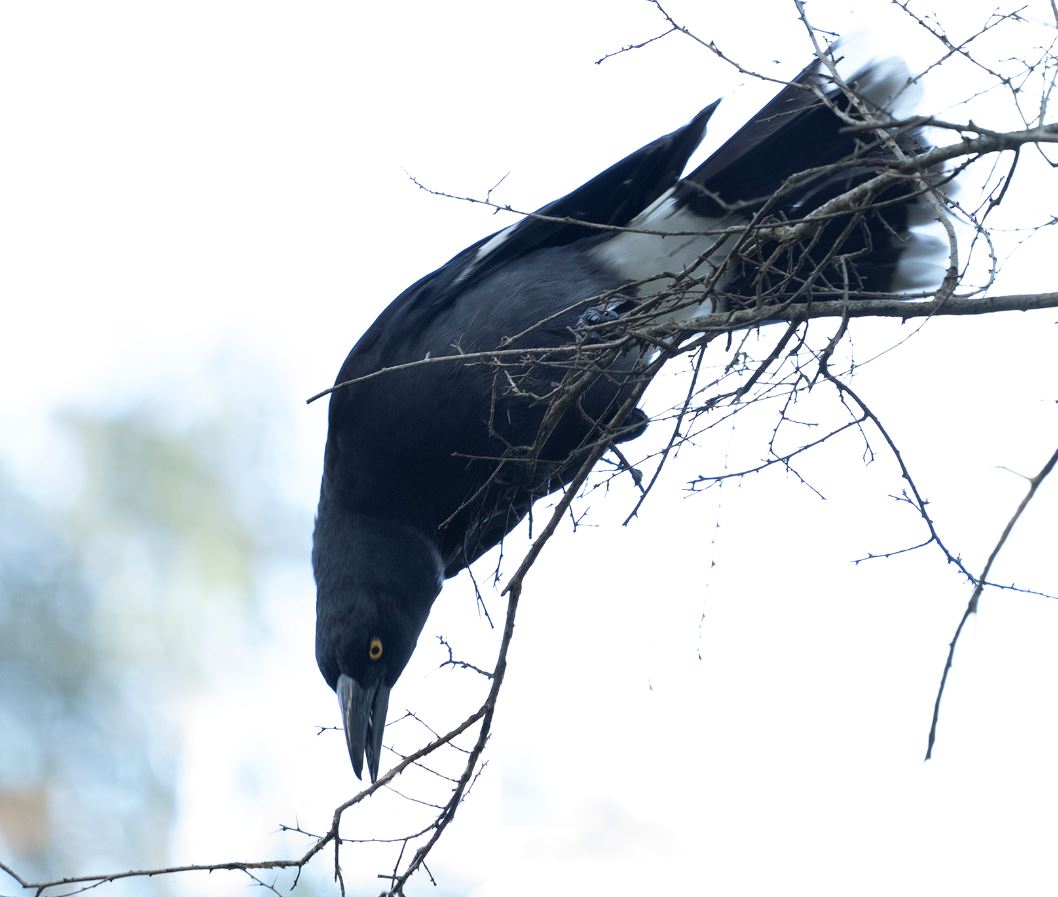
Currawong Secateurs – snipping twigs for nesting purposes (thanks Wendy)
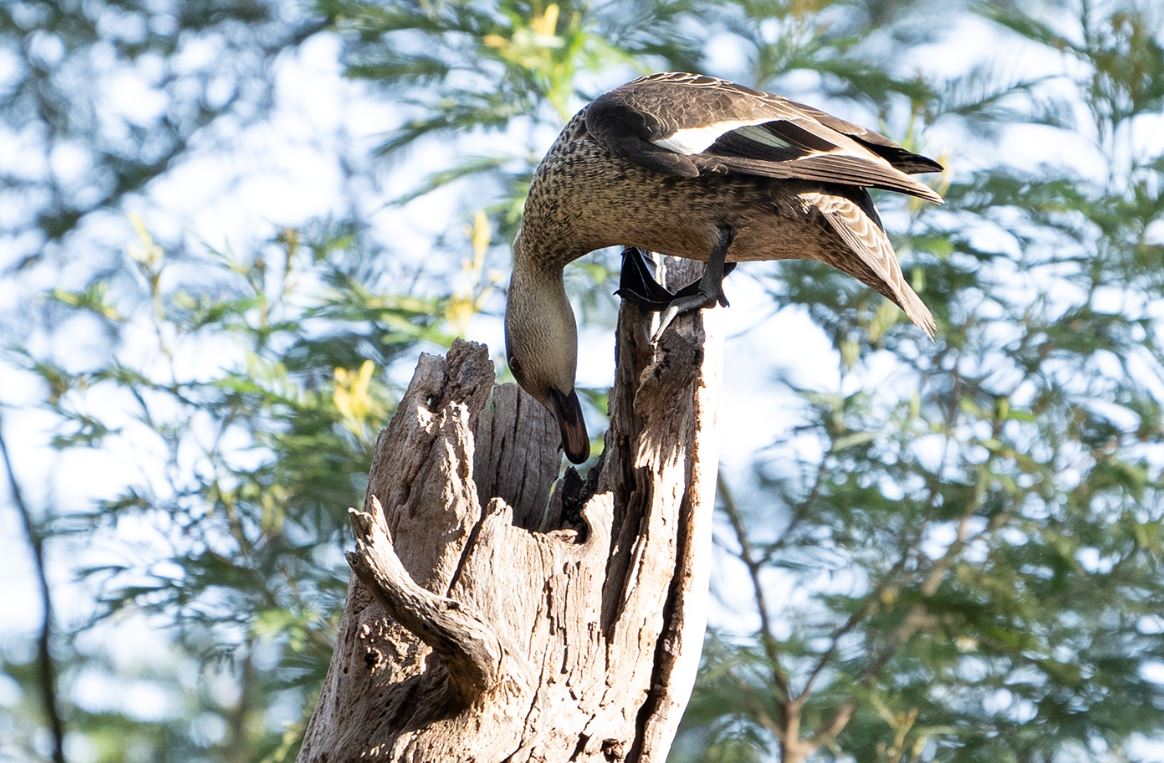
Female Chestnut Teal Duck inspecting a nest hole (thanks Wendy)
Other Sightings
- Wendy reports having seen a Dusky Moorhen just downstream from the Laurel Grove bridge and Grey Fantails recently. The Dusky Moorhen is a medium-sized, dark grey/black water bird with a red bill and facial shield possibly visiting from Blackburn Lake:
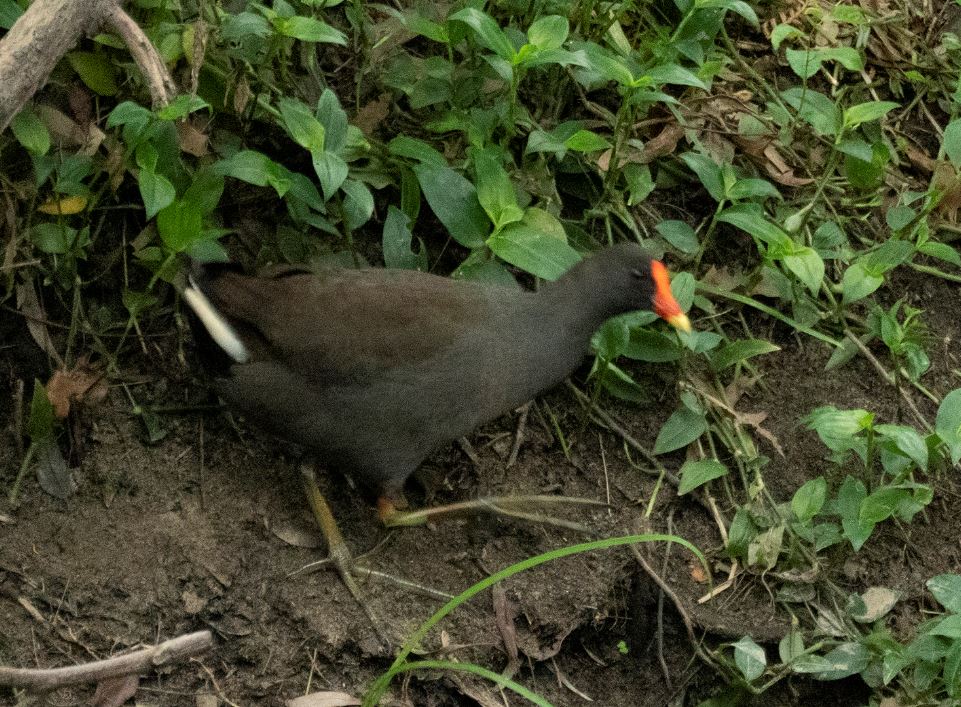
Dusky moorhen on the creekbank – Kalang Park (thanks Wendy)
- Other sightings have been:
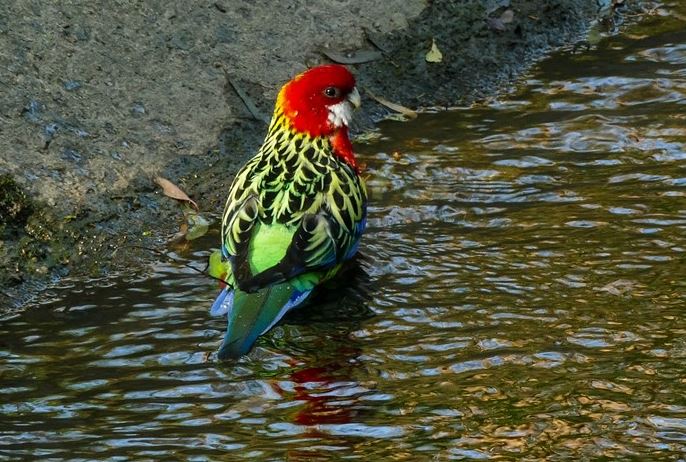
Bath time in the creek – beautiful “foliage” on the back (thanks Ruth)
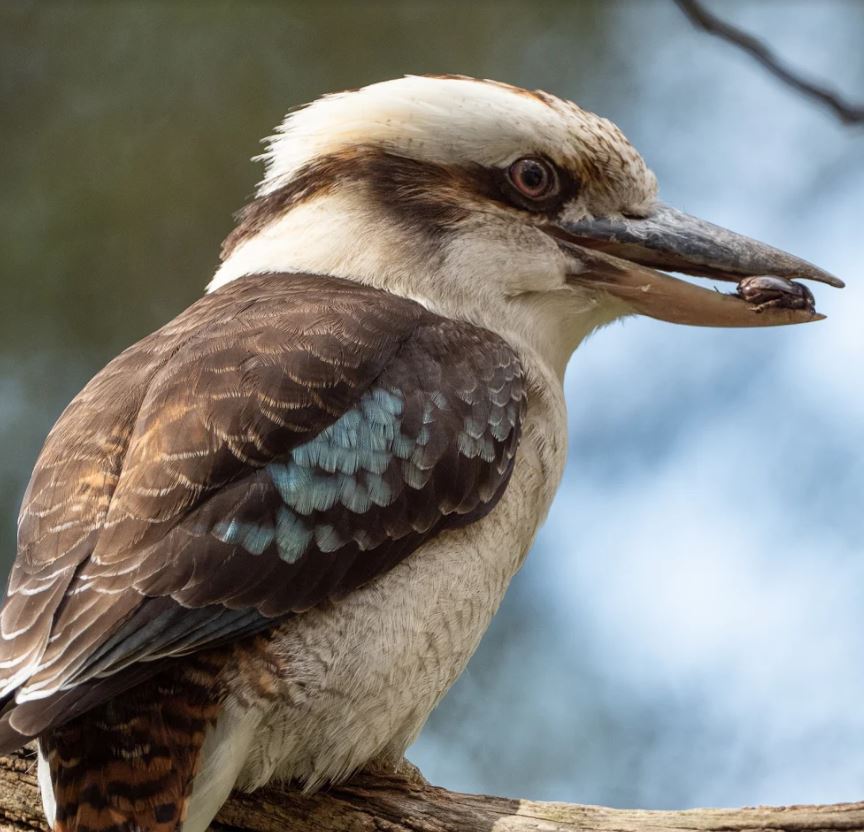
Yum! (thanks Greg)
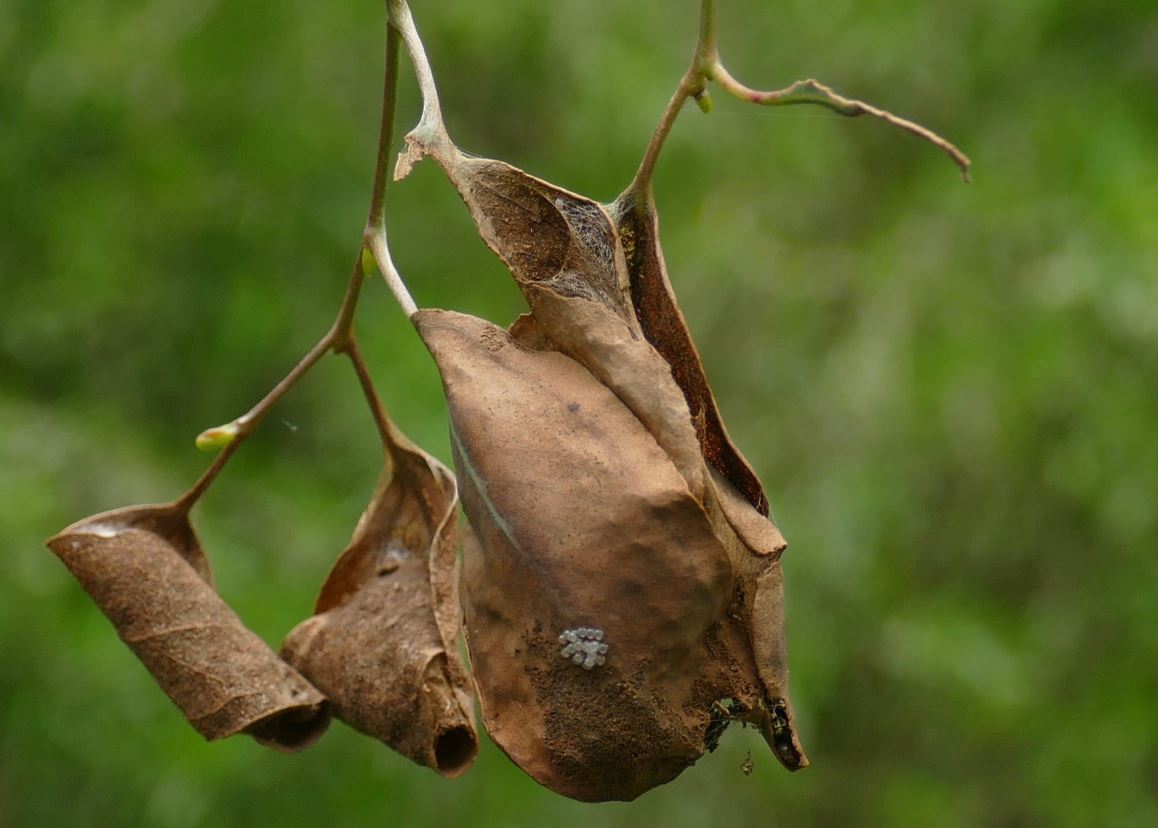
Who lives here? (thanks Rita)
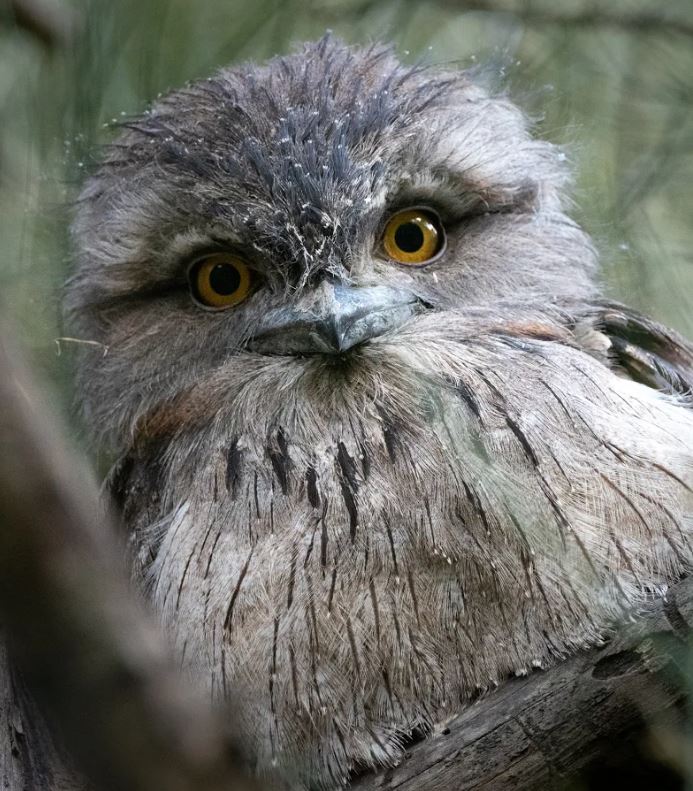
Tawnies can be cute too! (thanks Greg)
Plant of the Month
- Our Plant of the Month appeared in the bottom right corner of Lisa’s montage at the beginning of this newsletter – the Snowy Daisy Bush (Olearia lirata):
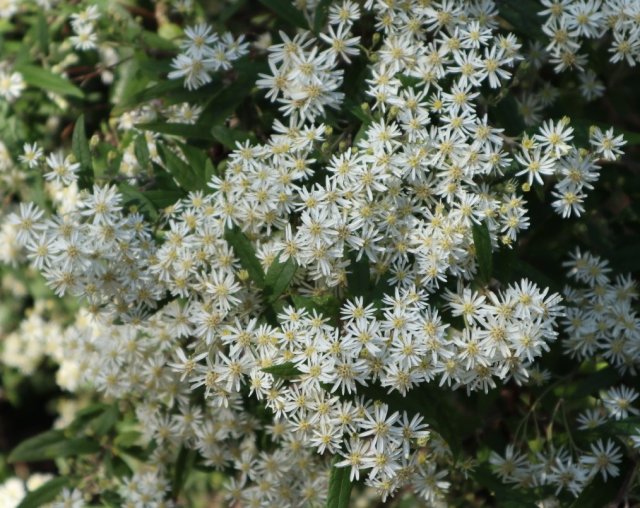
- As our photo shows, this plant flowers prolifically – bringing a definite touch of Spring to the park. Its small daisy-like flowers contrast beautifully with its soft green foliage.
- It likes partial shade and moist conditions.
We are all in it together!
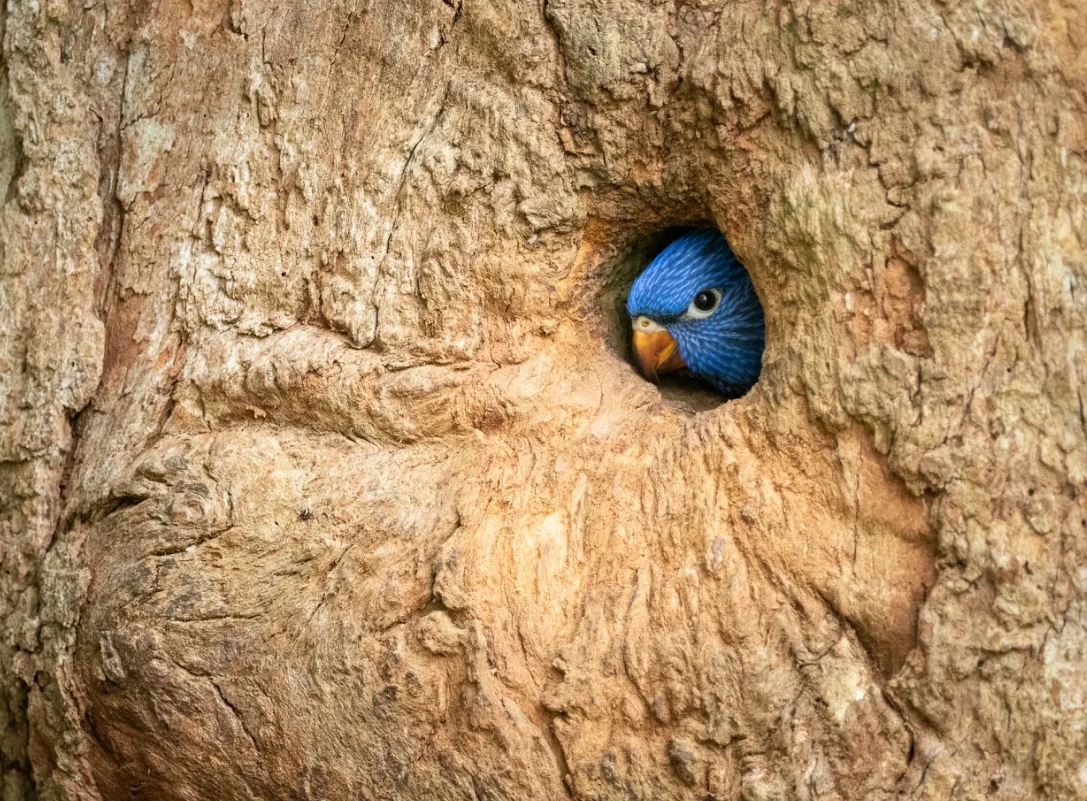
- Stay happy and stay safe – and please keep an eye out for friends and neighbours (thanks Greg)!
 Blackburn Creeklands
Pingback: Park News – February, 2021 | The Blackburn Creeklands
Pingback: Park News – September, 2021 | The Blackburn Creeklands
Pingback: Park News – September, 2022 | The Blackburn Creeklands