Mystery “Organism”
Our Maintenance Team was very excited recently to find what appeared to be a crusty, bright orange, cuboidal fungus growing in a very hot, exposed, dry and dusty location at the height of Summer weather during a recent working bee:
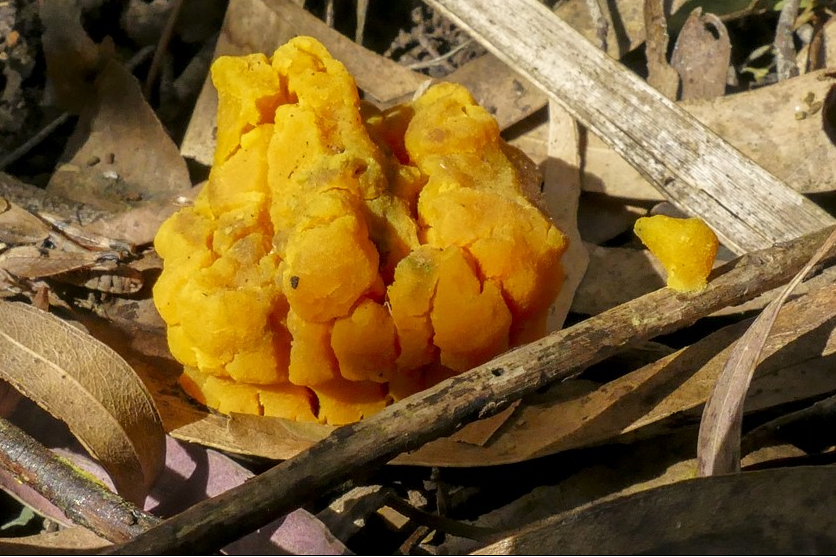
It had seemingly spread to other organic matter nearby. Alarm bells were ringing though – most of our fungi need moisture and “flower” in more temperate conditions. Still, to every “rule” in nature, there seems to be an exception.
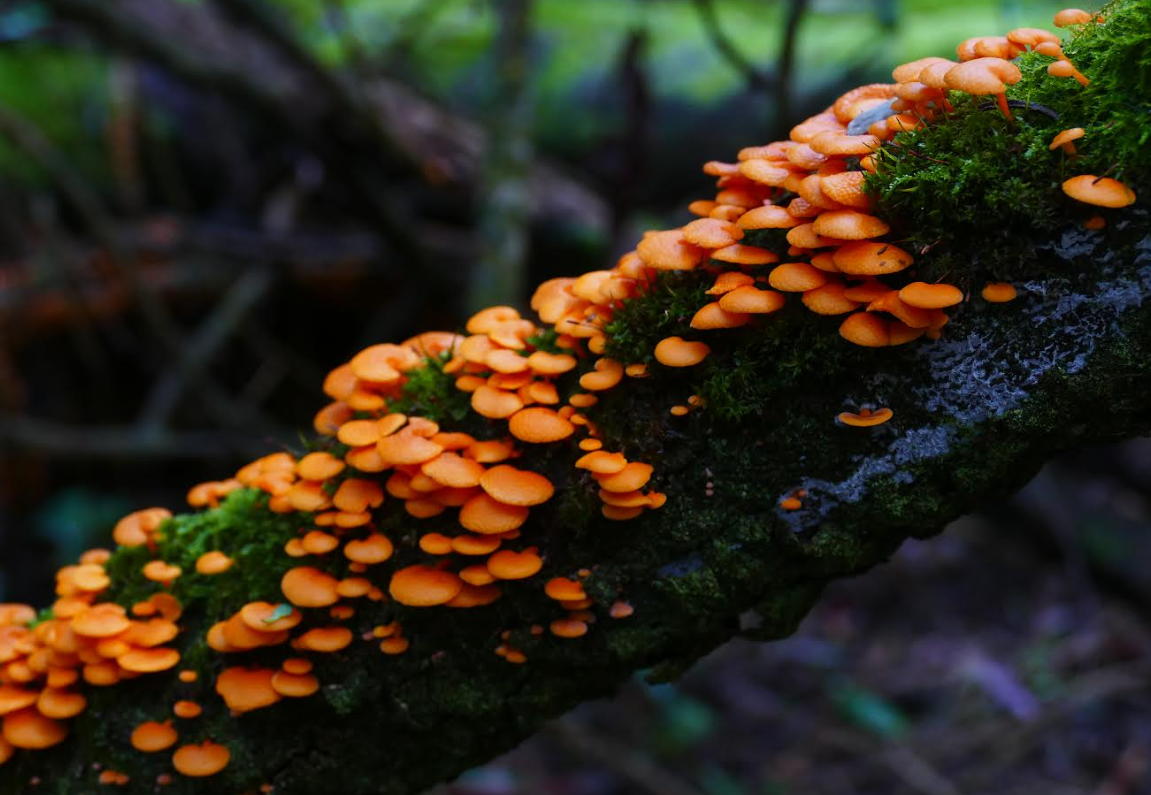
Bright orange colouration is certainly not unknown in our fungi – this is Orange Pore fungus or Orange Ping-Pong Bat (Favolaschia calocera) found by our friend Rita in June last year:
Anyway, we called in our Citizen Scientists to help – Wendy announced the startling decision that our discovery was actually “Play-Doh”.
“Doh” alright! – the team’s red faces were brighter than the fungus!
Kalang Oval – a dog park ?
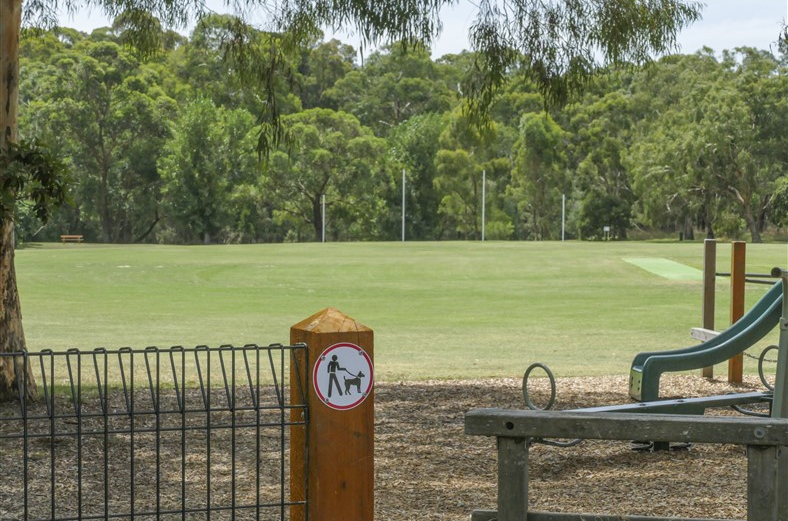
We wrote to all our registered Friends in mid-February via e-mail urging everyone to “have your say” on whether Kalang Oval should become a dogs-off-lead park or not. At present, all of the Blackburn Creeklands, including the oval, is an on-lead park.
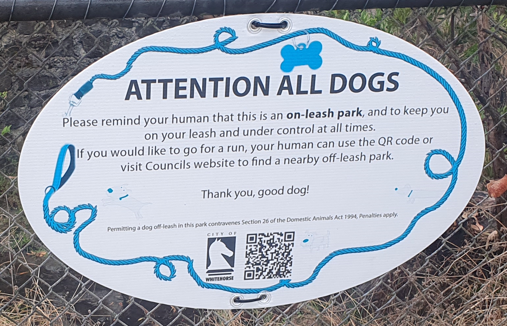
We know and understand perfectly that a lot of people want convenient places to exercise their dogs. However, we asked people to consider this case in particular, whether Kalang Oval is appropriate – it being in the centre of a bushland reserve. We were especially concerned that the proposed area includes a wetland in clear contradiction of Council’s previously stated guidelines. As everyone knows, unleashed dogs and wildlife just do not mix.
It turns out that our friends in the Laburnum Cricket Club and Auskick are also strongly opposed to the idea because of the adverse impacts on their activities – conflicting use, hygiene etc. It seems one of Moreton Park’s ovals, formerly available for dogs-off-lead, will be closed to them, and Kalang Oval is effectively being offered as a substitute. Why is “dogs-off-lead” not OK for one sporting oval, but fine for another?
Moreton Park is not a Bushland Reserve. We also note that Kalang Oval, unlike the Moreton Park oval, is not fenced and many park users would be opposed to that occurring. Many park users would not fancy a fence under the old oak tree between the oval and the path along the creek. It seems Council does not have a policy concerning when leash free areas should be fenced or not, whereas other Councils do. There also does not seem to be a policy concerning implementing dedicated dog off-lead reserves either. Obviously there are safety issues not only for dogs, but also children and vulnerable adults if there is interaction without protection.
So, where can dog owners go to exercise their pets off-lead ? Sparks Reserve is very close by (just over Middleborough Road from Blacks Walk). Also, one of the Moreton Park ovals remains available.
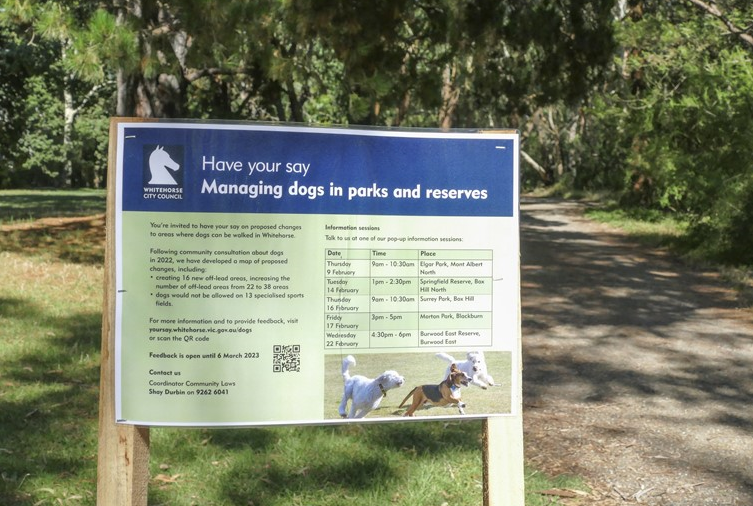
Today is the last day for making your submission. Please have your say at Council’s survey web-site: https://yoursay.whitehorse.vic.gov.au/dogs – if you haven’t already !
Main Street Resurfacing Completed
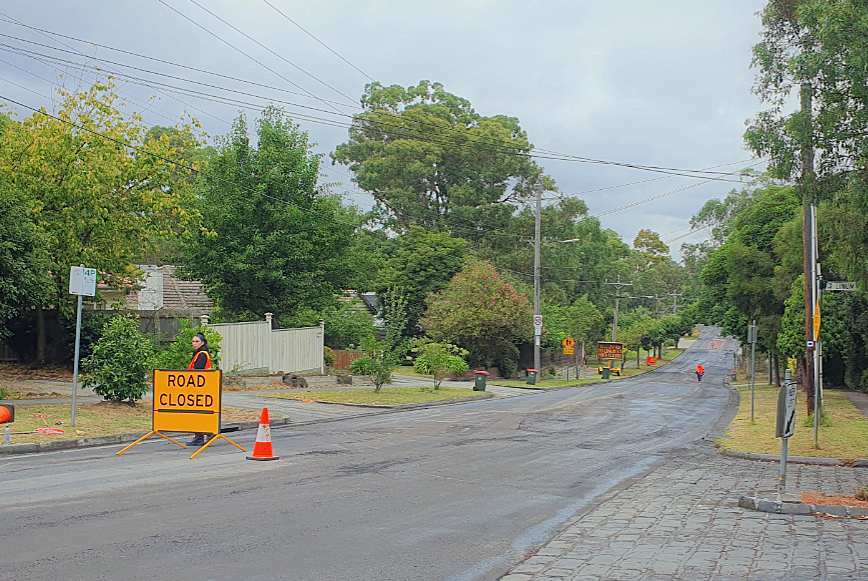
Council’s asphalt resurfacing of Main Street between Canterbury Road and Linum Street is completed.
Two new flat-top speed humps have been installed in Main Street either side of the park crossing to the immediate north and south of the bridge. These are on either side of the zebra crossing advocated by local residents. Committee was informed by Council about 12 months ago that Council will evaluate whether these treatments result in a safer, lower speed environment – and then determine whether a zebra crossing is actually needed.
Path works in Blacks Walk north
Paths on the northern part of Blacks Walk have recently been resurfaced with work commencing on the 28th February.
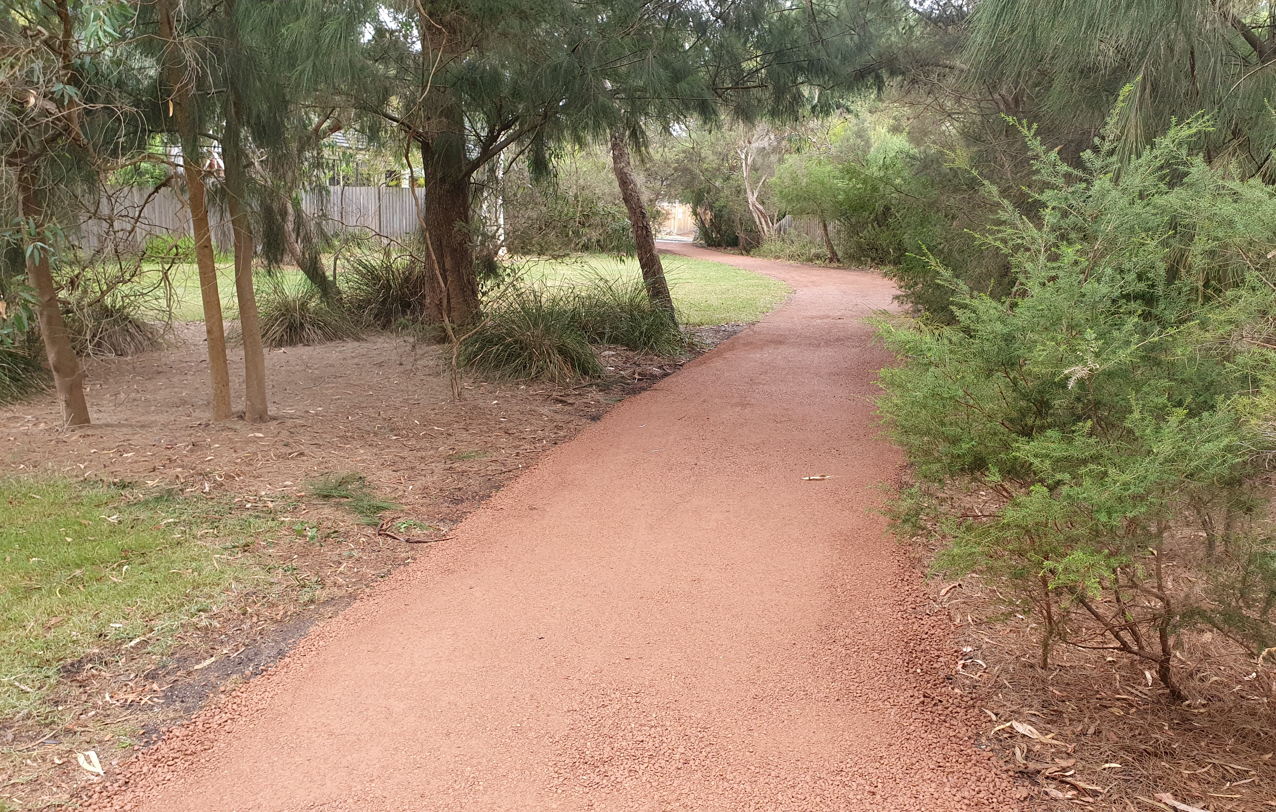
The reddish Castella mix was used given that Lilydale topping is no longer available. It contains some cement to bind the “fines” in the material. Nevertheless, Council tells us the resulting path is permeable.
Kalang Oval – Cricket safety nets to be extended
Kalang Oval is junior sized with the result that barrier nets are needed to protect neighbouring houses from errant cricket balls. A set of removable 6 metre high nets went up in 2015.
Following a recent safety audit, Council has announced to local residents that the cricket ball barrier nets at Kalang Park will be significantly extended. The safety netting, which currently runs along part of the western side of the park, will increase in length and height. Along Kalang Street (south side), netting will be 5m high and, on the western side (adjacent to properties) including Doogan Street, the height will be increased to 10m.
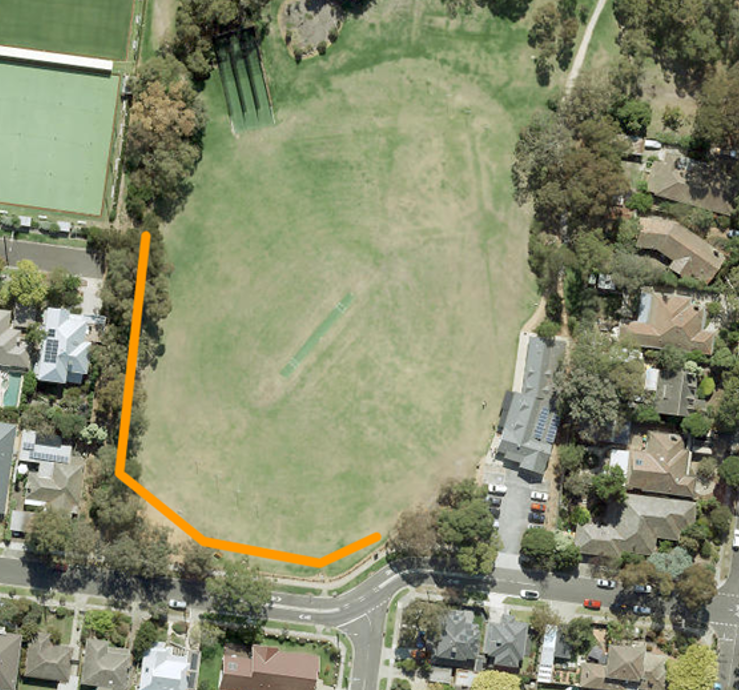
Council has advised that:
- No trees will be removed to install the netting.
- Safety netting will not affect the size of the sports field.
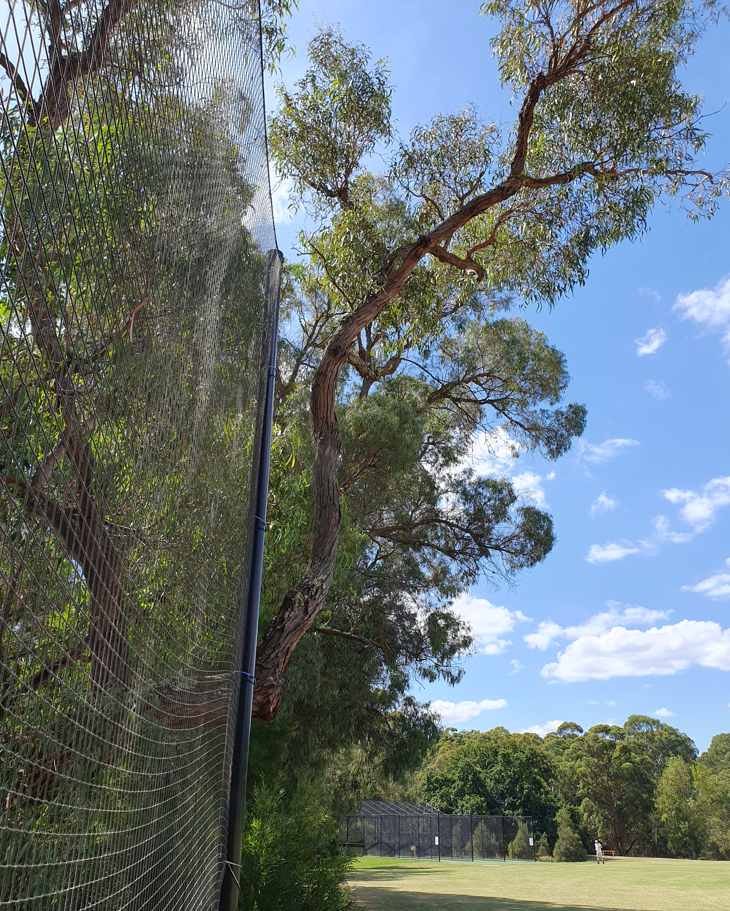
We have not been able to determine whether there would be adverse effects on wildlife but have raised concerns about the level of tree pruning that will be needed and also the new access restrictions – eg to the children’s playground and drinking water fountain.
Work is scheduled to take place during March, 2023.
Maintenance Team Report
Changes to work zones for 2023
The park is partitioned into a number of working zones in three categories – managed by your Committee, by Whitehorse Council’s Bushland Team and by its contractor. This example shows the former situation for Blacks Walk:
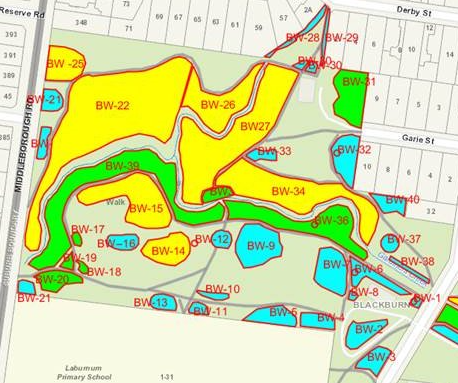
Council has been working with us to develop our Annual Maintenance Plan for the park. Although there is some overlap, the three different groups do different types of work. Our team conducts hand-weeding, mulching, planting, rubbish collection and Community Working Bees. Council and its contractor do chemical spraying, brush cutting and limited hand weeding and planting.
So, we all need to play to our strengths. This means some of our work zones have changed hands – you might see us working in different parts of the park this year.
Recent Maintenance Team Weeding and Mulching
Since last edition, the Maintenance Team has been working in the patch west of the billabong and on both sides of the track from there to Pakenham Street including the area around the Noticeboard.
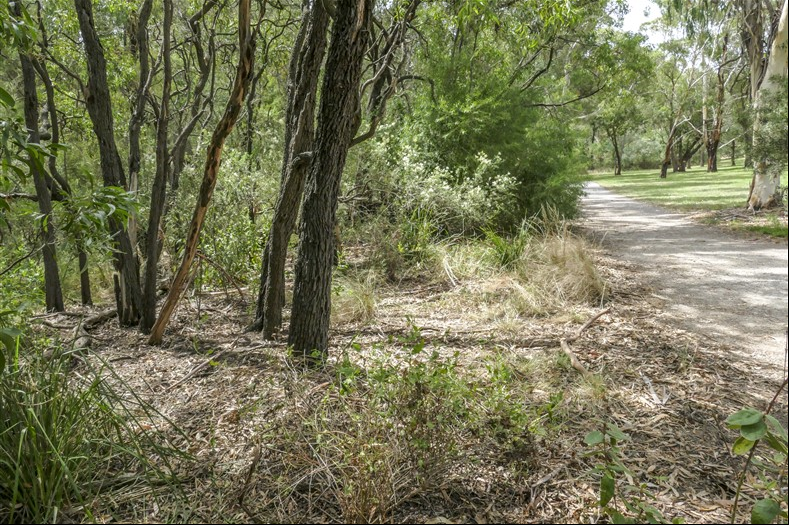
The team has heavily mulched the Noticeboard precinct in an experiment to see if weed regrowth can be controlled ahead of major in-fill planting later. Five truckloads of wood chip mulch have been spread in sometimes hot and humid conditions. We thank the team for their efforts.
Tools trailer
We’re been quite proud of our tools trailer which can be easily hauled through the park along any of the tracks to our work locations and packed ready for action in our tiny cage at the Kalang Pavilion. All the equipment for the day’s work is delivered in one run – excepting in planting situations where we need the pump, water buckets etc which require a second delivery.
However, we note that the Rewilding Stonnington group has taken the tools trailer to the next level – a vehicle hauled trailer which includes its own solar power. They won a grant from the Federal Government for their innovative ideas.
Plant Orders and Community Working Bee
Given that our plans for 2023 are now solidifying, we have been able to order plants for our first major Community Working Bee and for in-fill planting.
One for your diaries – our first Community Working Bee for 2023 will be a revegetation planting session on the 28th May in Kalang Park – just east of the Laurel Grove bridge – you may have seen the Council signage there.
Autumn Bird Survey
Another one for your diaries – we are very pleased that our fantastic group leaders, Pat Bingham and Ian Moodie, are available on Saturday 29th April at 7.30 am and have agreed to lead our Autumn bird survey.
“We can live in hope”
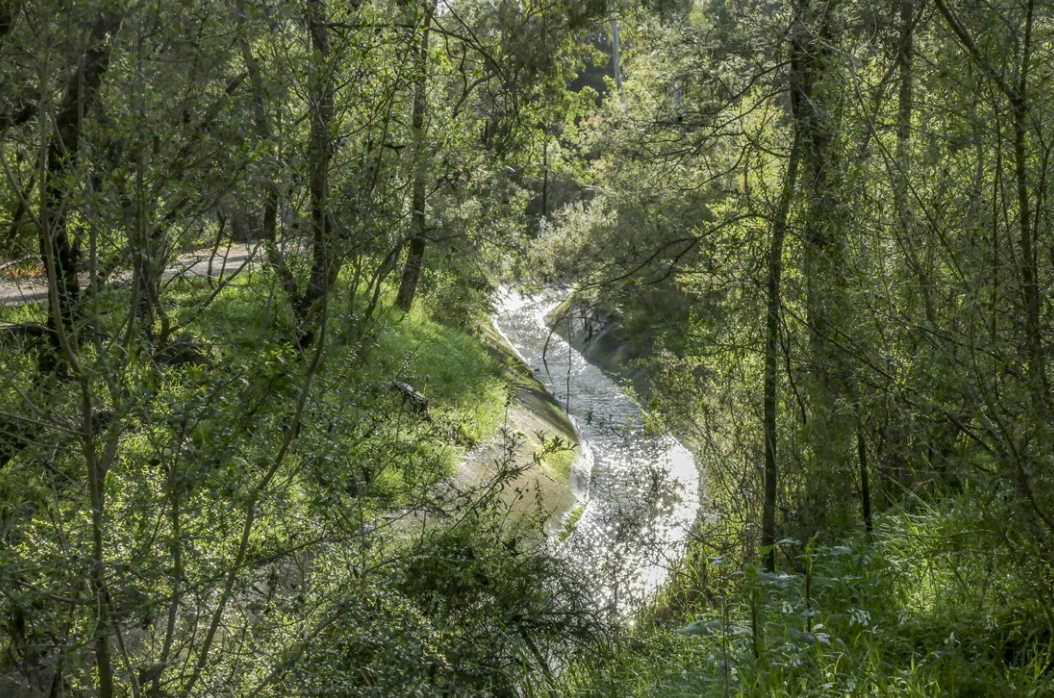
“We can live in hope” – a simple message from one of our Friends. Not everyone admires the “barrelled” section of the creek which extends east from the Laurel Grove bridge towards Main Street.
What can be done about it? The picture below from The Age 3/2/2023 shows one approach taken in the north of our city on Moonee Ponds Creek at Strathmore.
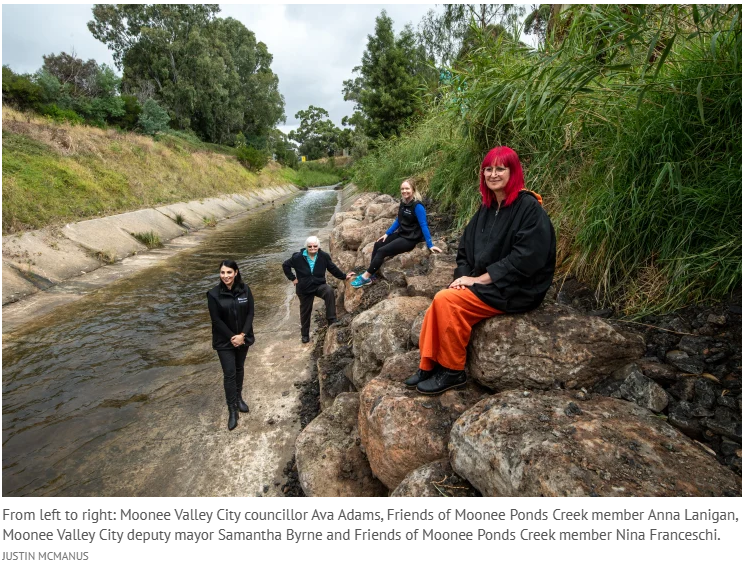
It’s just one of many creek restoration projects underway in Melbourne, with similar schemes in Werribee, Lewis Park, Melton West, Boronia, Croydon and St Albans.
The first stage of the project involves removing 50 metres of concrete (we would have 200m to remove though ours is narrower), planting 43,000 native plants (!), creating rock weirs, installing seating, and building a bike and pedestrian path. It is expected to be completed next year.
Sightings
Cappuccino Creek
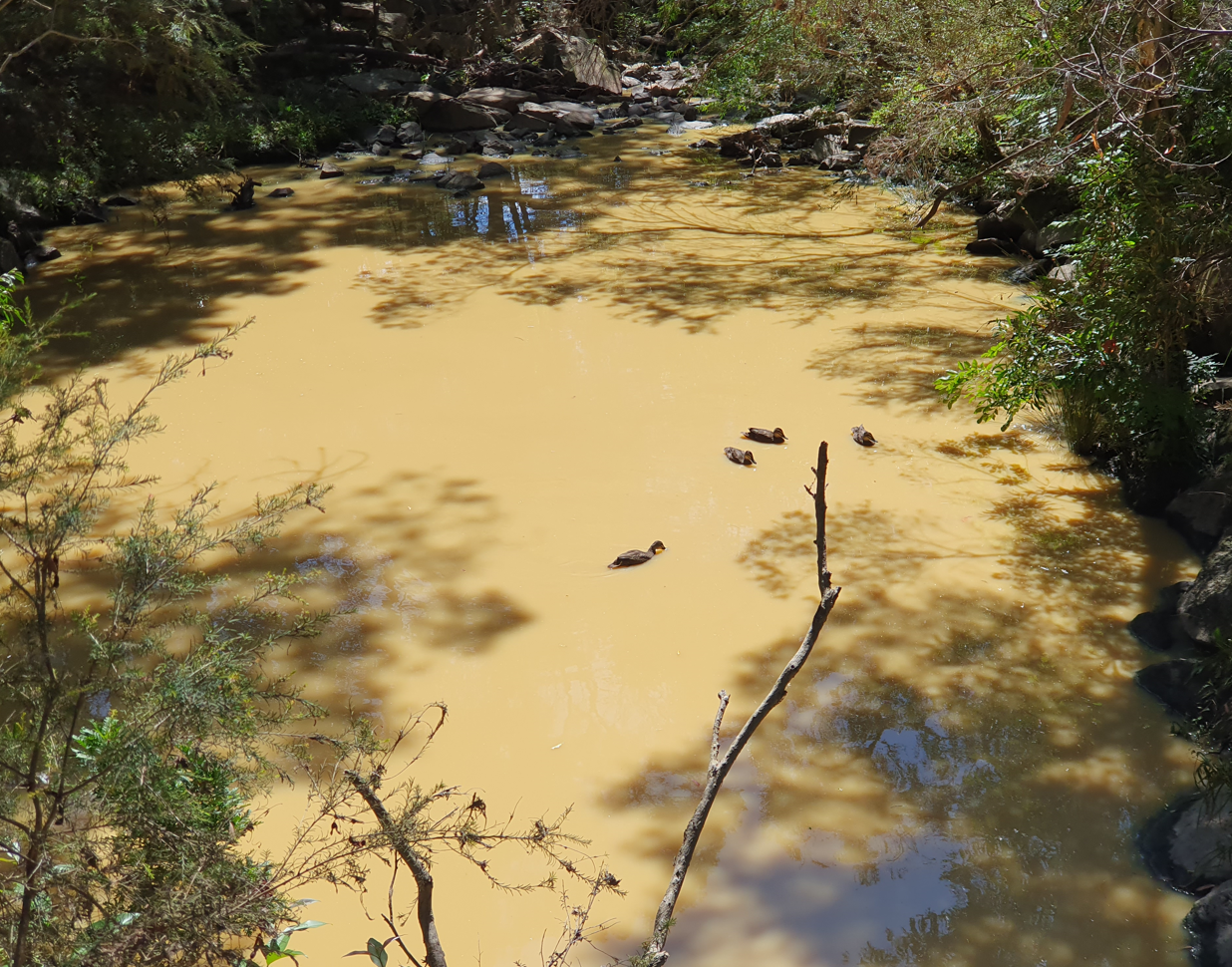
Typically, this yellowish colour results from clay contamination from a burst water main somewhere in the creek’s catchment.
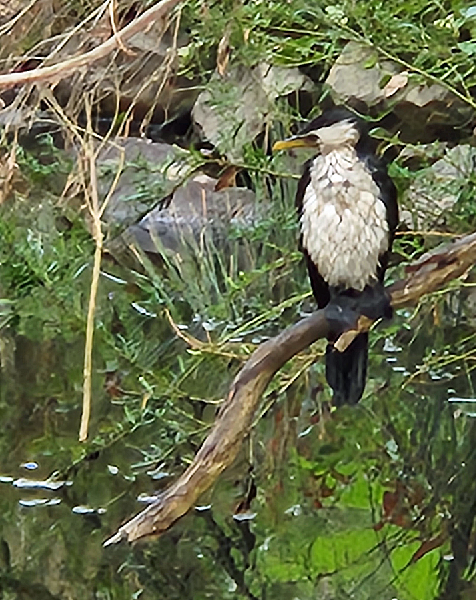
We are not sure how underwater hunters such as our Little Pied Cormorant can feed in such opaque water.
The species has been absent from the park for some time, but our friend Victor took this picture a couple of days before the event pictured above.
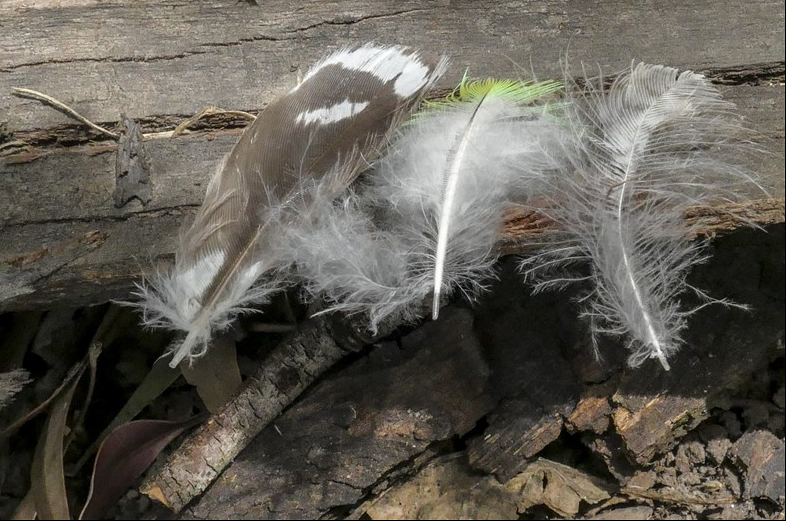
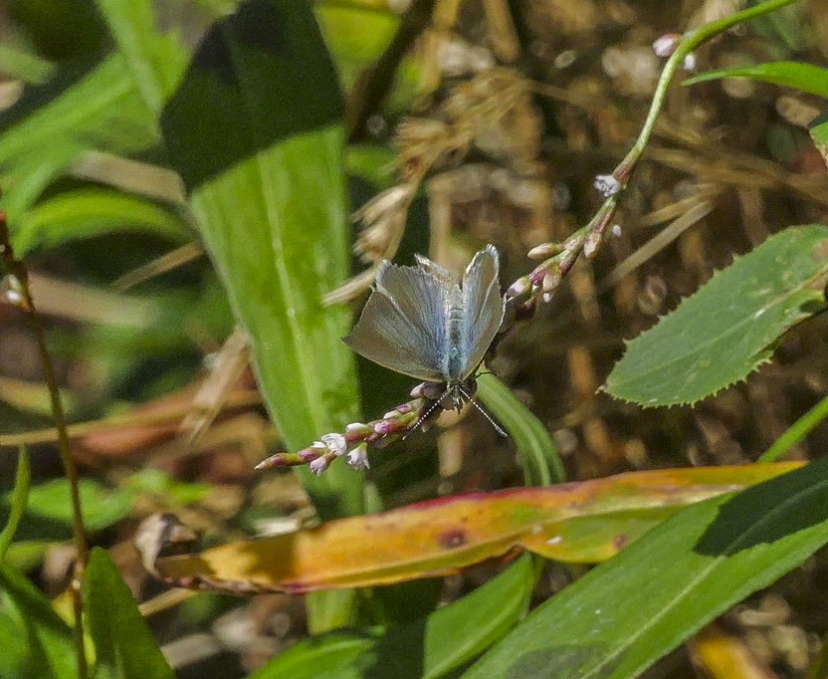
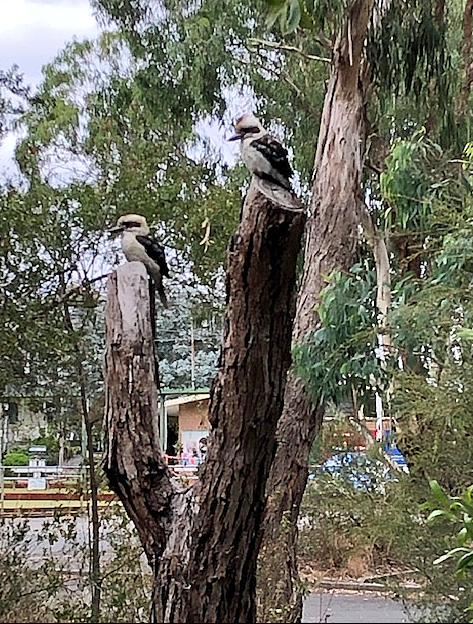
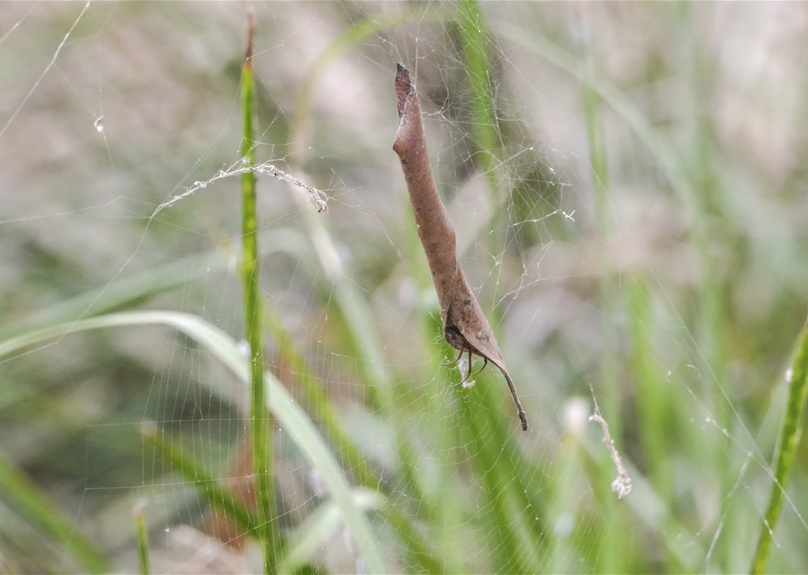
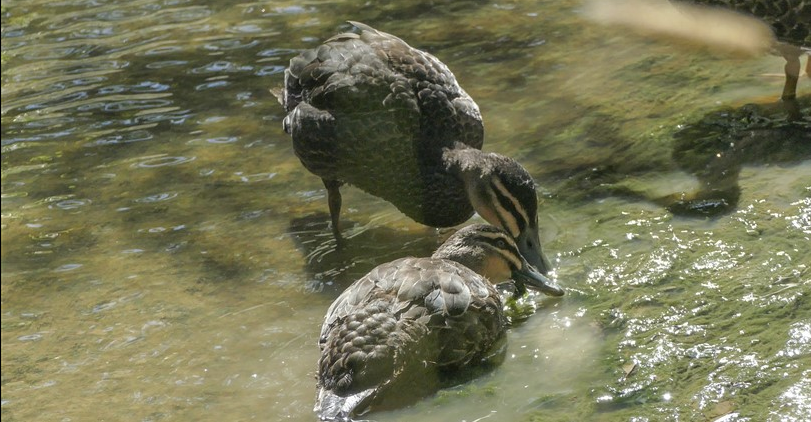
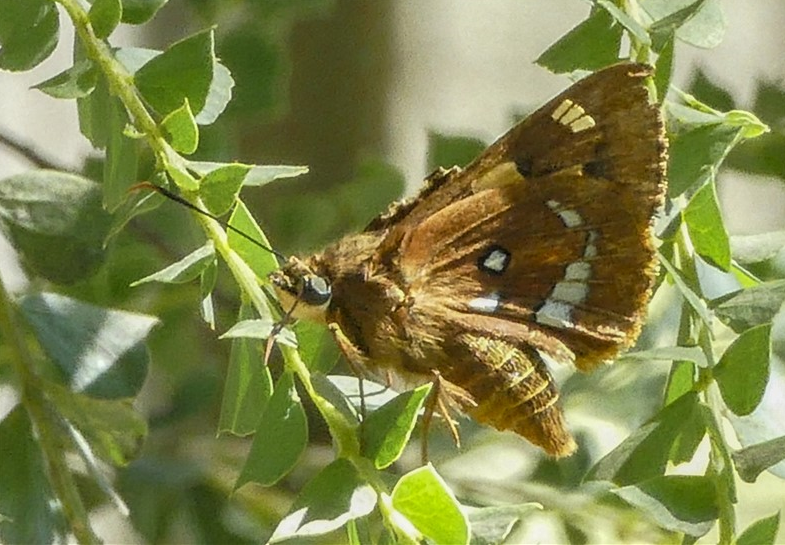
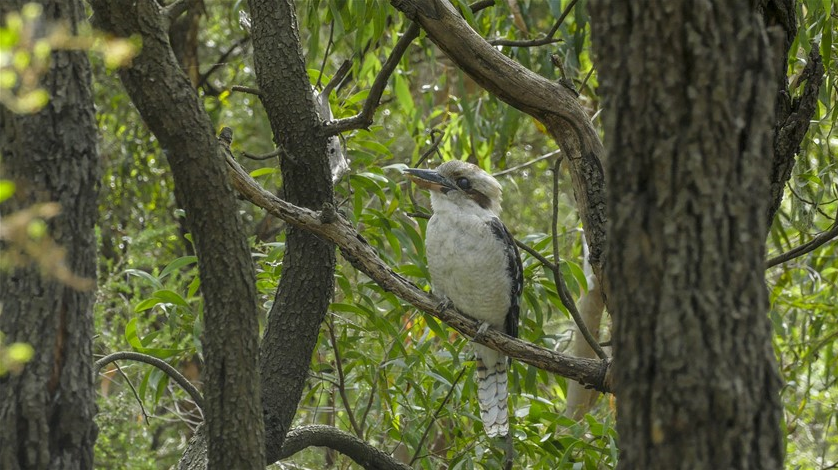
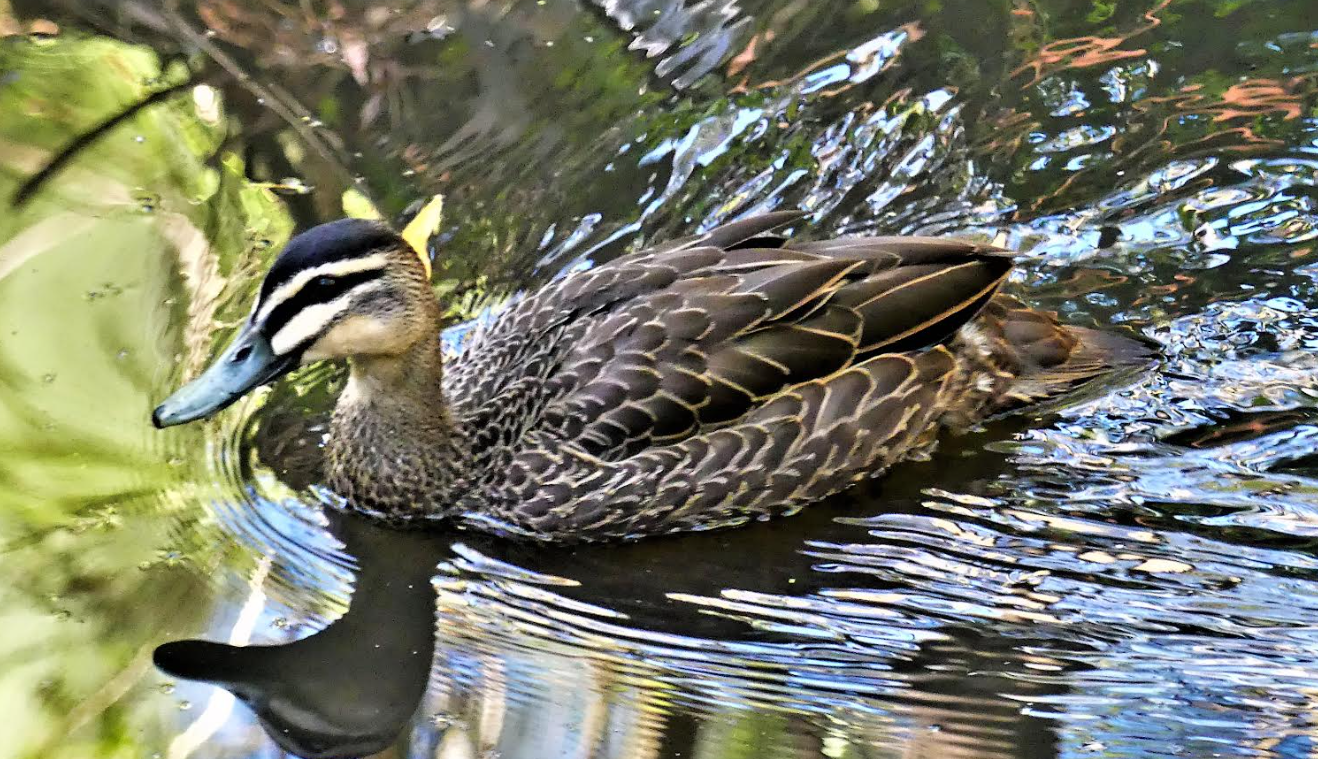
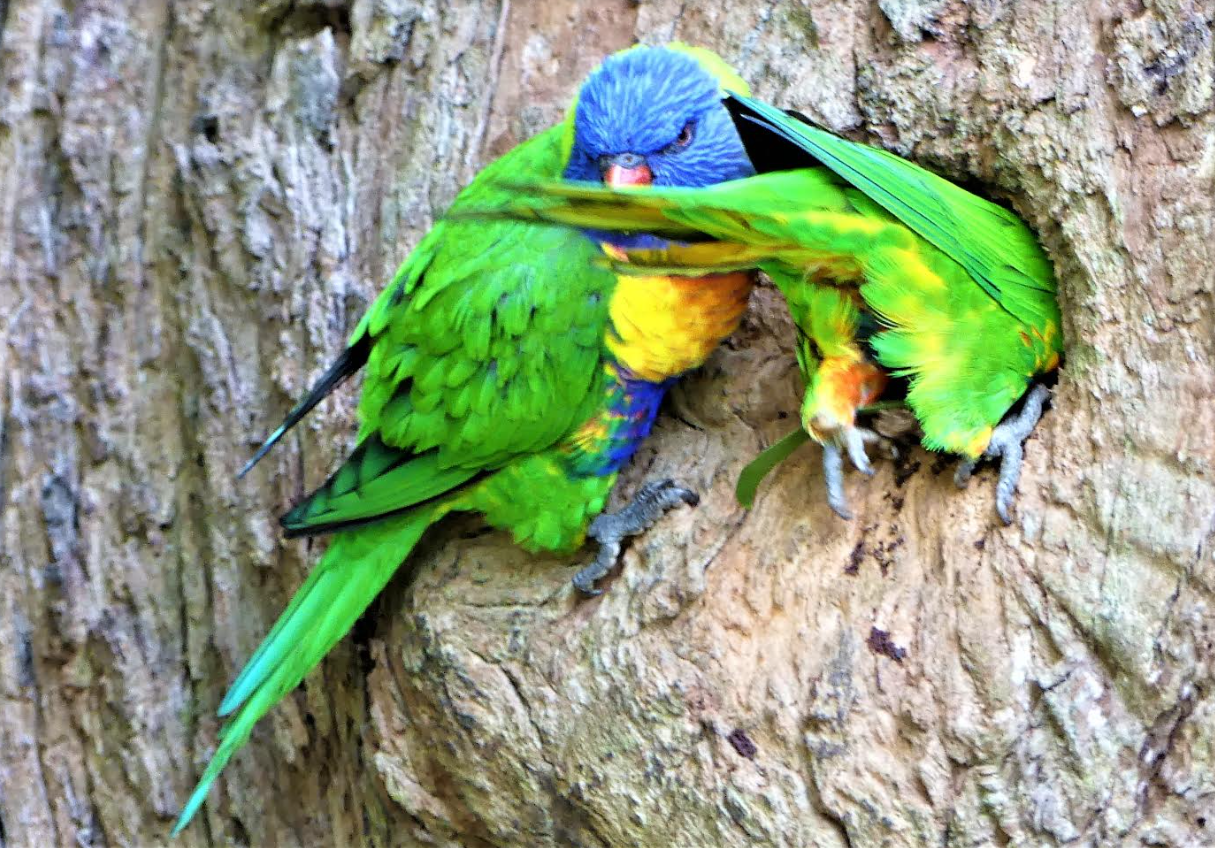
Here is an assortment of photos from our photographer friends including a bright-eyed Currawong (thanks Lindy), a Pacific Black Duck cruising (thanks Russell), another shot from Russell showing a pair of Lorikeets cross that someone has taken over their home (one is removing nesting material put in there by the interloper), a shot from Nicky proving “habitat pruning” is not all bad and several other shots from local photographers showing our wetland flowerings, ducks feeding, a damselfly, Common Blue butterfly, Leaf Curl spider, a photo showing the different structures of bird feathers, a Skipper and more:
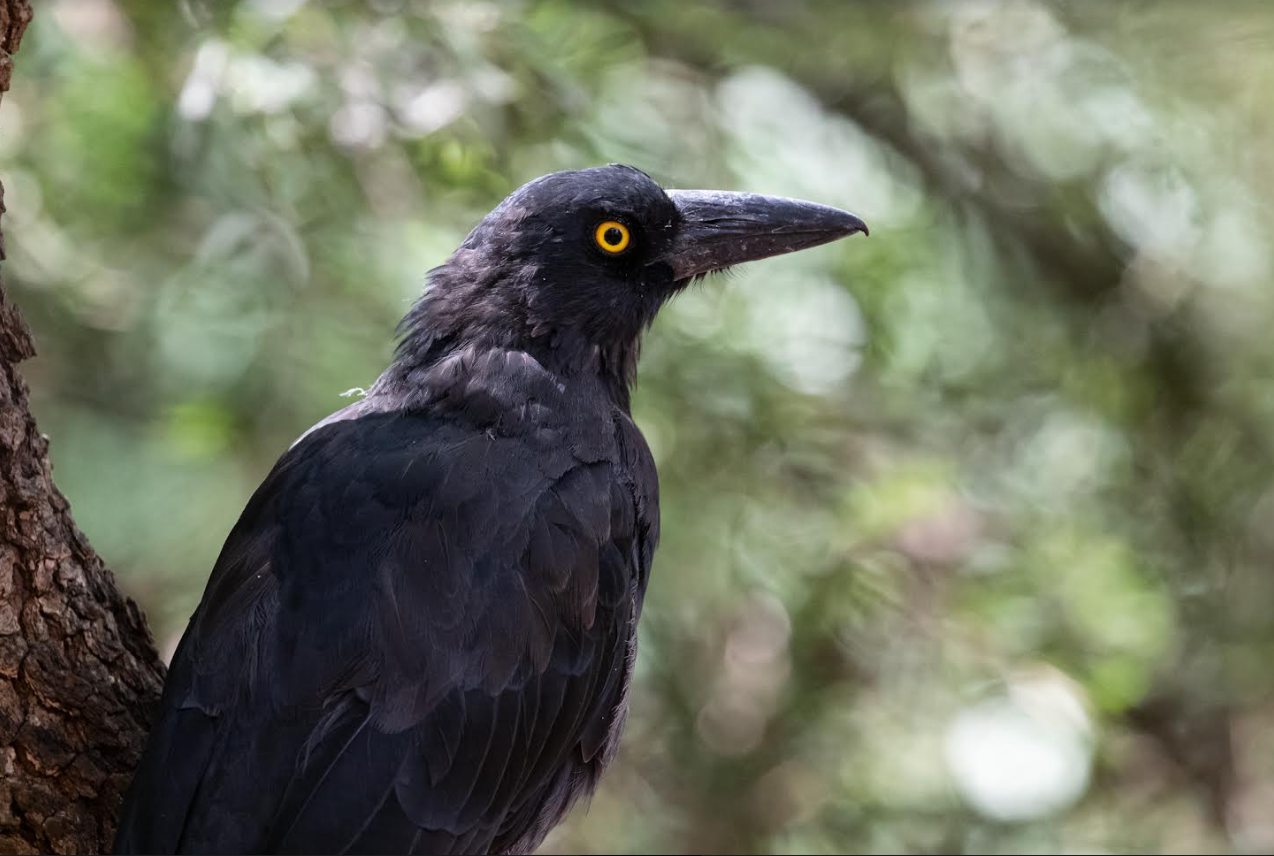
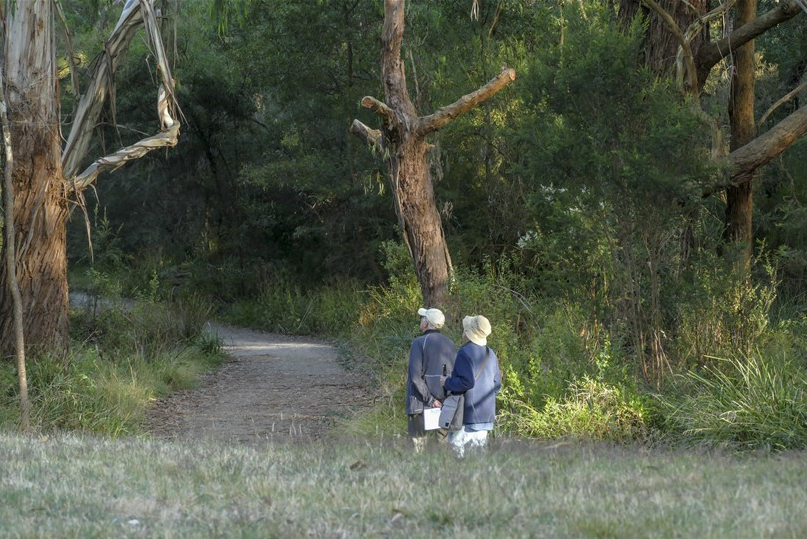
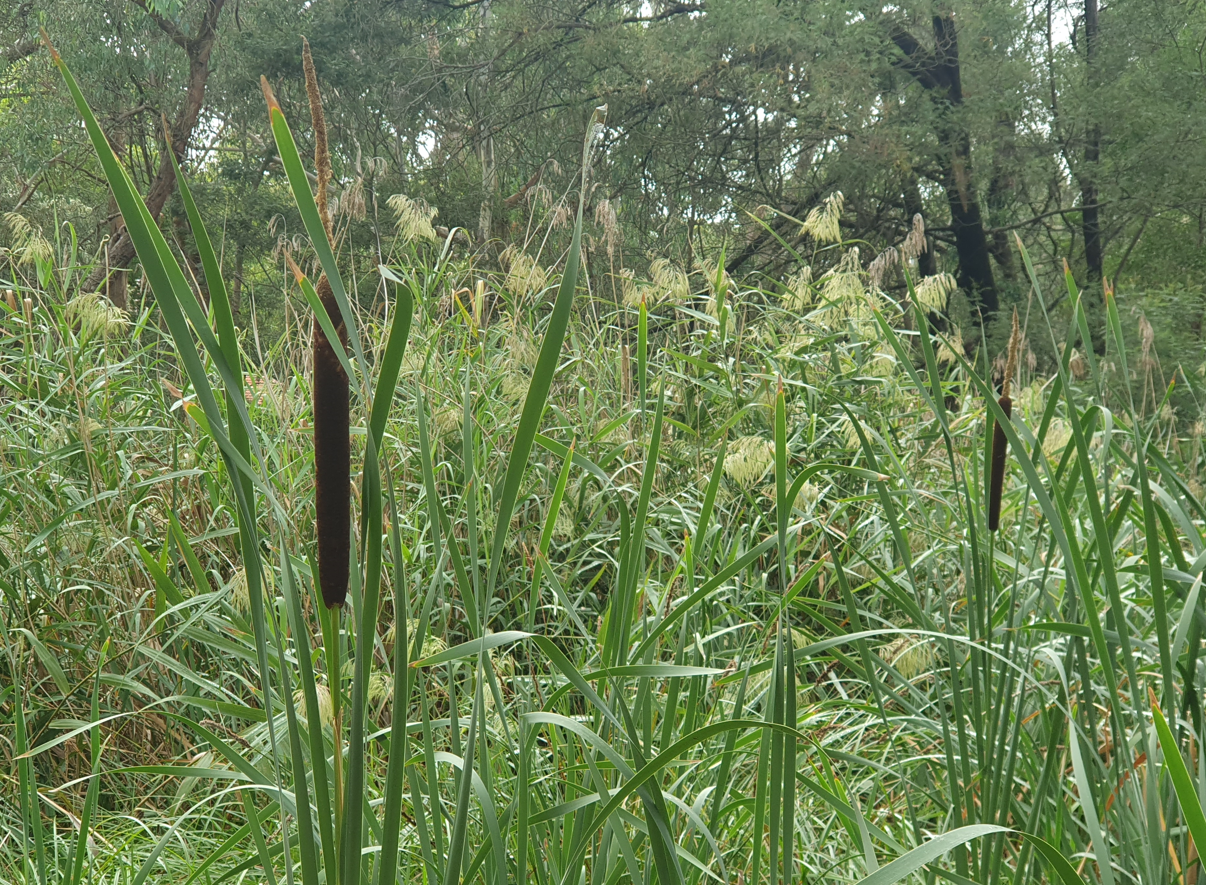
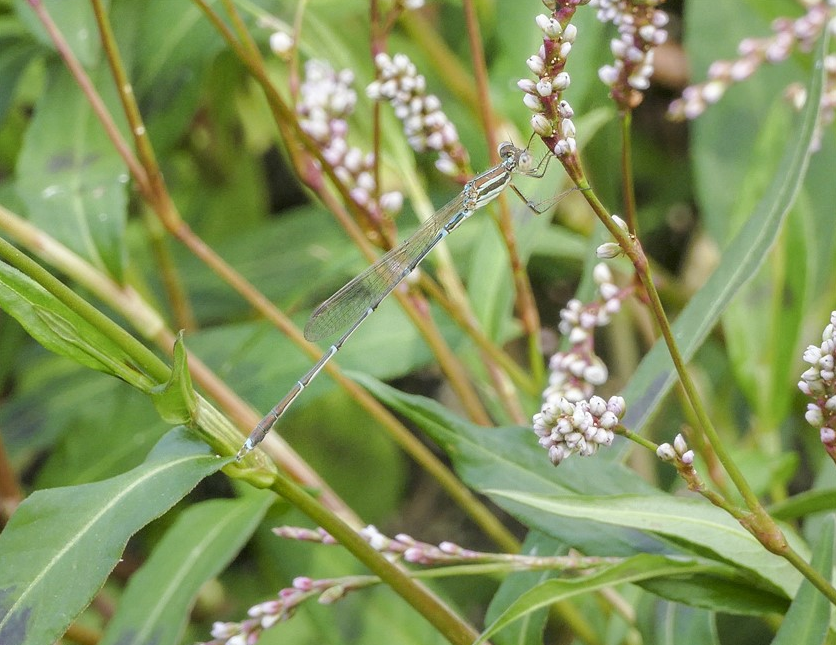
Please click to enlarge and hit the ‘X’ to exit.
What’s a skipper ? We have a movie to show you with accompanying text from the local author:
This skipper butterfly [Hesperiidae sp.] was filmed briefly as it flew from some strap leaved plants to a flowering hop goodenia [ Goodenia ovata] growing beside Gardiners Creek, also known as the Kooyong Koot waterway. The skipper butterfly’s proboscis can be seen after it was uncoiled to feed on the nectar in the yellow Goodenia ovata flower. The Audio track in this video has the bird calls of the Noisy Miner (Manorina melanocephala) nearby as well as the sounds from a children’s playground.
You might have seen some cheeky young ducks feeding along the main tracks:
Pacific Black Duck (Anas superciliosa) adult females and males have similar plumage. They feed on aquatic vegetation, grass seeds and insects. This video shows one of two Pacific Black Ducks seen as they foraged in the grass/rushes beside the creek bank and within the low grassy vegetation before returning to the water in Gardiners Creek, also known as the KooyongKoot. Retaining vegetation around wetlands and ponds as well as along suburban creeks and waterways provides vital habitat for these Pacific Black Ducks. In this section of Gardiners Creek most of the creek bank vegetation is classified as weeds. Weed removal /revegetation processes should consider staggered habitat replacement to allow the wildlife to continue to maintain their original territories. Pacific Black Duck usually make a nest close to water and may have 2 broods each year. Nests are made from grass and lined with feathers on the ground hidden in vegetation or in tree hollows. Maintaining water quality adequate for invertebrate life is a vital component in the food chain for suburban wildlife. The Audio track in this video has the calls of the Magpie-lark (Grallina cyanoleuca) nearby as well as the sound of the creek water.
Corridor News
People have long advocated the retention of canopy trees. As early as 1951-53, famous architect Robin Boyd:
… continued his passionate denunciations of tree felling: a forest at Ashburton, blue gums at Lorne, wattles in Beaumaris… Don’t ringbark Ringwood.
Robin Boyd, A Life by Geoffrey Serle (1996)
We are fortunate to still have many canopy trees in private property around the park. This is so important for the corridor given that the ribbon of parks following the creek is so narrow. Corridors are critical for ecological processes including the movement of animals and the continuation of viable populations. By providing links to larger areas of habitat, corridors enable migration, colonisation and interbreeding thereby increasing biodiversity.
Given the response to increased population and increased density of housing, the trend to continuing destruction of mature canopy trees is very worrying. Some developers flout or circumvent the planning rules and policies designed to protect our environment.
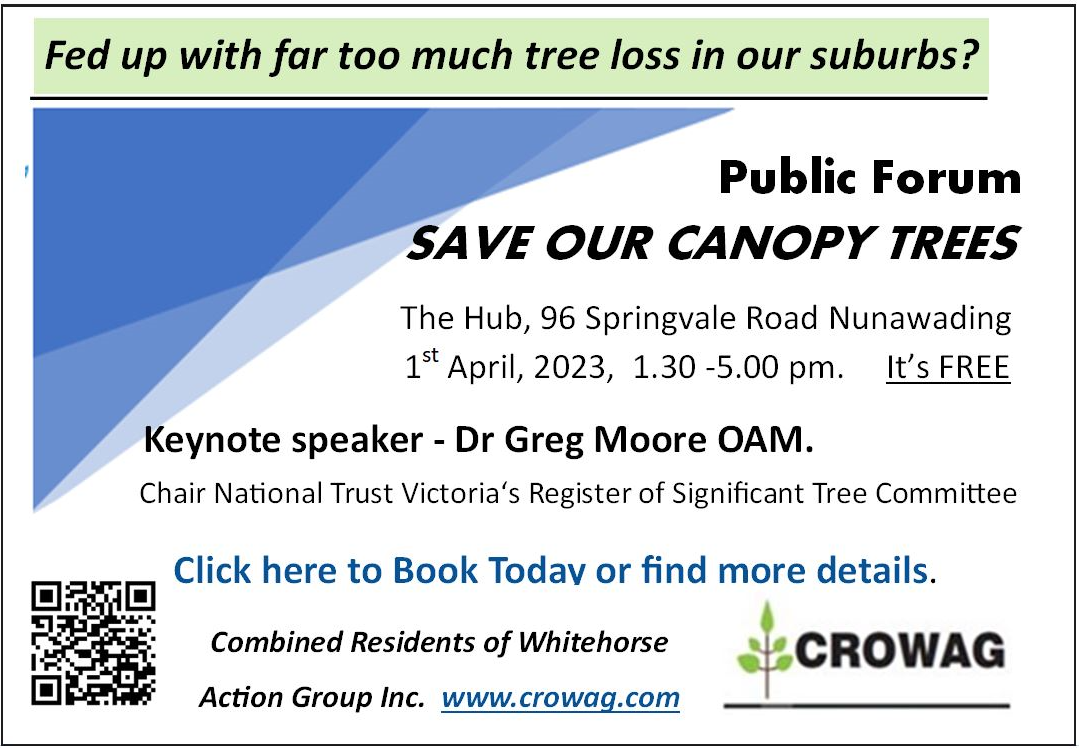
The Combined Residents of Whitehorse Action Group (CROWAG) Save our Canopy trees event is on Saturday, 1st April from 1:15 pm – 5:00 pm at The Hub.
CROWAG says:
CROWAG is a non-political, peak organisation in Whitehorse. It advocates for the entire community and its well-being. Our members and affiliate groups have rated Tree Canopy Loss as a major concern. CROWAG has lobbied Council and The State Planning department to improve compliance and enforcement of existing rules and to strengthen policies to better protect tree canopy. Tree canopy has many social and physical benefits notably shading our increasingly heated suburbs.
CROWAG has arranged some impressive speakers for its Forum on 1st April. They will cover the impacts of canopy loss and associated issues, how Councils and the State Planning authority are addressing tree canopy loss and what can be done to empower community action.
Our keynote speaker is Dr Greg Moore OAM, chair of the National Trust of Victoria’s Register of Significant Trees committee and a senior research associate at University of Melbourne, (Ecosystem and Forest Sciences), Burnley Campus.
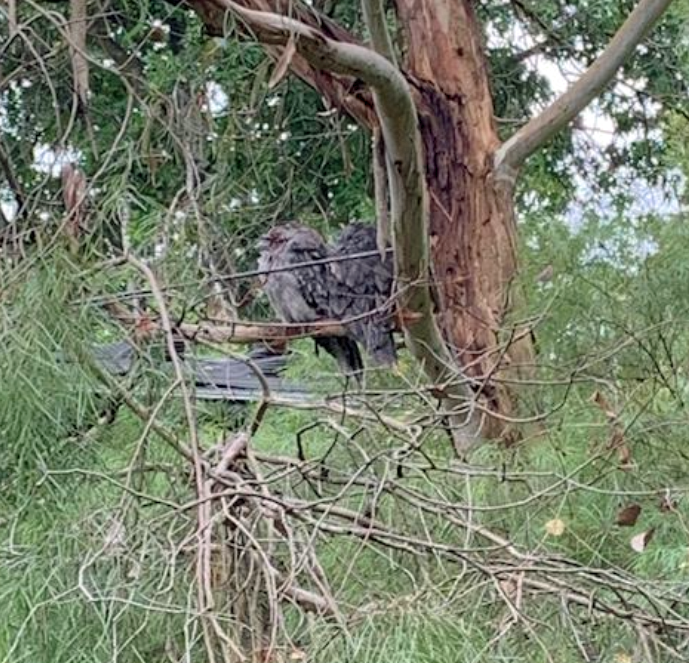
Here’s a shot from Michael, who lives in the nearby corridor, showing two Tawny Frogmouths nesting in a tree at his place – quite low to the ground:
Whitehorse Civic Awards
Among the deserving winners of this year’s Whitehorse Civic Awards, we noticed:
- Citizen of the Year is Emi Luppino – Vice President of Greenlink nursery as well as being involved with other community groups within Whitehorse.
- A Community Achievement Award went to David Berry who has played a vital role in many community groups in Whitehorse since the 1980s including the Blackburn & District Tree Preservation Society, the Wurundjeri Walk Advisory Committee and CROWAG.
We are very pleased that such worthy people who have contributed so strongly to our parks and the environment have been honoured. Our congratulations to them both.
Weed of the month
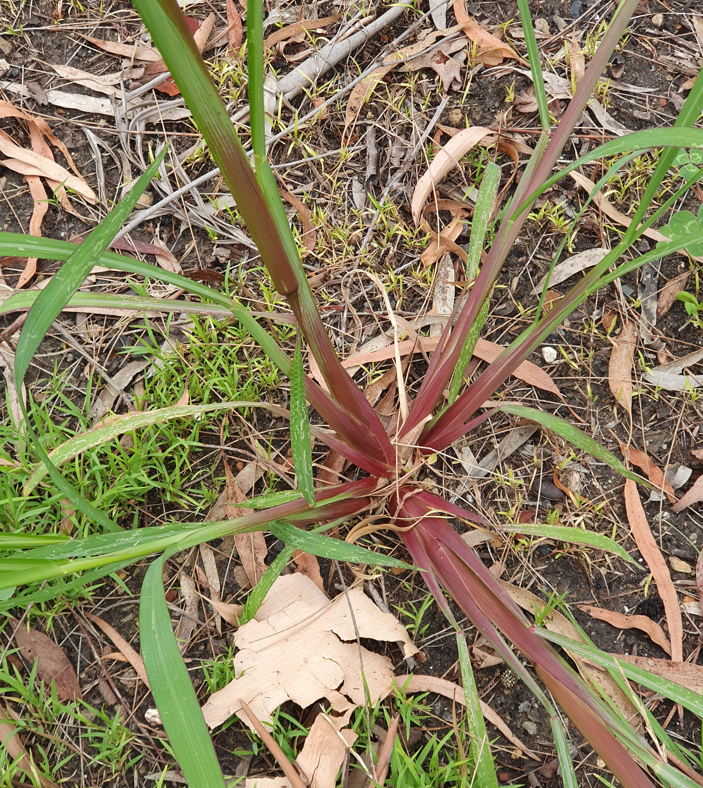
Weed of the month is Barnyard Grass (Echinochloa sp) – it is a tall fast-growing grass that looks a bit like bamboo at first glance. Barnyard grass is an annual native to tropical Asia that can grow to more than a metre high.
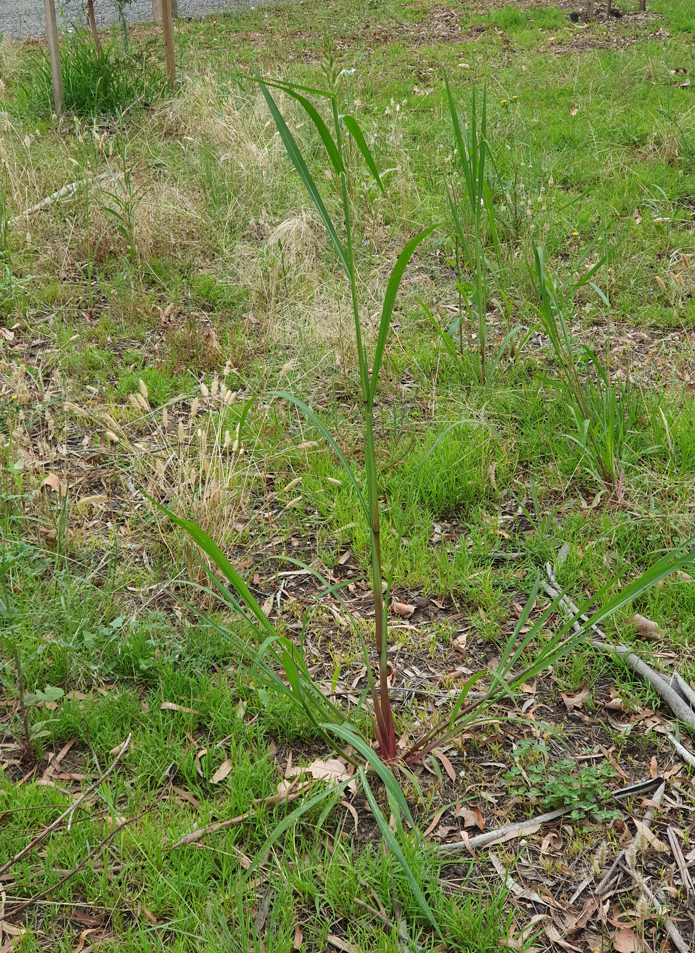
It’s not been seen in the Creeklands in recent times but has come up at the former Guide Hall site planted up by Council. The weed probably arrived with the top-up soil needed there or, possibly, on equipment used to prepare the site or for the demolition prior to that.
Otherwise the plantings there are going well – a mixture of canopy trees and the indigenous grass Microlaena stipoides – common name Weeping Grass.
 Blackburn Creeklands
Pingback: Park News – March, 2023 | The Blackburn Creeklands