Sorry! – Our apologies for the lateness of this edition – there was no power at our Editorial Office all day on Monday (2/9) due to the storm overnight beforehand. The weather has been strange in August – starting from very low temperatures requiring a later start work time, to unseasonally warm days, to windy weather due to cold fronts – often without that much cold!
Recent storms have caused damage too – but luckily there was a lull in the winds on Sunday for our Wattle Day working bee – but more on both of those points in next month’s newsletter – because that’s really September news!
Events coming up:
- Blackburn Creeklands Bird Walk: Saturday, 19th October 07:30
- Wurundjeri Walk working bee Sunday,15th September 10 am to 12 pm
- Gardiners Reserve – from our KooyongKoot Alliance allies – the Urban Guerillas:
- 8 September 10 am – 12 Noon 2nd Planting
- 15 September 10 am 12 Noon. 3rd Planting

Following our somewhat fearful SOS in our last issue, we were so pleased by the amount of support we received from the community. Thank you, thank you , thank you!
We have filled our crucial Treasurer Role – Mark answered the call! He is a former Committee member who had to retire from Committee a while back due to work and travel pressures. He is a fantastic reacquisition – having a passion for addressing the litter and pollution problems in the creek as well as a tolerance for the accounting stuff – he being an experienced business administrator!
We are also expanding our Committee – we were so pleased to have Jenna, Greg and Delldint express interest in joining us to help protect and enhance our environment. Ruby, Clare, Emma & Corey are also happy to continue contributing and are thinking about other ways they might assist. All of our wonderful new folks offer a variety of knowledge, skills, experience – not to mention passion – that will help us meet our challenges.
Certainly the extra hands-on-deck will enable us to do much more. First cab-off-the-rank is to research running events such as Possum Prowls for the community. We are also running a significant analysis of seating within the park. We are using professional, external help from an old friend for this work as well as several of our Committee people in various roles.
Seats
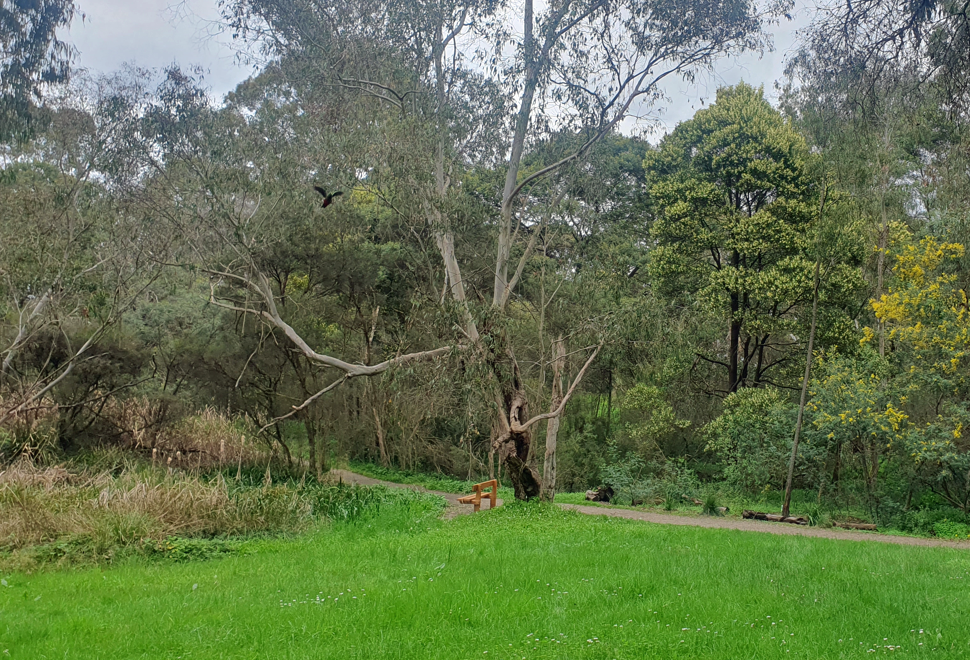
Linear parks (eg parks following a creek like ours) tend to be very good for walking by all – and inclusive seating is a required enabler. We’ve commenced work on a project to review the adequacy of our current seating – factors such as seat location, siting, distance from other seats, seat height, whether they are on a safe, level surface, predictability, proximity to entrances and so forth.
Although the Creeklands have been widely regarded as safe for walking for more than 40 years, residents who have mobility restrictions (such as the elderly) are especially vulnerable. There is a well-researched standard called the “6 minute test” which specifies that seating should be placed in close proximity to paths at no greater distances apart than what can be comfortably managed in 6 minutes by people with mobility issues.
So far, we’ve mapped the actual seat locations across the Blackburn Creeklands. The next step is to test them for conformance with the “6 minute test” benchmark.
Our conclusions will be reported back to Council’s parks management when complete. Watch this space for further updates.
Whitehorse Open Space Strategy
Our new Committee members and friends were immediately confronted by new challenges in dealing with the draft Whitehorse Open Space Strategy from Council. This strategy sets the direction for management of all public open space in the municipality including bushland parks like ours until 2036.
The ability to comment closed on 30/8 – we hope those interested were able to submit their views through the survey or other responses by then. Actually, Council will accept hard-copy survey responses over this week (until 4/9) if you’ve otherwise missed the boat so far.
How are the Creeklands affected ?
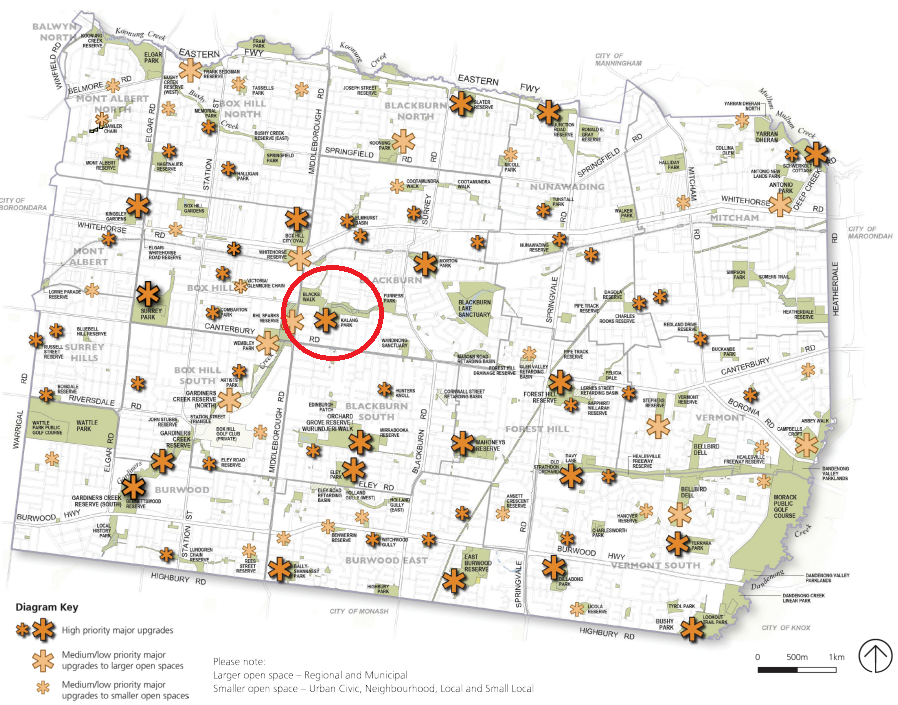
As you can see, the strategy proposes quite a few open space enhancement projects over time – which of course would be subject to the usual budget constraints and priorities – assuming the strategy is accepted by Council later this year. The project circled relates to a High Priority Major Upgrade to Kalang Park. We were invited to a special session at Council offices for Park Advisory Committees on 29/8 and, luckily, five of our people were able to attend at short notice, ask questions and consolidate our position.
Delving into the details, we see this proposed future for the Blackburn Creeklands:
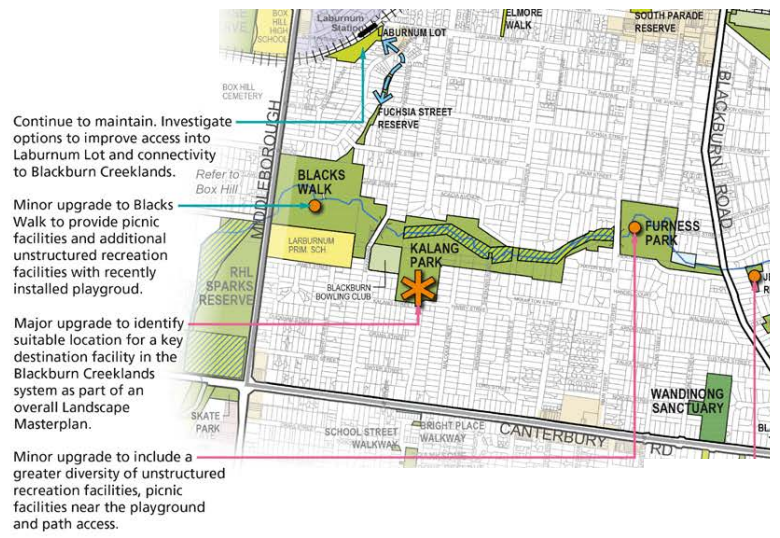
The main points in our submission are:
- Planning for the Blackburn Creeklands should always be done as a whole – not for each of the historical parks which comprise it as Council has tended to do. We strongly desire to maintain the existing, common “look and feel” across the entire park.
- Council seems to want to introduce sealed paths. We think they are generally incompatible with bushland parks. Although they are intended to make our parks more accessible, perhaps counter-intuitively, they are less safe for people with risks of falling and also tend to encourage bikes and scooters on our pedestrian paths to go faster increasing the risks and severity of collisions and personal risks to cyclists etc.
- The proposed major development of Kalang Park is a “key destination facility” (no details available at this stage). We think this is unlikely to be compatible with the nature conservation, passive recreation and linear characters of our park.
Thursday Team Report
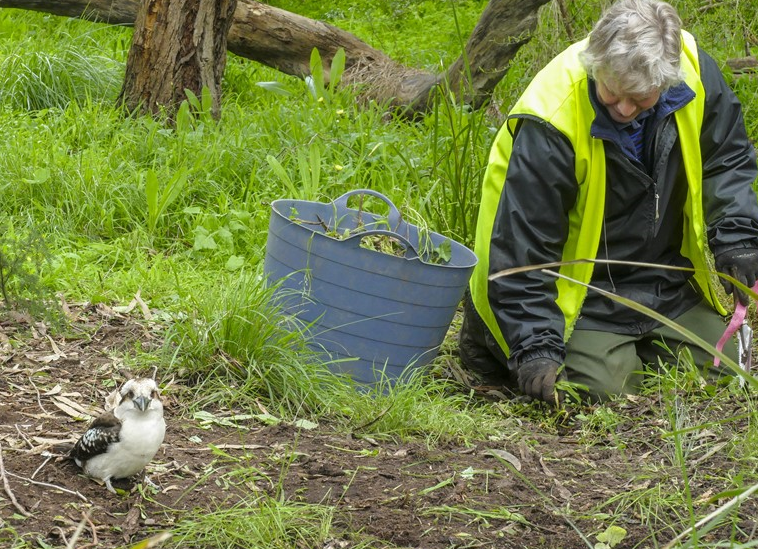
New gear
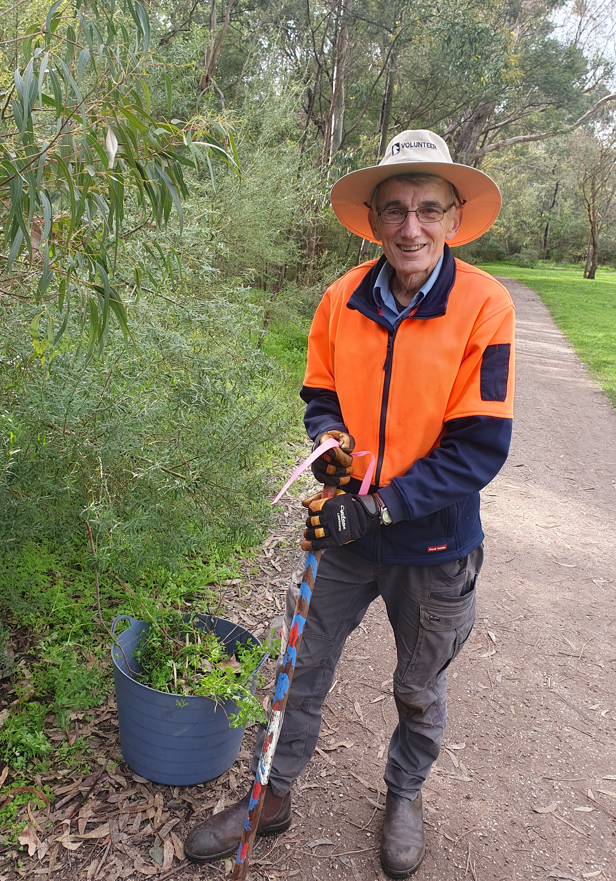
We’re very grateful to Council for topping up some of our PPE gear and supplies recently. Our photo shows Andy modelling one of the new broad-brimmed hats which neatly deliver a well-deserved halo effect to our volunteers – which is very apt in Andy’s case!
This spiffy new model (the hat – not Andy!) replaces the old “Baggy Green” that not only offered very little sun protection, but also such a very daggy 1959 beach hat look! The new hats were snapped up by our appreciative volunteers within a few seconds.
We also now have a few “fluoros” in kids’ sizes for Community Working Bees – not only for the kids’ safety, but also so they can “look the part”.
Otherwise, the Team has been working:
- in Kalang Park north of the oval along the main track (on Andy’s right)
- adjacent the Garie Street playground – mulching and weeding
- hand-weeding near the Bowls Club carpark.
We welcomed Delldint as a new participant in our Thursday events.
Storage
We’ve run out of tools/equipment storage in our cage at the Kalang Oval Pavilion necessitating barrows etc to be stored “sub-optimally” elsewhere. Local Councillor Munroe has facilitated our working with Council Officers to find a solution.
Council officers from the Leisure and Recreation Services department have been very responsive and are exploring ways to help us out. If we can consolidate our tools better, we’ll donate our “coffin” (an appropriate name for our in-the-field tool chest given its prone disposition) to our Yarran Dheran colleagues who are looking for one at present.
Insurance for all
After lobbying for several years, Council has informed us that all of our 400 Friends are now covered for both Thursday and Community Working Bees. We don’t have all the details yet – but will follow up in next month’s edition.
Council Works
More Cricket Nets
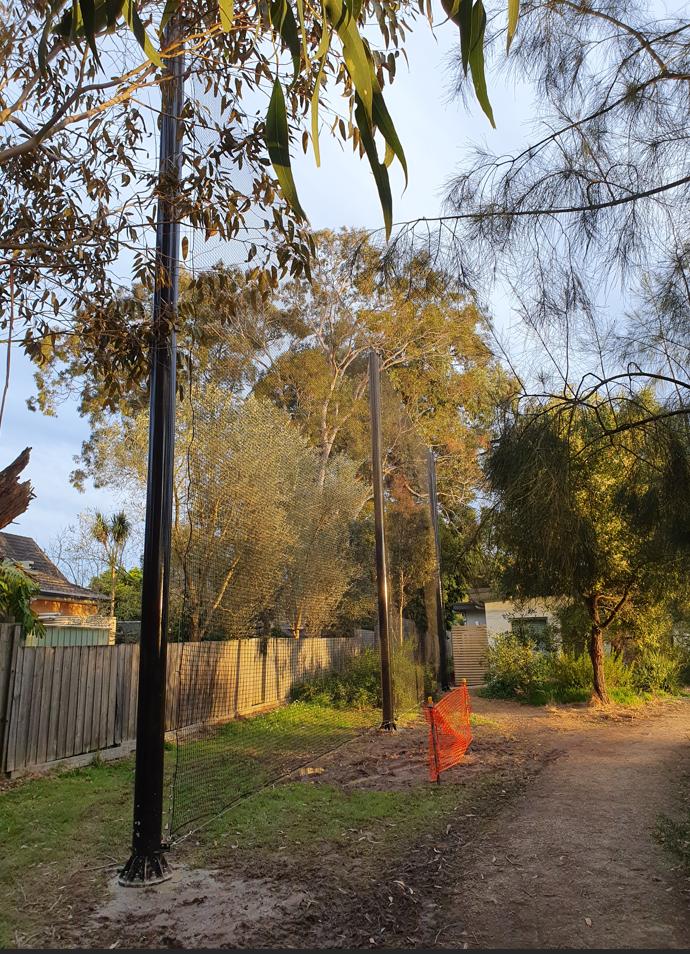
An additional cricket safety net has gone up – this time on the eastern side of Kalang Oval approximately butting up to the northern end of the Pavilion.
It is designed to protect nearby private property in Malcolm Street from errant cricket balls.
Council has promised to plant up around the net to further reduce the visual impact of the nets and perhaps stop more balls in their tracks.
Rubbish bin in Furness Park
Council has moved the rubbish bin in Furness Park to make it unnecessary for the rubbish truck to drive into the park to collect it (which has caused continuing damage to path edges near the park entrance from the zebra crossing). It has also been moved further away from the childrens’ play area making its unwelcome and malodorous contributions to the general ambience (aka stink) on warmer days less impactful. A bin win!
SRLA Offset Plantings – another win for the Creeklands
The Suburban Rail Loop project has resulted in the removal of a lot of trees within the municipality – especially around the proposed stations. To compensate, the authority must fund offset tree plantings.
As a result, Council will conduct a tree planting program in the Blackburn Creeklands. Sixty-five canopy trees are expected to be planted throughout the park as part of that program.
Bird boxes in the park
Council is intending to remove illegally placed bird boxes in the park. While well-intentioned, they are often occupied by unwanted occupants such as feral European honey bees. We are fortunate in the Creeklands having a large number of mature trees in the park which form natural hollows – so don’t really need artificial ones. Sometimes they are badly mounted too (eg using nails or taut wire) such that there is damage to their host trees.
Damage in Furness from sewerage main maintenance
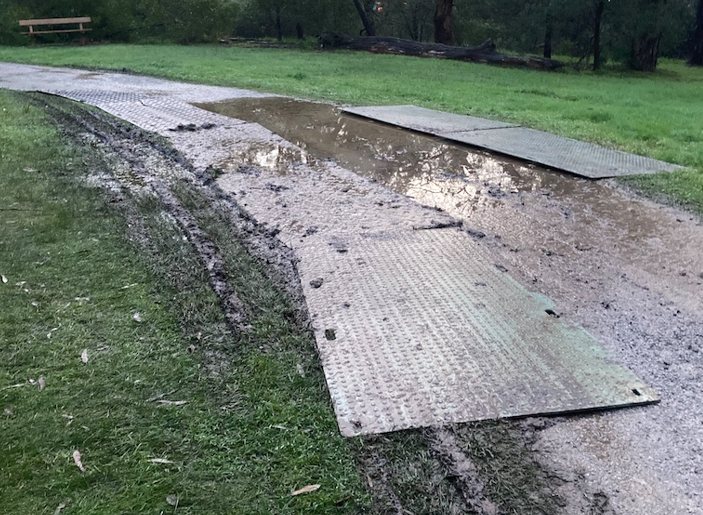
There has been access damage to Furness Park caused by Yarra Valley Water trucks accessing the main sewer under the park (wheel ruts etc despite protective gear being used). YVW has been conducting essential maintenance relining the main sewer – but work has not been completed due a machine breakdown.
Council will assess the damage and remediation needed after the works have been completed.
Spring Bird Walk
One for diaries – our extraordinary group leaders, Ian Moodie and Pat Bingham, will be available for our next Spring bird walk on Saturday, 19th October.
See you there!
Were there Bellbirds in our Park ?
In our April 2024 edition, we talked about the “Bellbird Area” and the Bellbirds (also known as Bell Miners) – prompted by a photo-study of a female King-parrot and a “bell” found in Blacks Walk. We wondered where the colonies were and what role our park played in their habitat. As research for the article, we talked to some long-time residents and birdos testing their memories as to where the birds were and when they “disappeared”.
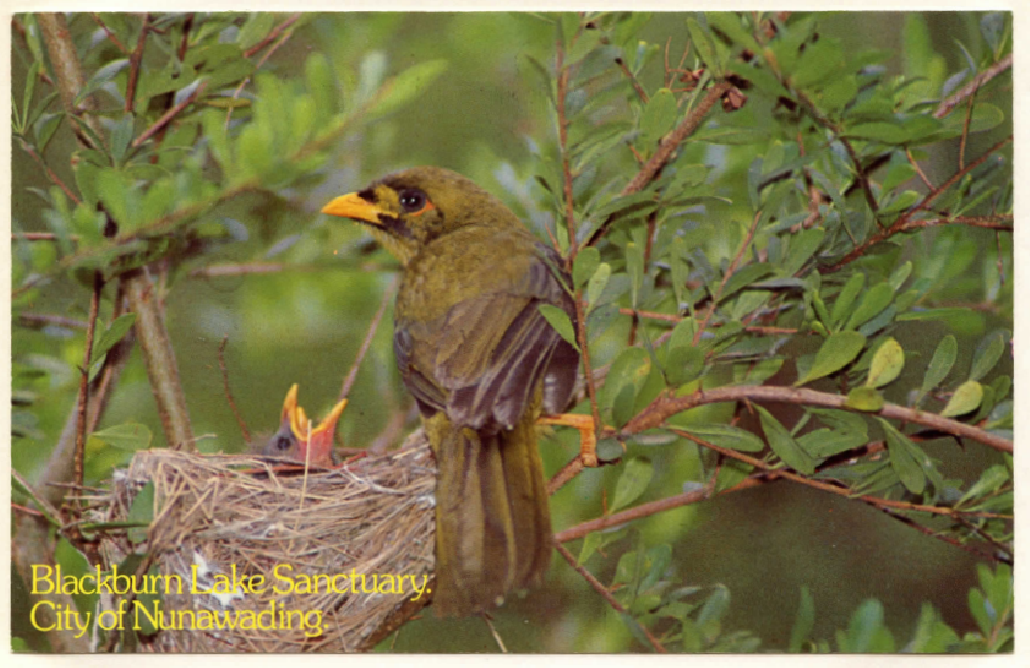
Former long-time resident, Tony Kjar, referred us to a definitive study by a budding young scientist, Martin Short, who was a Year 10 student at the time. Martin* conducted a thorough study of the bellbird colonies in the then City of Nunawading in 1991-2. His work won a prestigious national Earthworm Environmental Award in 1992.
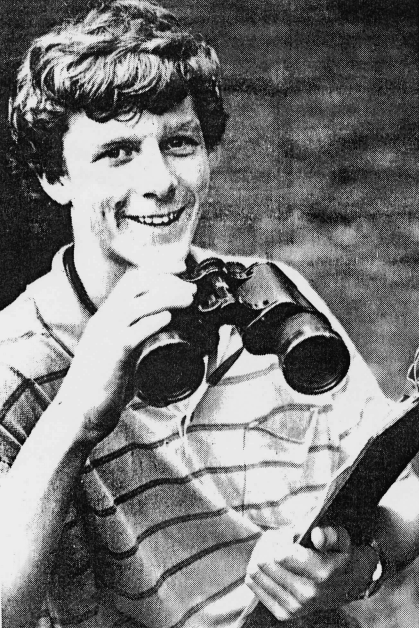
His work built on prior studies by others in 1971–1974 and 1981. Martin was interested in whether the number of Bell Miner (aka Bellbird) colonies had declined and wanted to better understand the reasons for their movement around the municipality.
His findings were that:
- The total number of colonies in the municipality had only dropped from 21 to 18 in the twenty years since the 1971 study – perhaps (temporarily) allaying fears about the population decline.
- Bell Miners can survive remarkably well in a suburban environment provided they have:
- Dense understorey vegetation.
- Original, mature Eucalypts carrying lerps [for food].
- No competition from Noisy Miners.
- Caring residents supplying water.
*Although Martin (now Dr Martin Short) is raising his own family elsewhere in Melbourne, he remains one of our “friends” and is still keen to keep tabs on what is happening in Blackburn. He has generously granted us permission to use his report for this article and to save it in our Archives for posterity.
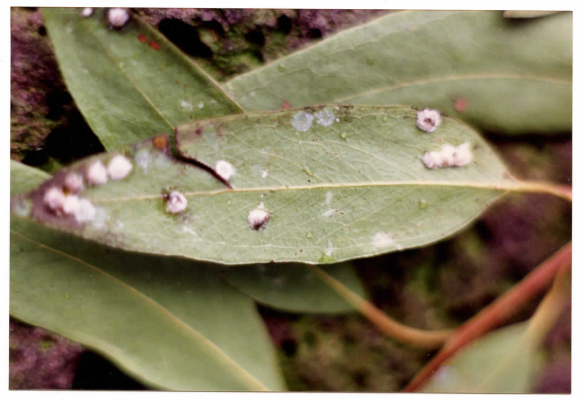
What’s a Lerp ?
A lerp is a protective hard cover of crystallized honeydew (like a hard hat) produced by the larvae of psyllid bugs – plant-feeding insects related to aphids that are commonly known as lerp insects – there are over 300 species in Australia.
Lerps are energy rich, consisting mostly of starch, with some proteins and fats. They are eaten by flying foxes, possums and birds such as pardalotes and honeyeaters.
Noisy Miners (Manorina melanocephala) vs Bell Miners (Manorina melanophrys)
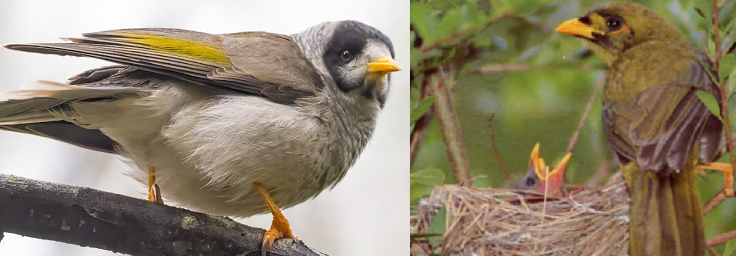
Both species belong to the genus Manorina (Miners – one type of Honeyeater) – the second parts of their scientific names (melanocephala and melanophrys) translate to “black head” and “black eyebrow” respectively.
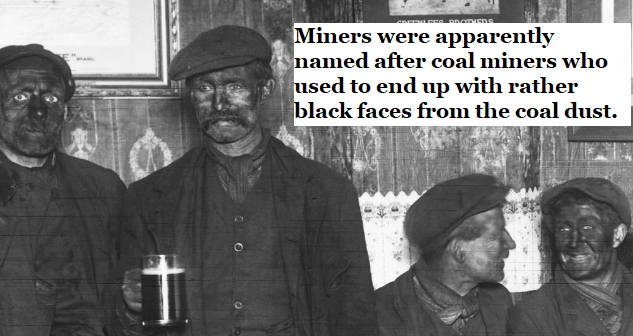
Both species have complex social and colonial behaviours and will “gang up” to chase off predators like Pied Currawongs. Also, both tend to exclude all other small birds from their territories. Bell Miners are the better disguised being in khaki livery and surprisingly hard to see despite their persistent “dings”. As most of us are very aware, Noisy Miners are now one of the most dominant local species in the park and the surrounding area.
One key difference is their preferred habitat – Noisy Miners prefer open woodland whereas Bell Miners prefer woodland with dense understorey. Noisy Miners have a size/weight advantage – they are 40% larger and twice the weight of their Bell cousins.
So – where were the bellbirds ?
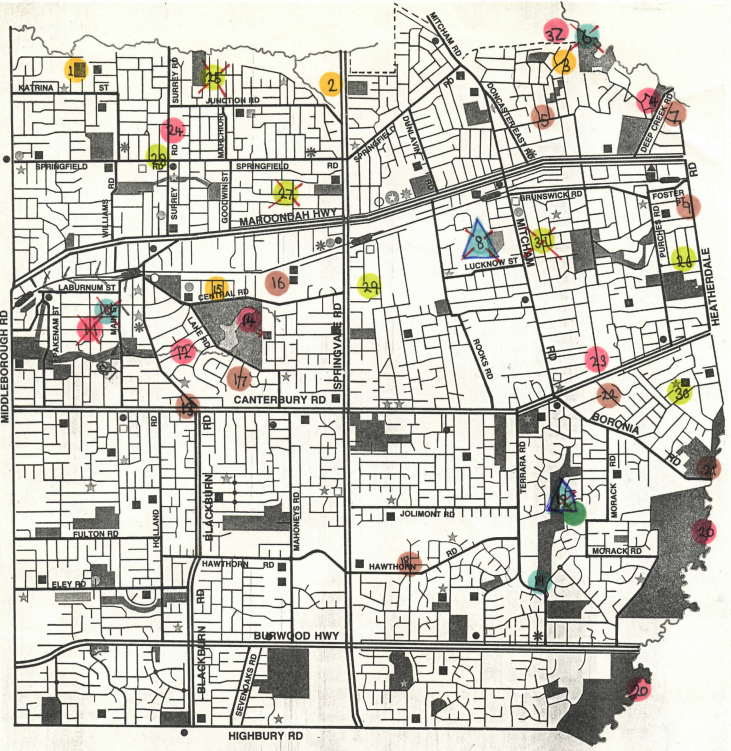

The answer is surprising to relative newcomers to the area like this author – there were colonies throughout the former City of Nunawading – excluding Blackburn South and the western side of Forest Hill – but including one colony of the eastern side of Forest Hill, several in Vermont and Vermont South, Nunawading, Mitcham and Blackburn North – as well as central Blackburn as expected.
Interestingly too, there were (disappointingly) no colonies in our park despite our canopy trees hosting lerps and it having the presence of water – however, there was a colony within the Blackburn Lake Sanctuary (#14). Does the species prefer a suburban setting ? If so, why ? It is known that the species prefers dense understorey (common in gardens) – something we’ve been trying to build up in our park over the past 20 years.
Martin’s study seems to have been motivated by the perception that the Bellbird colonies were in decline due to loss of habitat following increasing urbanisation in the area. Regarding the red X in the legend above, Martin must have remained interested in his study – because he updated his map in 1996 which showed that a further 8 of the 1991 colonies had vanished.
The Blackburn Bellbird Area
Advertisements from the time refer to Blackburn Bellbird Area being in the central National Trust / now SLO1 areas including central Blackburn and the area around Jeffery Street following our creek to Blackburn Lake:
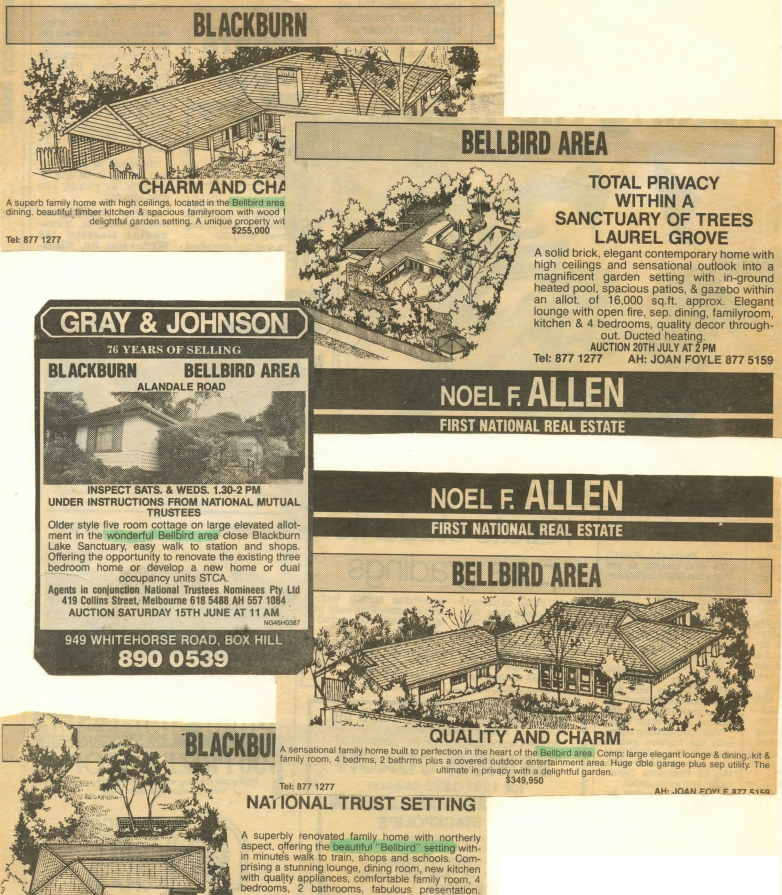
Oddly enough, the two well known colonies in central Blackburn (#10 and #11 on the map) had gone by 1996 when Martin revisited them. Only colony 12, centred on Jeffery Street, remained in the original “Blackburn Bellbird Area”.
So – why did the Bell Miners move on ?
Let’s review the possibilities:
- Dry conditions leading up to the Millenium Drought started around 1996. Although climate changes could have been a factor, it seems Martin was already onto the start of the decline around 1991. Certainly, his revisiting of the colonies in 1996 indicates that a major decline was underway by then. So, we can confidently rule drought out!
- The third stage of the Eastern Freeway, which extended 7km from Doncaster Road to Springvale Road following Koonung Creek shown at the top left of the map, opened in December, 1997 after completion of the second stage in 1982. It’s certainly possible that the freeway construction and its eventual operation made the northern parts of the municipality less palatable to the species.
- The aforementioned former resident, Tony, lived at the epicentre of colony 11. Tony’s recollection is that the birds “disappeared” in 1993. Unprompted, he added that the influx of Noisy Miners occurred in the same period. However, it’s hard to know whether the Noisy Miners pushed them out or filled the gap left after they’d gone – one suspects the former though their preferences for different habitat suggest the latter.
- Martin noticed the presence of domestic cats at some sites which are fearsome predators. Whitehorse Council introduced a cat curfew in October, 2010 (15 years later) which meant that all cats must be confined at home between 8:00PM and 6:00AM. However, there is no compelling evidence that the cat population had a sudden impact in the late 1980s or 1990s. So, cat predation is only a possibility – certainly less likely to have been significantly worse in the more established areas like central Blackburn.
- Our area’s tree canopy has been in rapid decline since the 1990s when multi-unit development seemed to ratchet up. There is little doubt that the decline still continues despite the current tree protections. Private open space is disappearing – as multi-unit developments continue and as preferences for larger houses with less garden prevail. Sadly, tree protections do not protect mid-storey plants and we all know how destructive “moon-scaping” actually is. The reality is that there have been significant losses in both tree canopy and mid-storey vegetation bordering on the catastrophic since the 1990s.
There is an interesting theory that Bell Miners “farm” the lerp making psyllids. They may selectively eat only older nymphs OR may often eat the lerps (shields) and leave the nymph unharmed. Although, evidence for this theory is mixed, a behavioral comparison between Bell and Noisy Miners observed that Bell Miners carefully used their tongues* to remove lerps leaving the nymph intact. In contrast, Noisy Miners pried both the lerp and nymph off with their beaks to consume both. This might explain how Bell Miners’ colonies can persist in one place for so long without running out of food. Could it be that, as Noisy Miners began to enter an area, they not only ate the food of their cousins but also disturbed their sustainable farming techniques – figuratively, not only eating the ripe apples but chopping down the trees ? Bell Miners have been implicated in Eucalypt dieback. Counter-intuitively, it may have been good for our trees not to be hosting Bell Miners!
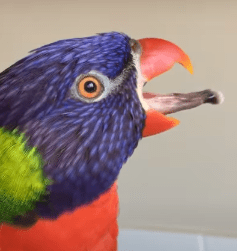
*What – birds have tongues ?
Yes, they all do, but they vary a lot between species !
This Month’s Sightings
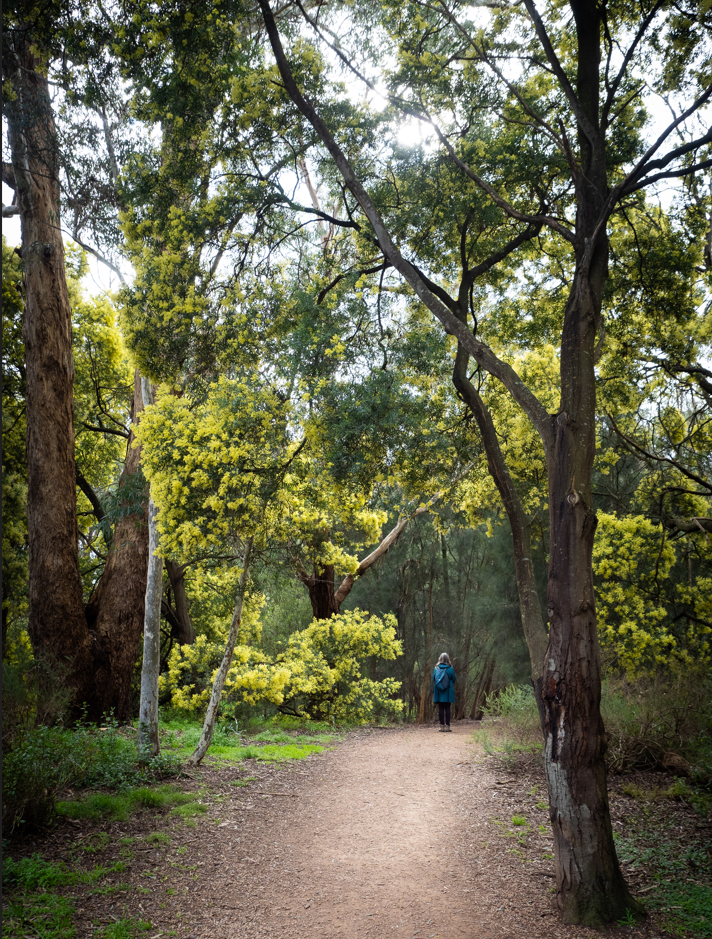
Our wattles are simply stunning at the moment:
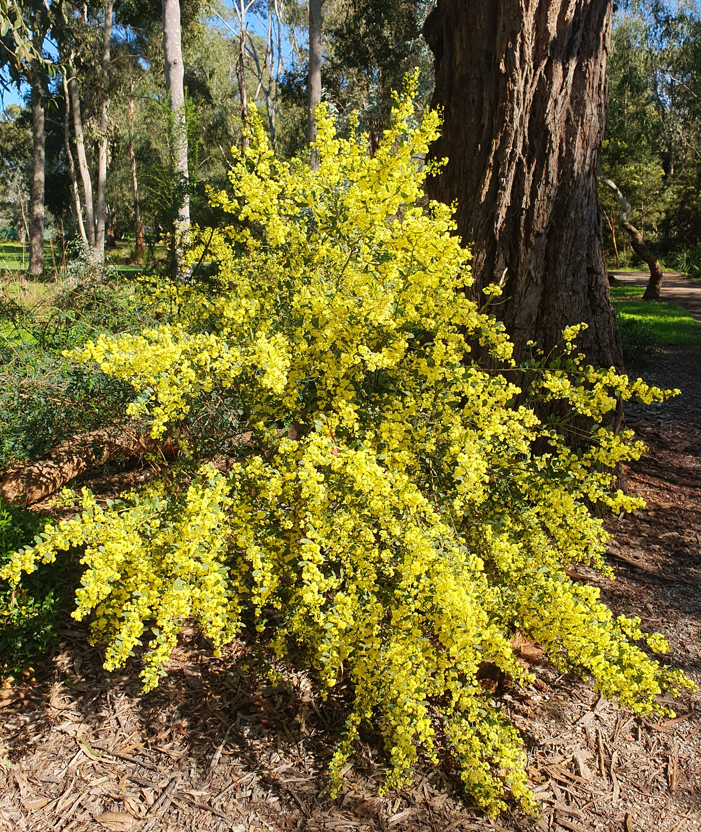
Even the shrubs are doing their level best to cheer us up:
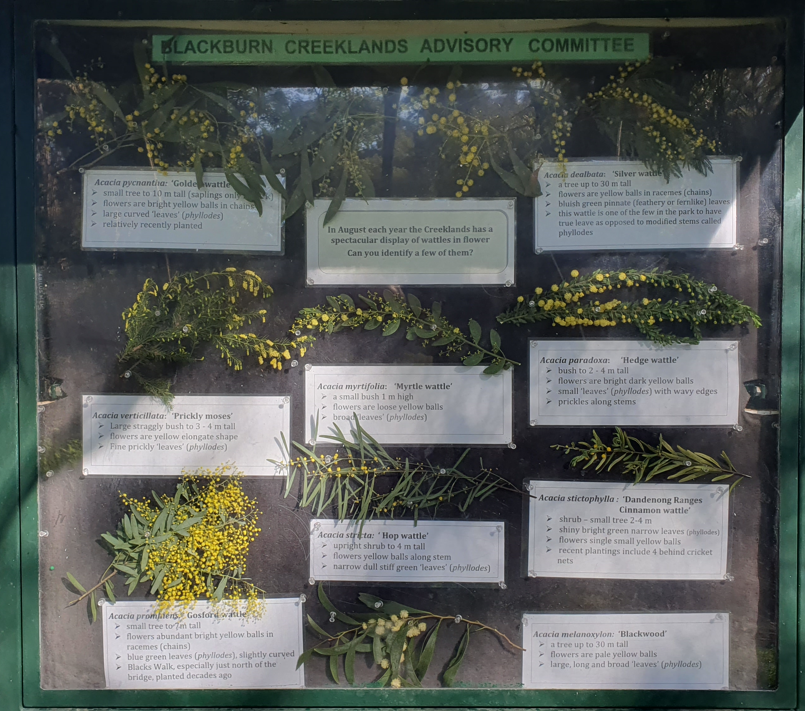
If you would like to know more about our wattles, or the ones in your garden, make a bee line to our noticeboard which covers all of the species you’ll find in the park.
Pardalotes Spotted Nesting
Normally, Spotted Pardalotes are canopy feeders – being small and high up in eucalypts feeding on Lerps (see our earlier article on the Bell Miners here), they are very hard to, well, “spot” (sorry!) – but they can be clearly heard. Things change when they nest – they like to dig tunnels in creek banks for their nests – which brings them down to ground level. Greg has discovered a pair doing just that in Furness Park:
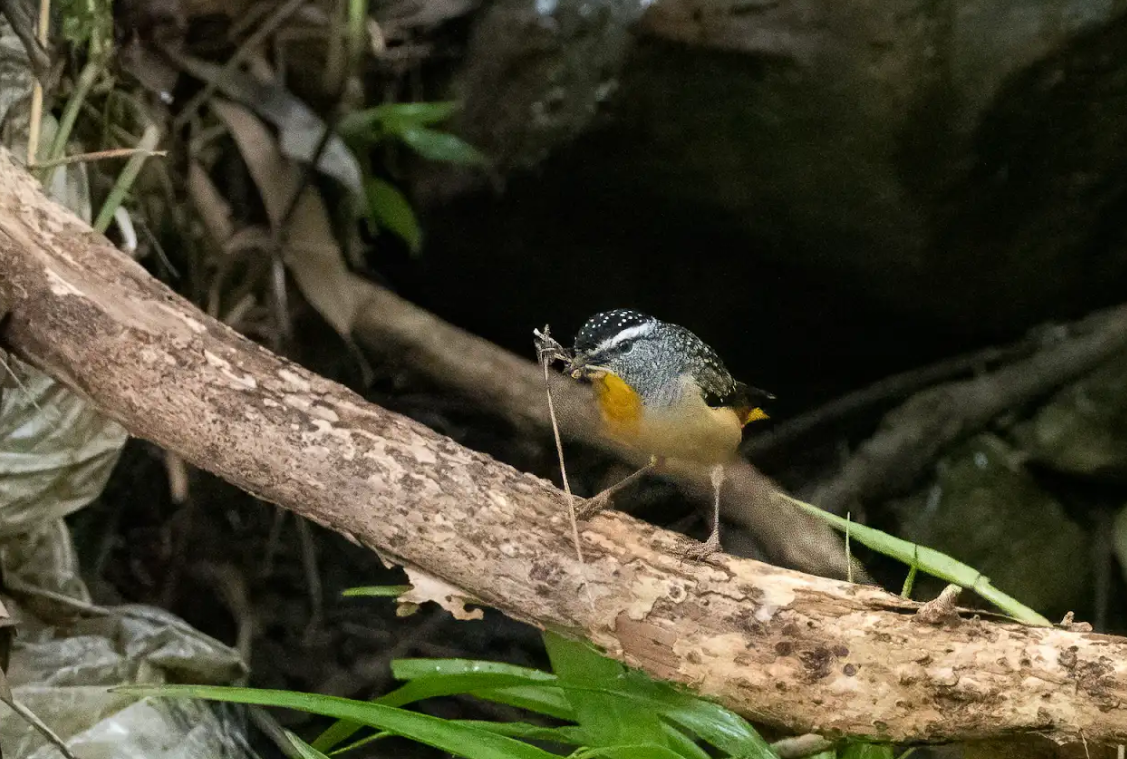
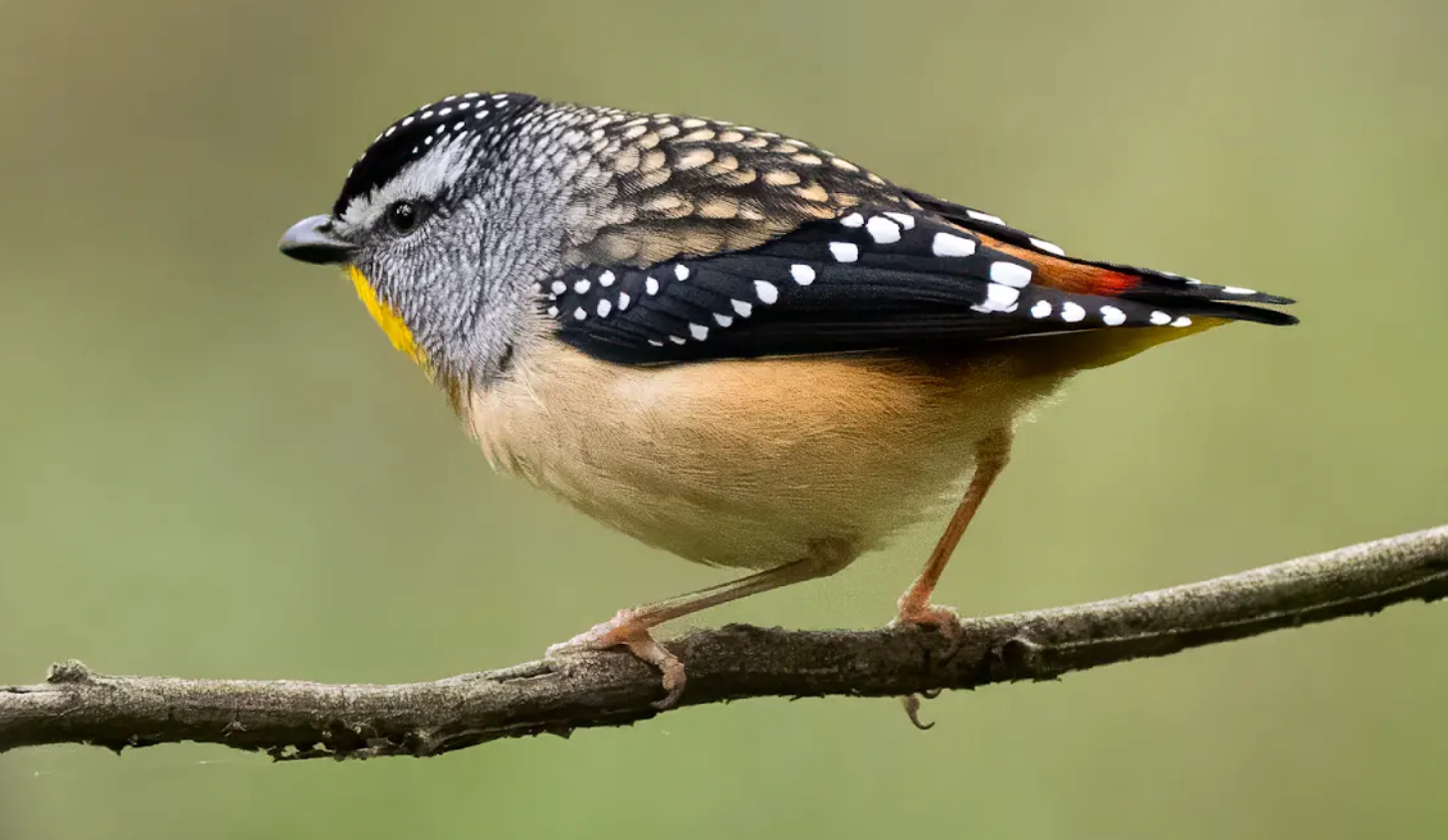
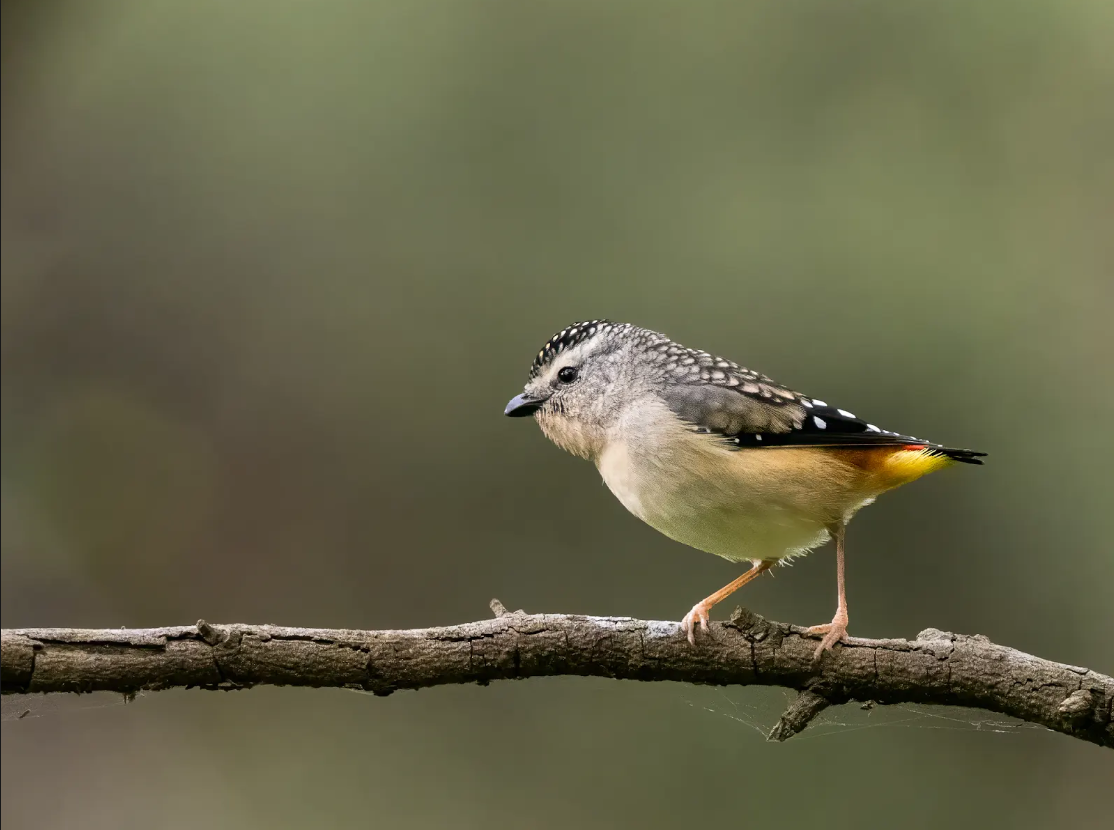
Please click on image to enlarge; click on the X to return
Males have the yellow “bib”. He’s carrying nesting material to the tunnel in the first shot. It’s great to see the species breeding in the park – numbers do seem to be down anecdotally. There is a similar, larger species on the bird list for the park – the Striated Pardalote (it has stripes rather than dots) but, sadly, none have been seen here for many years. Let’s hope we don’t lose those delightful little spotted cousins too! They play an important role in maintaining our canopy trees’ health by helping keep the Lerp psyllids in balance.
Russell took this shot of a mystery bird in Blacks Walk:
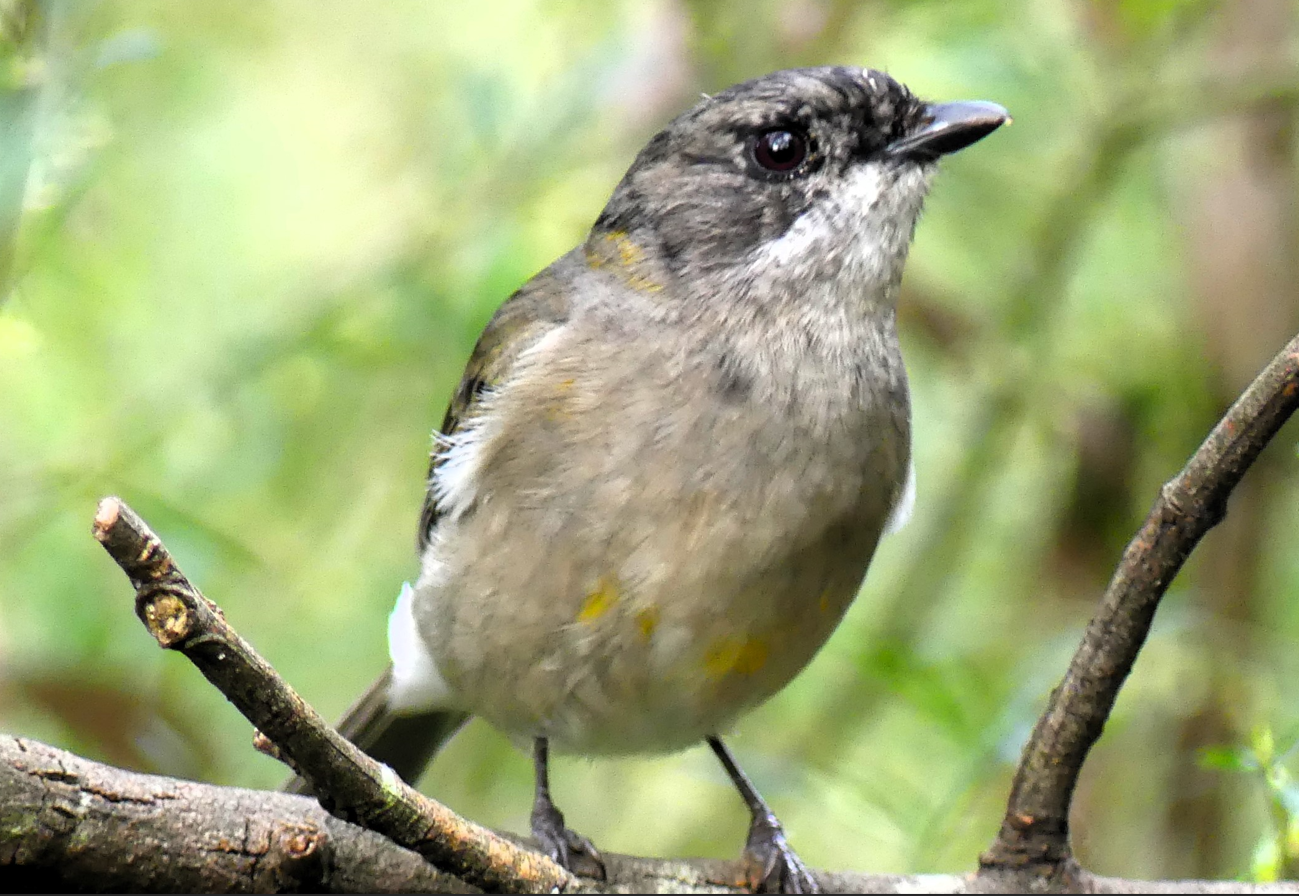
We think (hope?) he’s an immature male Golden Whistler. We’ve had females in the park in recent times – but they don’t have the brilliant gold chest. Can you see the little flecks of yellow on the bird ???? It’d be exciting to find him again in September !
Here are some other sightings from our intrepid photographers (Greg, Lisa, Russell and others) which show many of the birds and flowers you are likely to see at the moment:
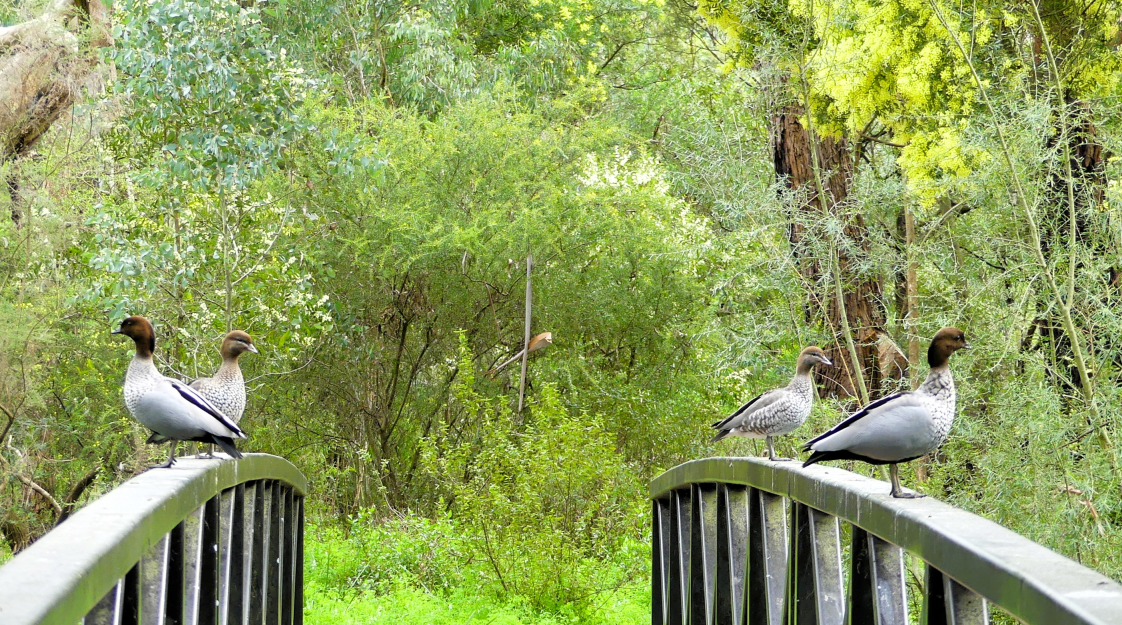
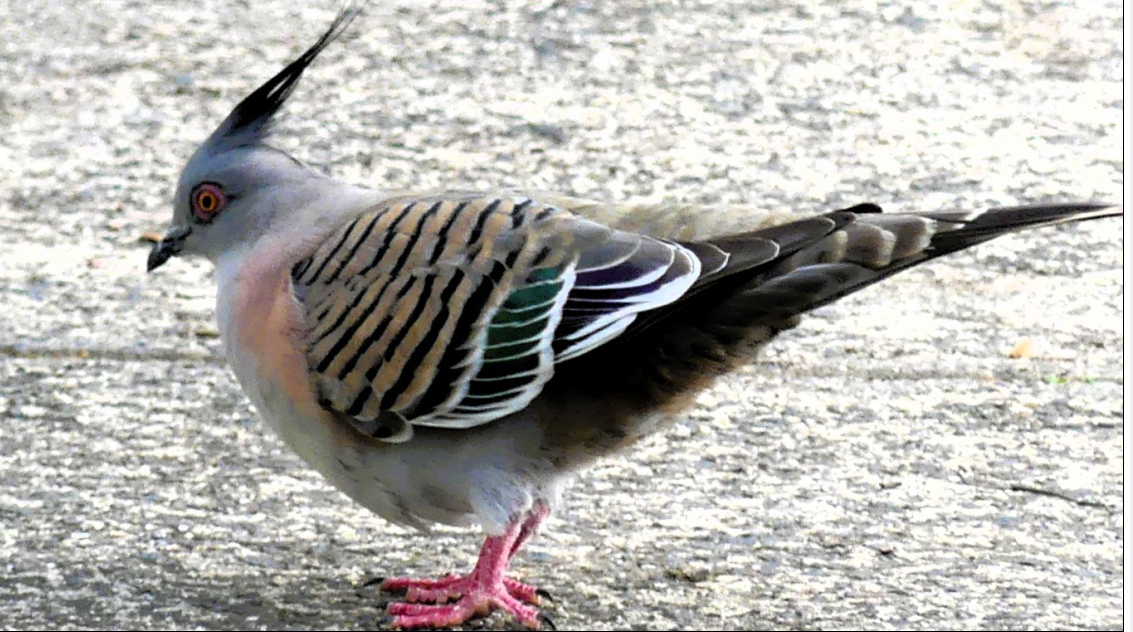
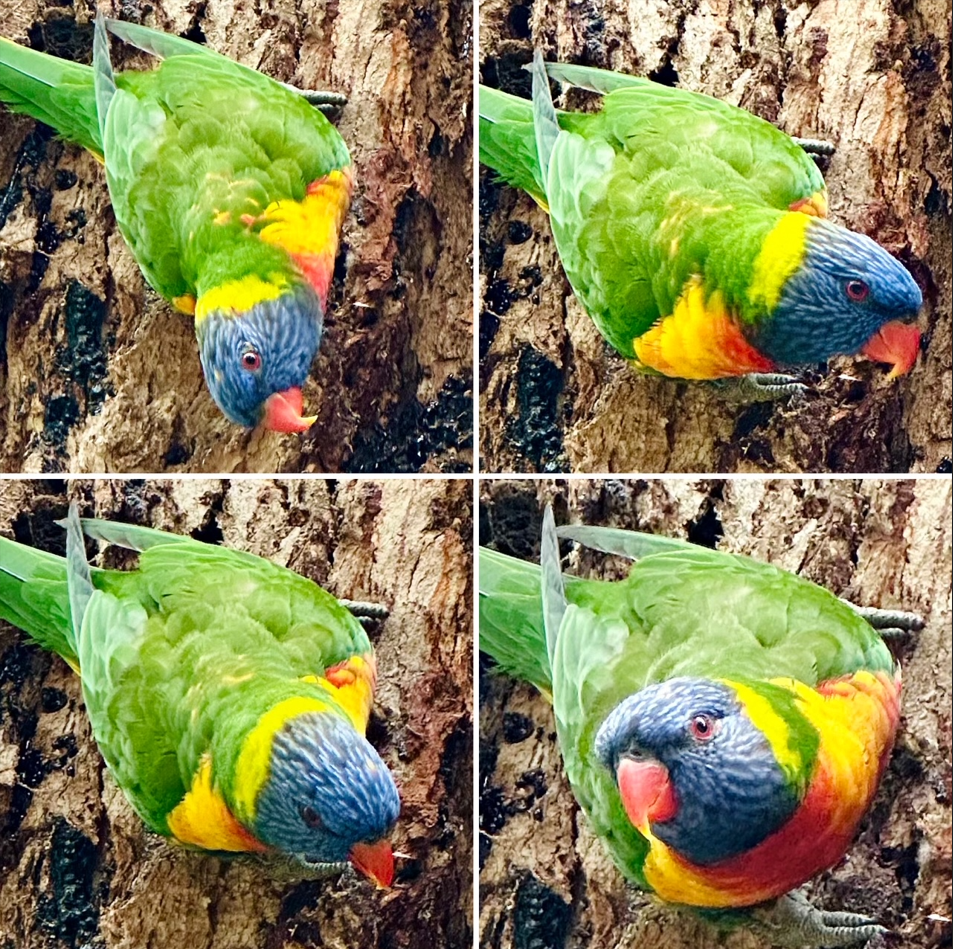
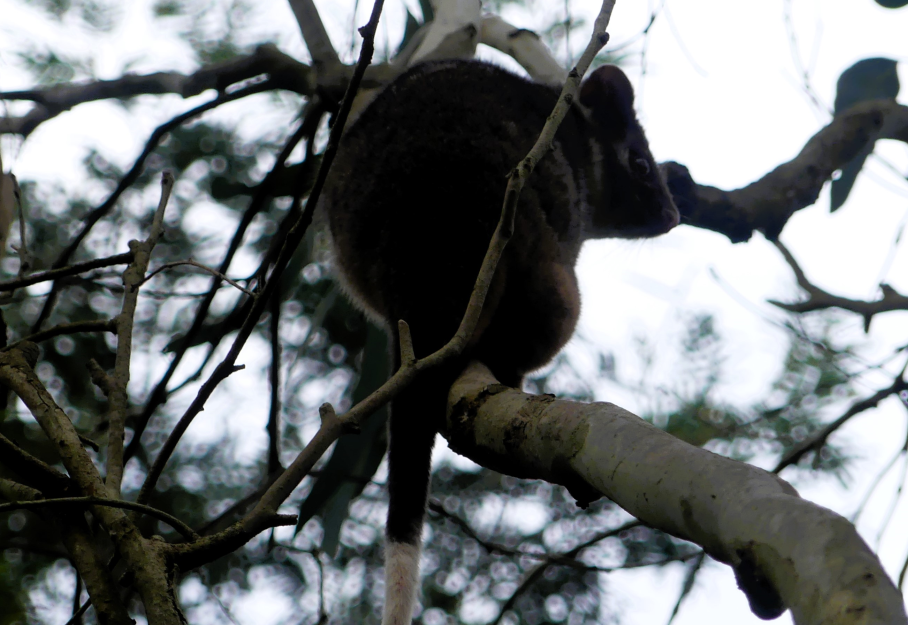
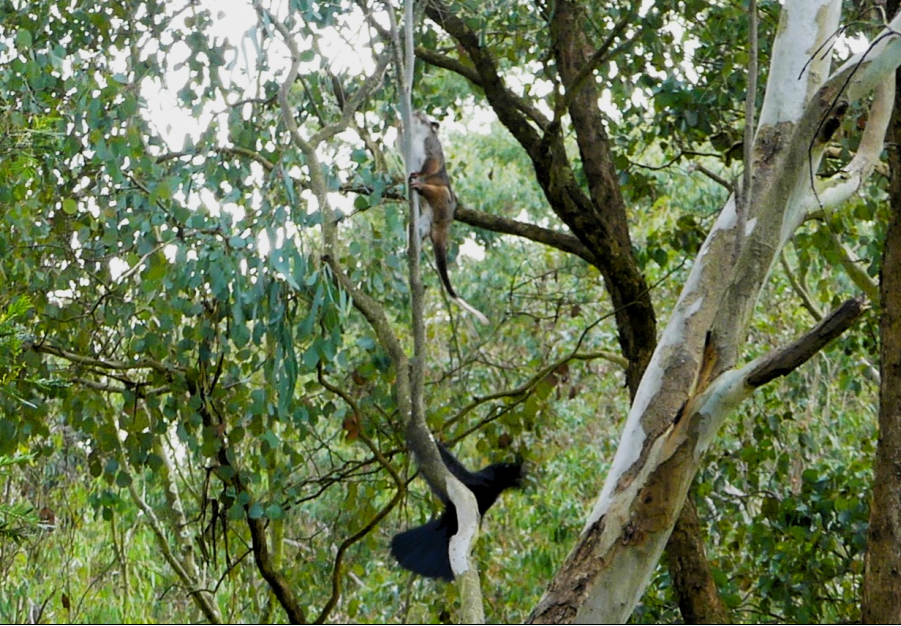
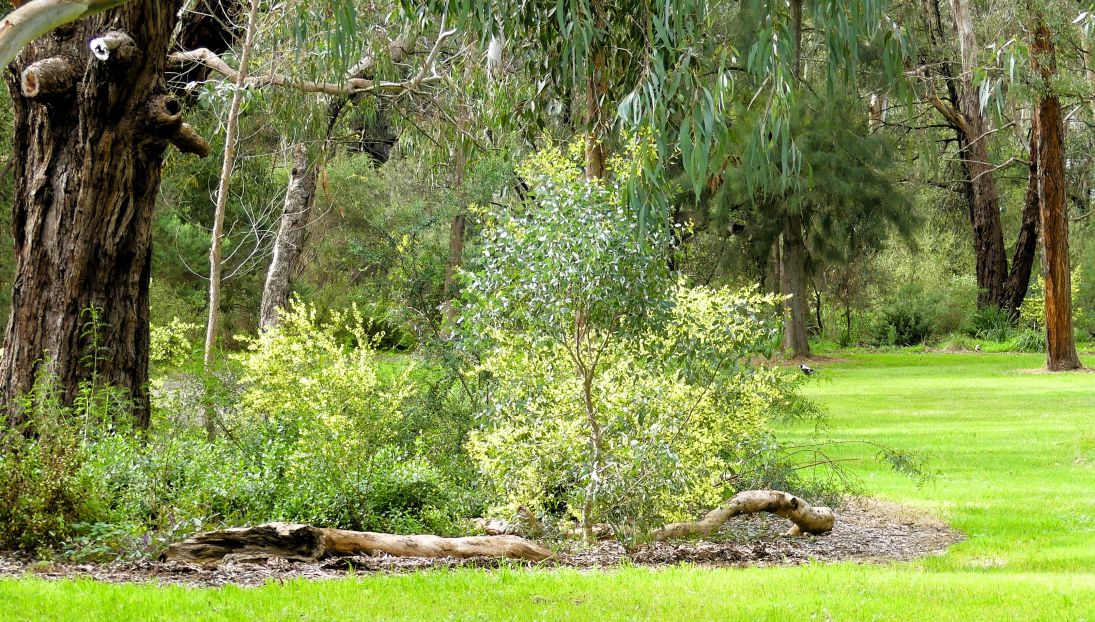
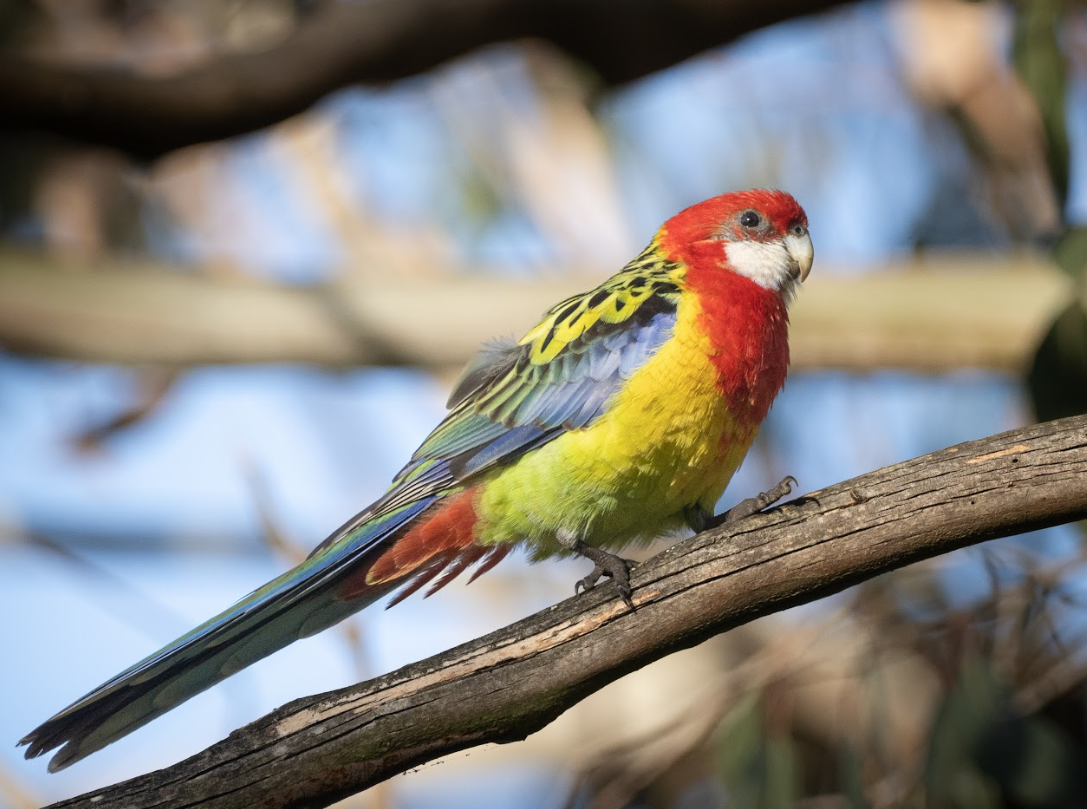
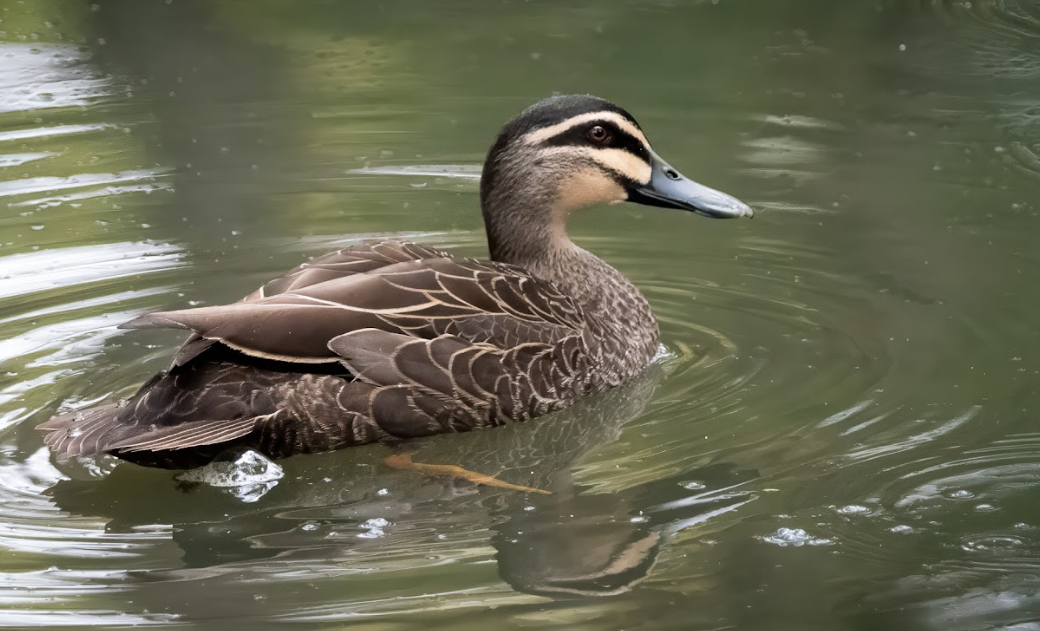
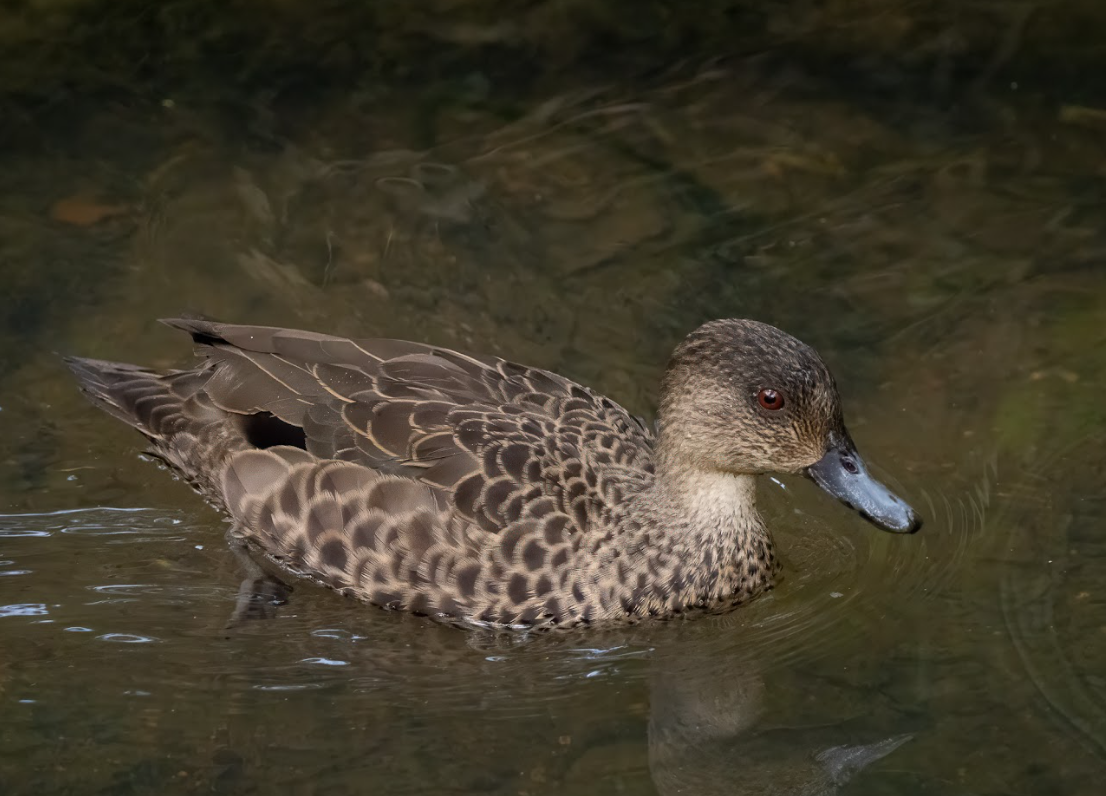
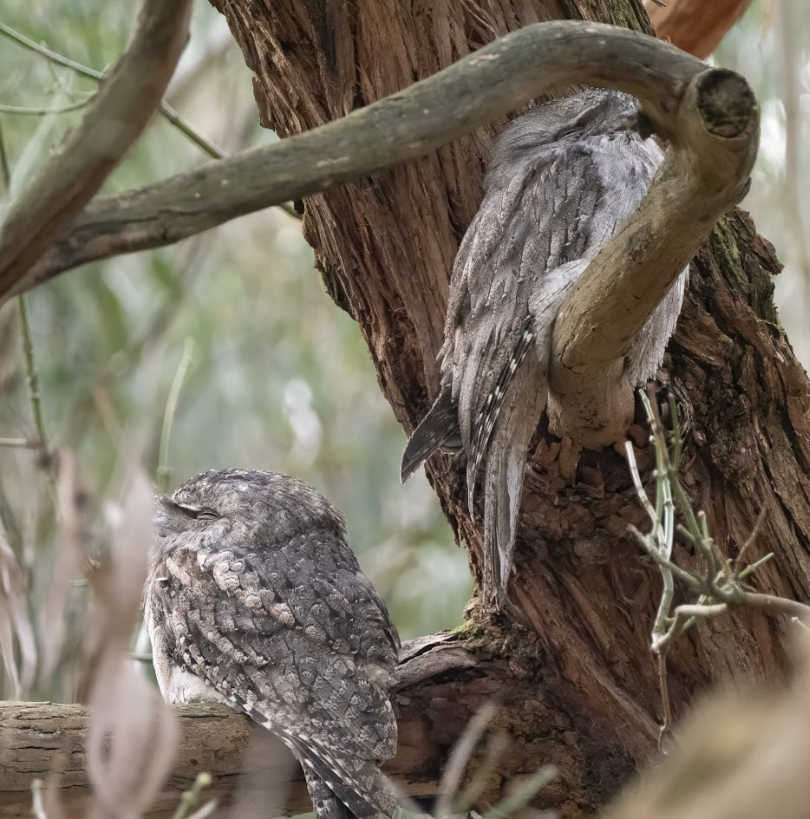
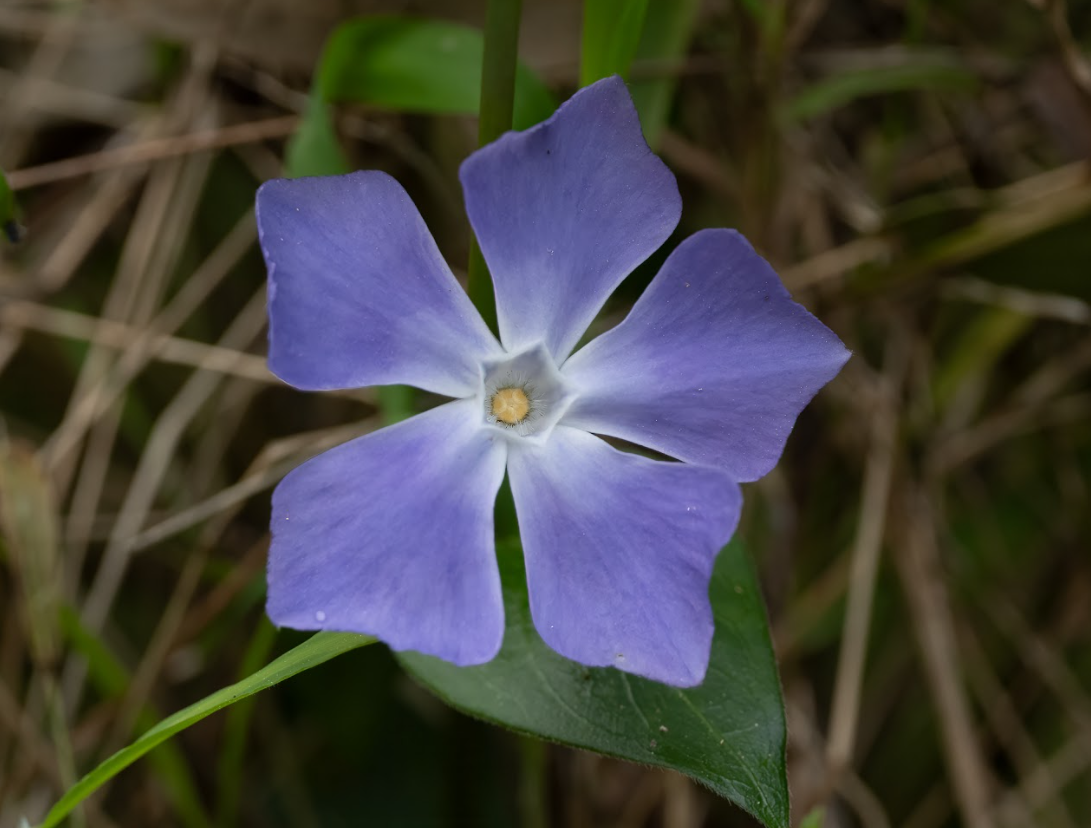
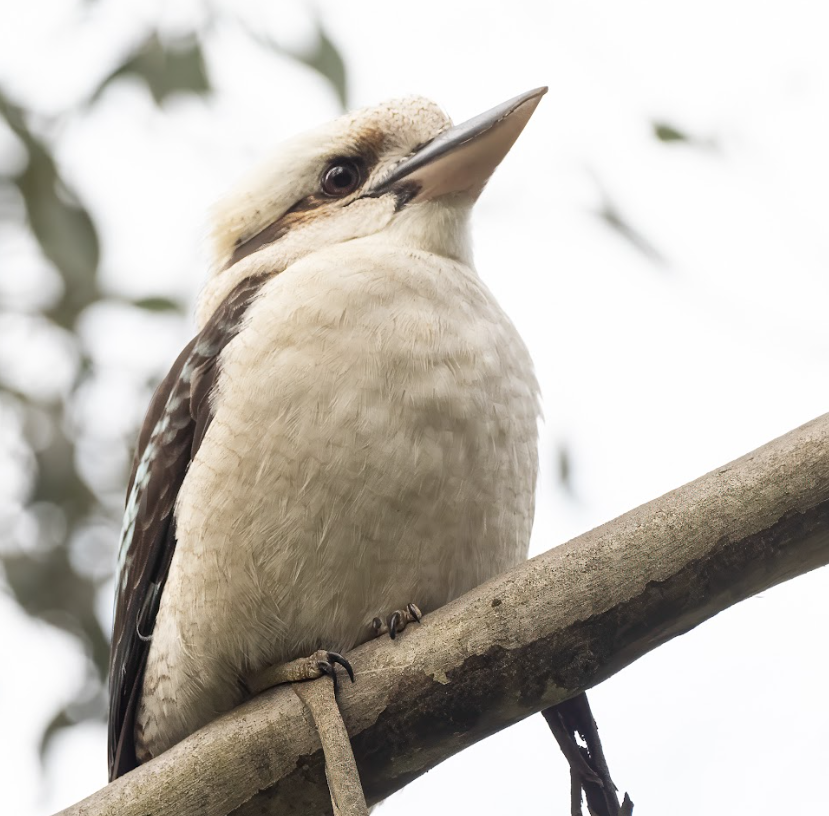
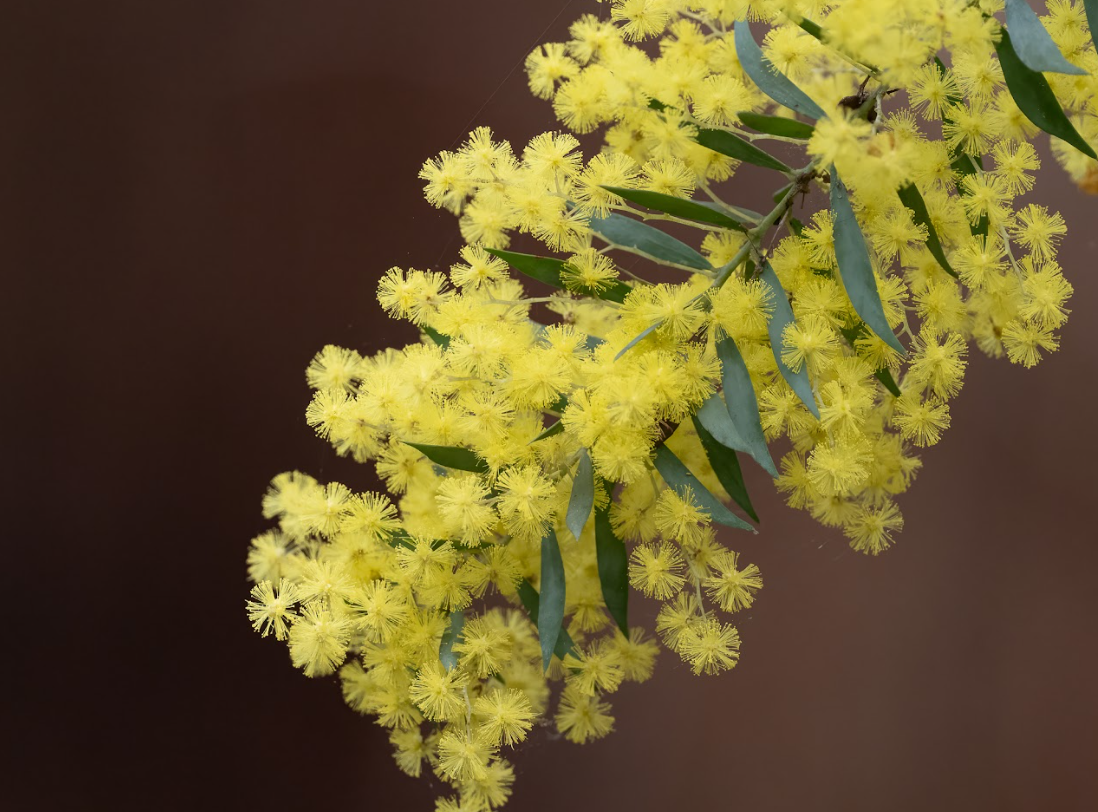
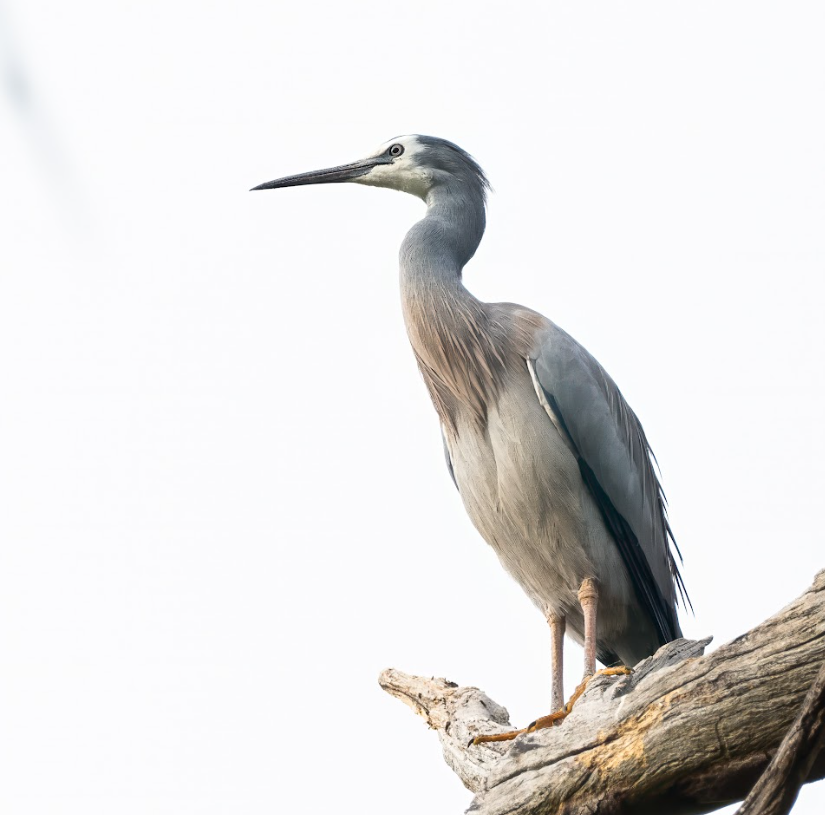
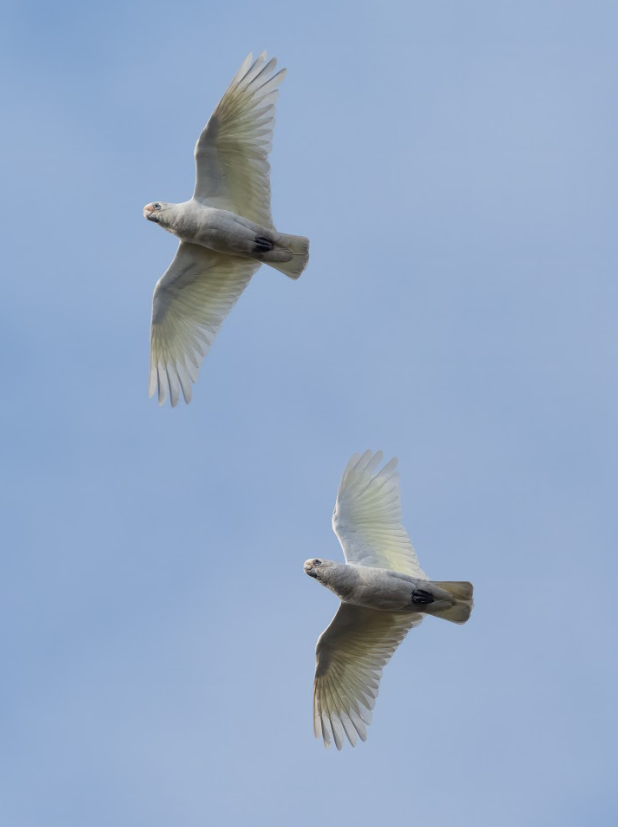
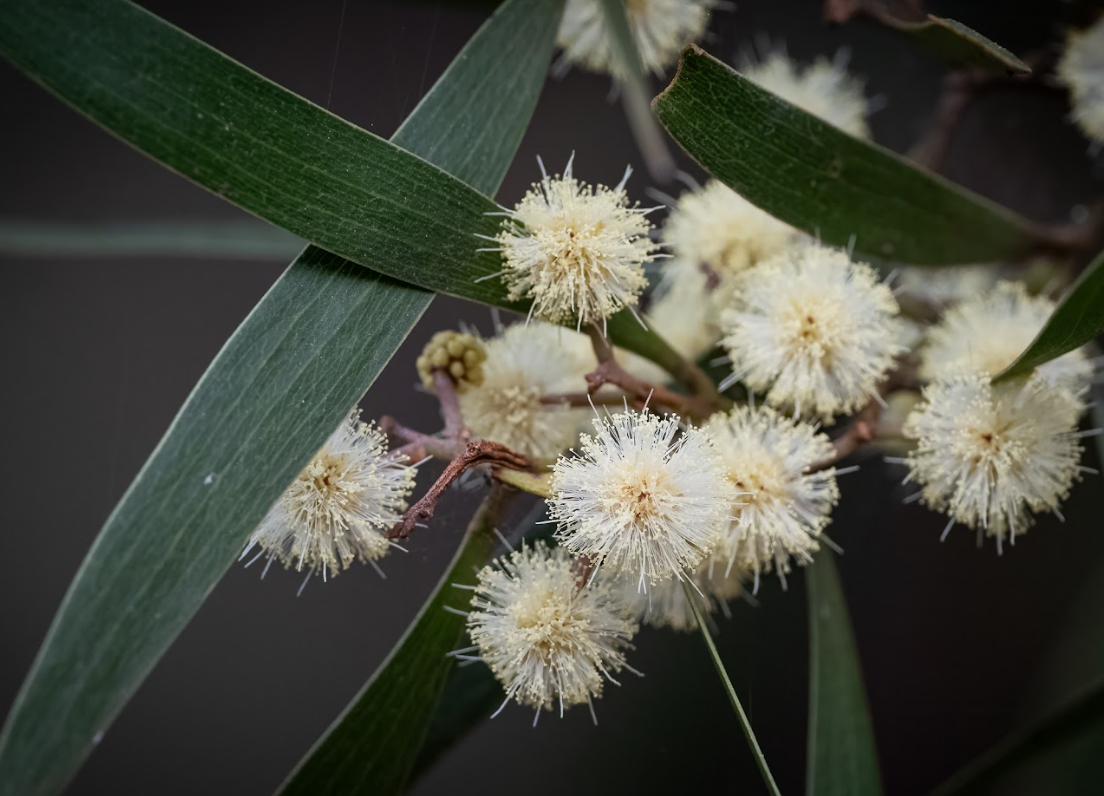
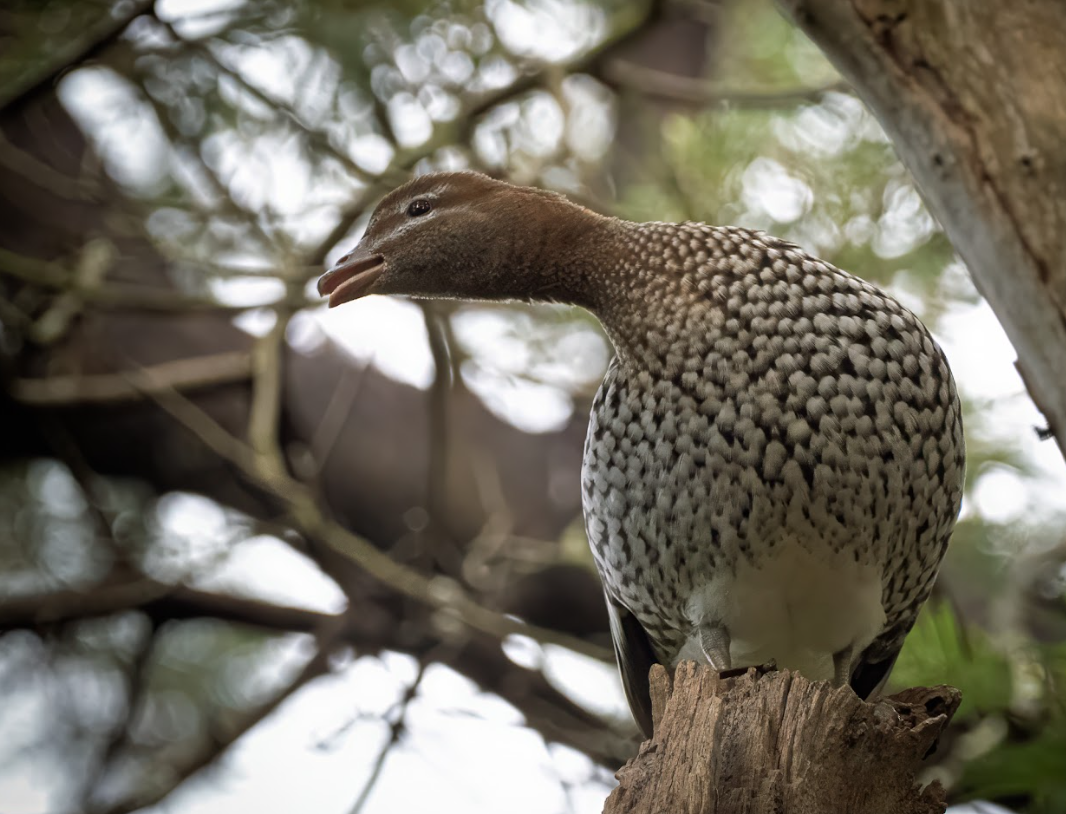
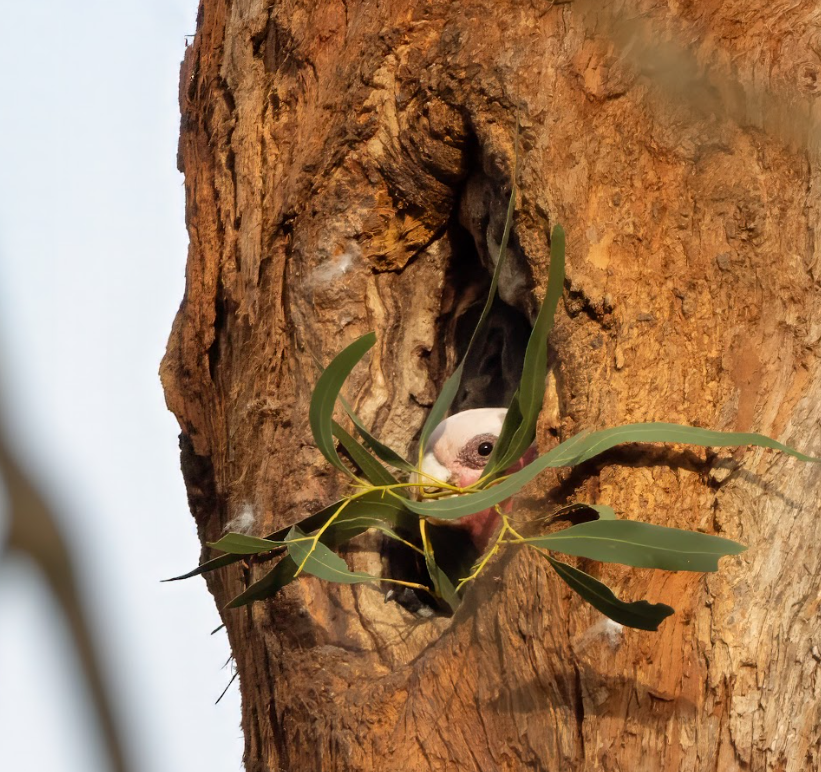
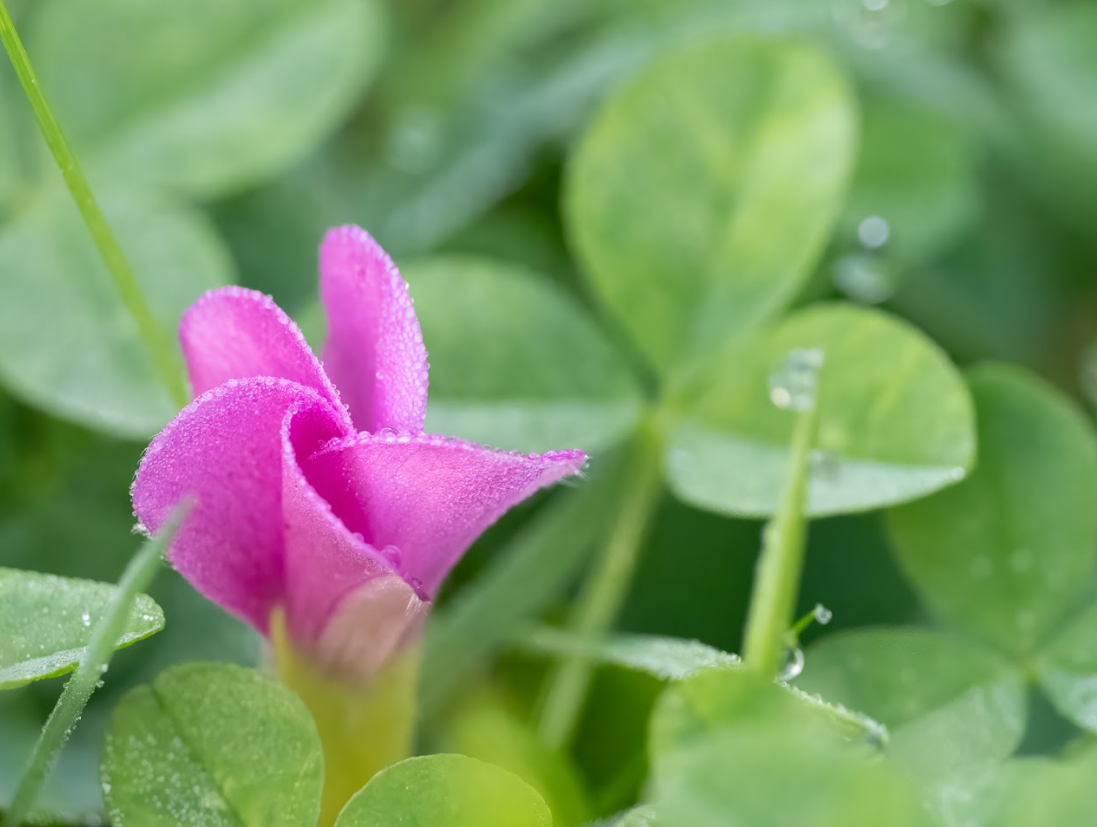
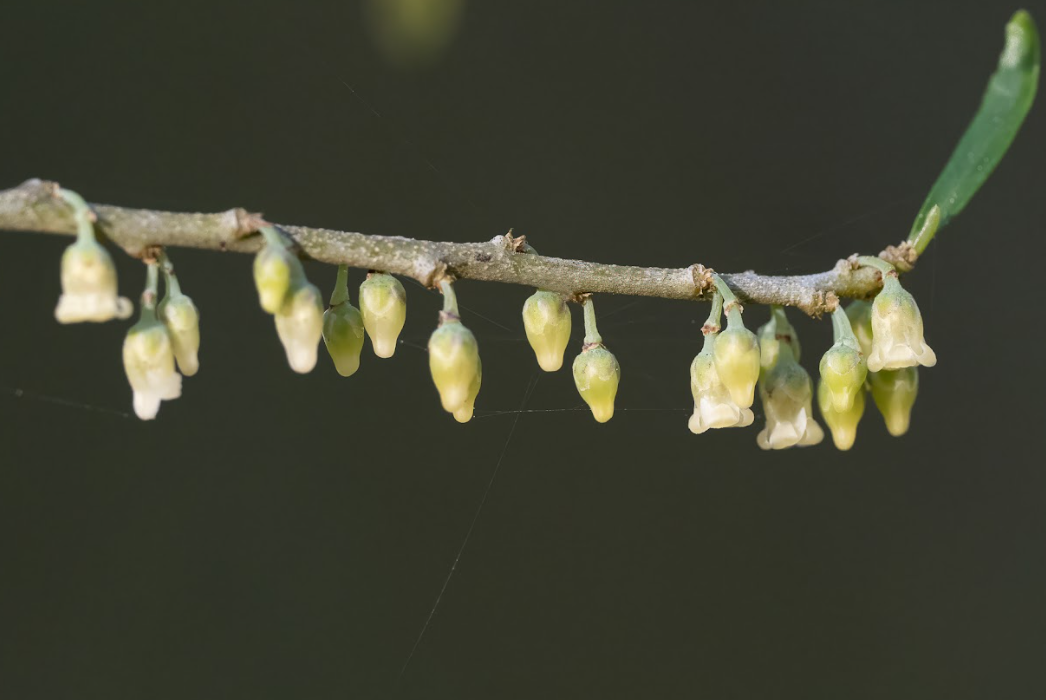
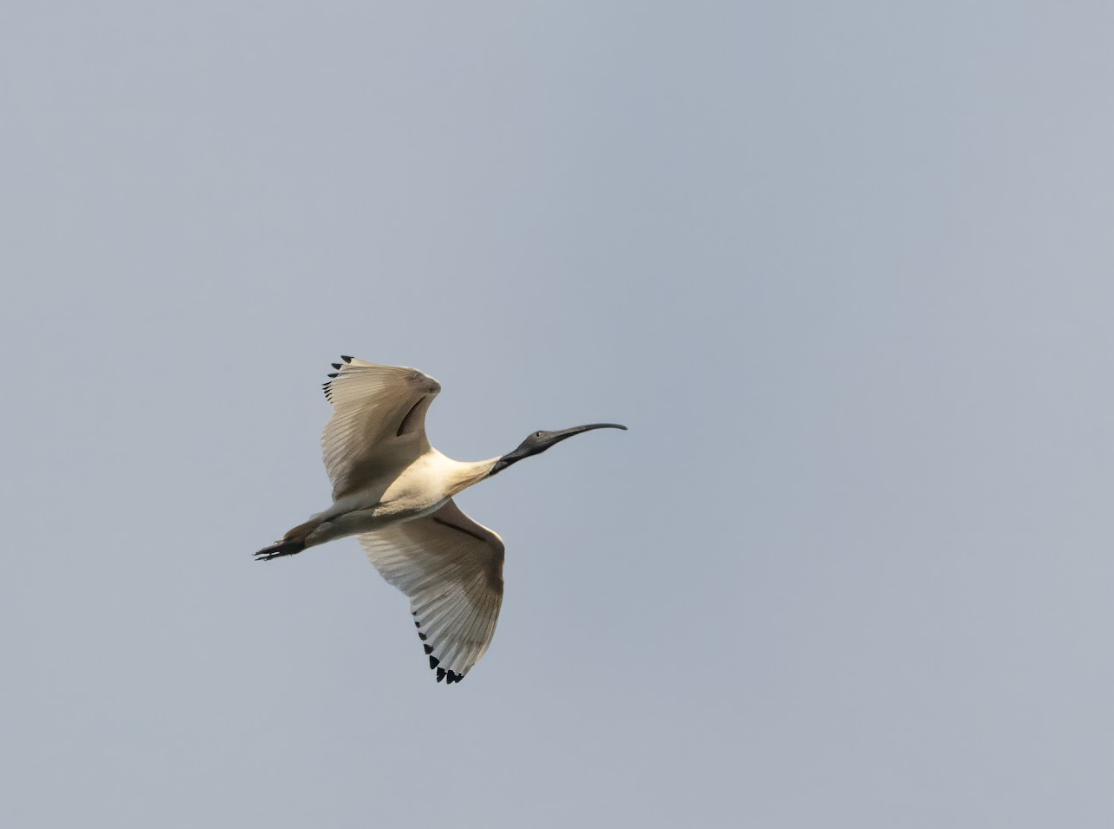
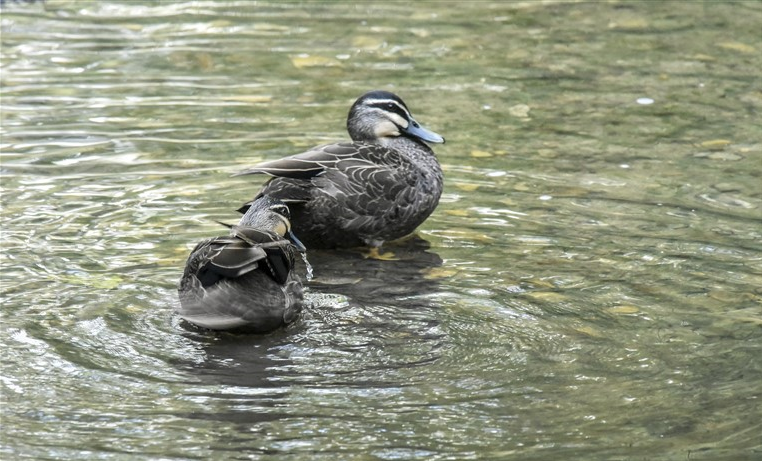
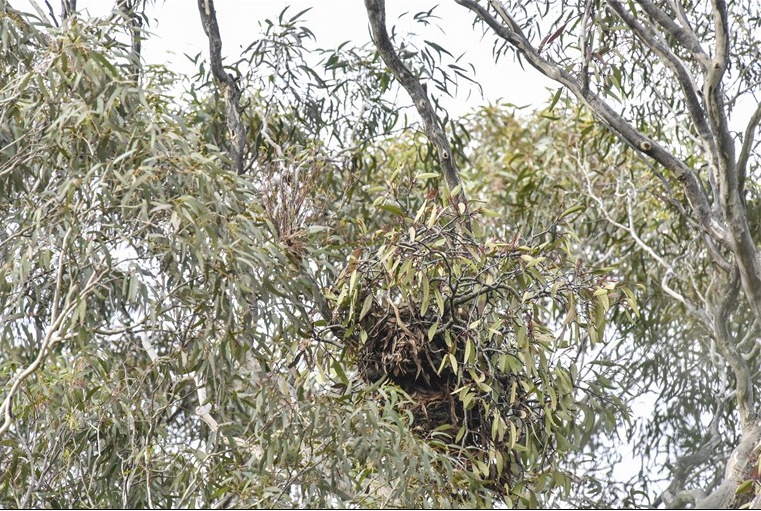
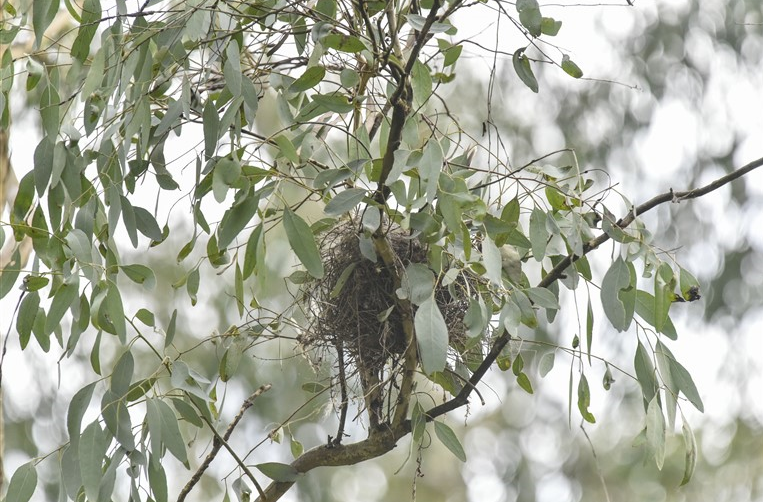
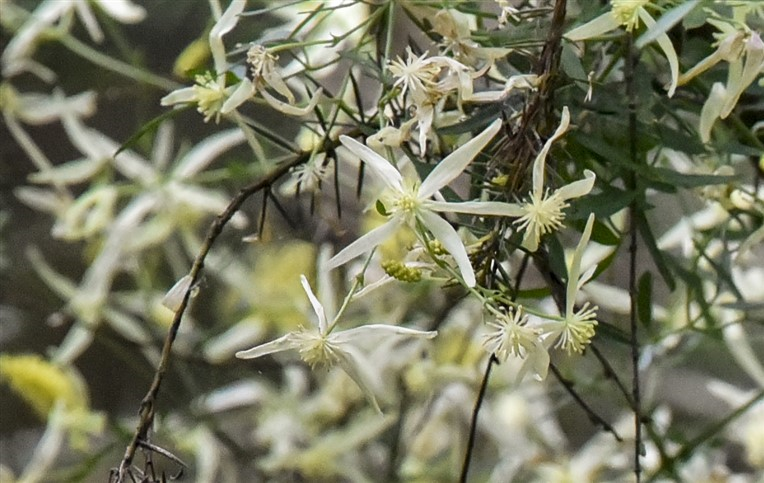
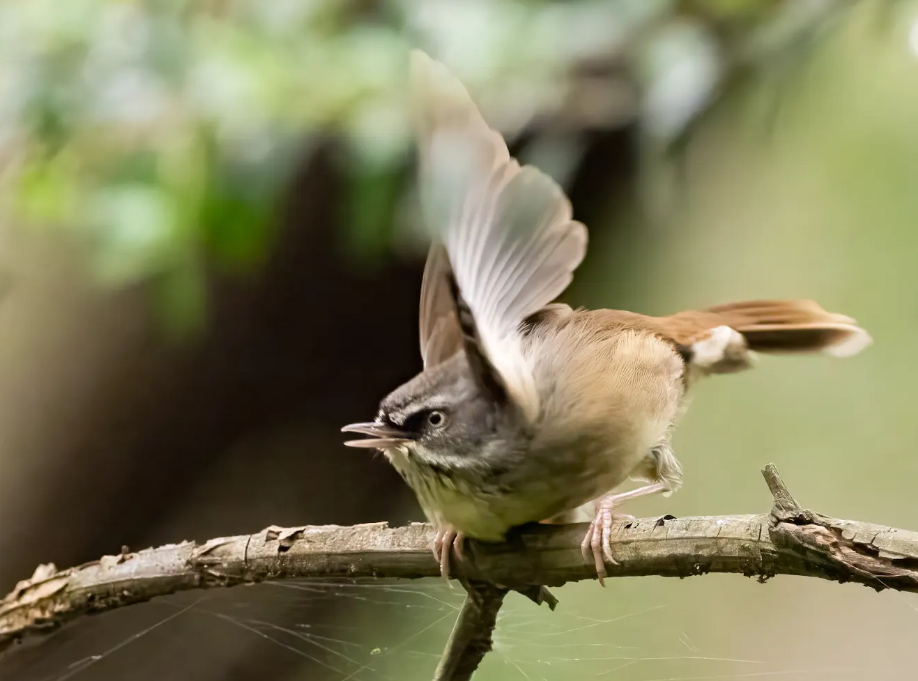
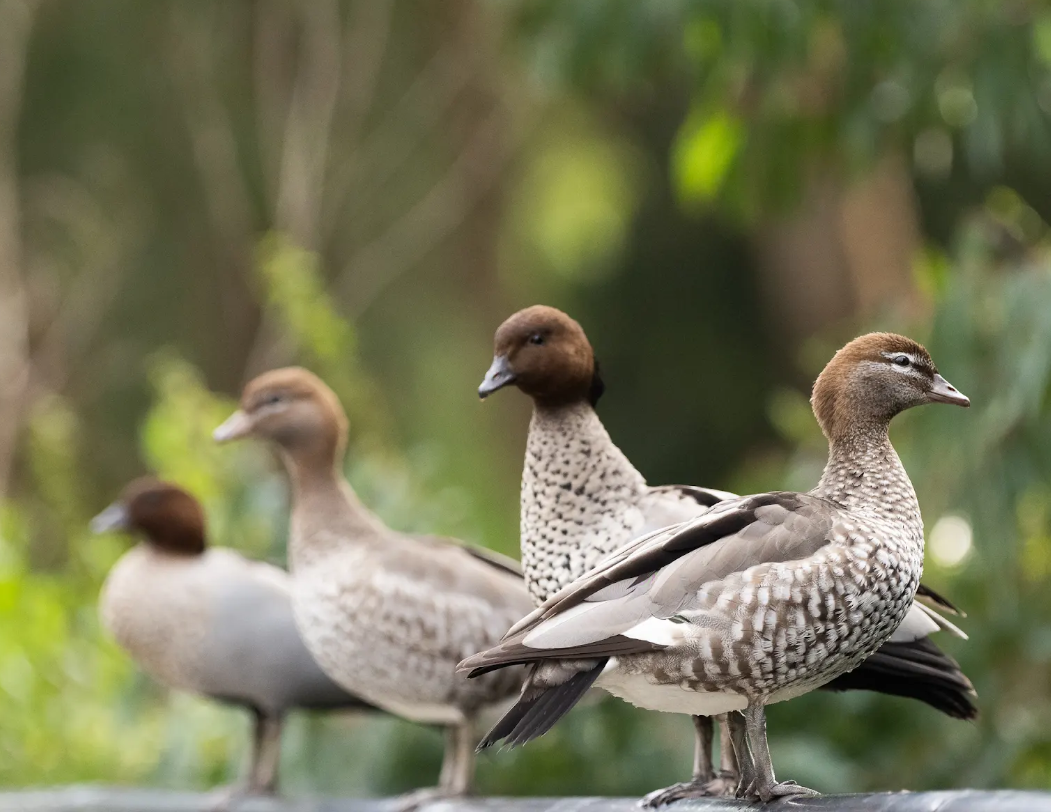
Please click on image to enlarge; click on the X to return
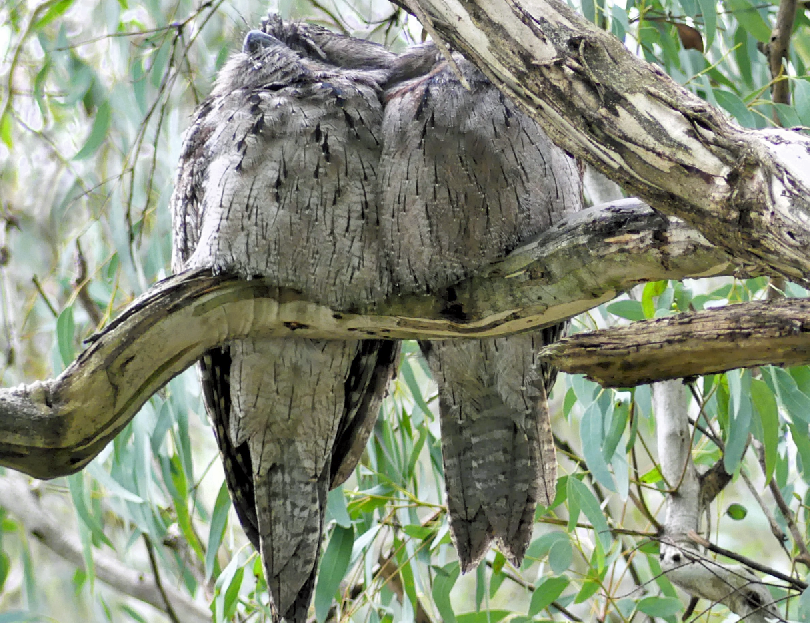
Russell sent us this photo of a Tawny Frogmouth pairs hanging on grimly on one of those windy and colder days:
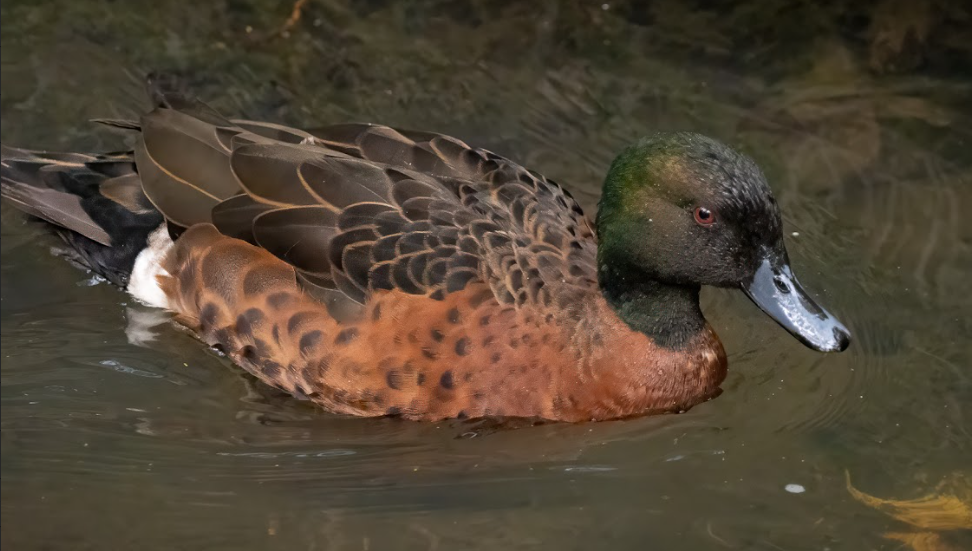
This author commented to Russell that I had seen an unusual sight – a male Chestnut Teal seeing off what seemed to be two females around that bend near the Billabong precinct – making that funny peep they make afterwards as he returned downstream. Maybe he was already spoken for ? Russell responded with this photo with the comment “this guy had 3 females expressing an interest“:
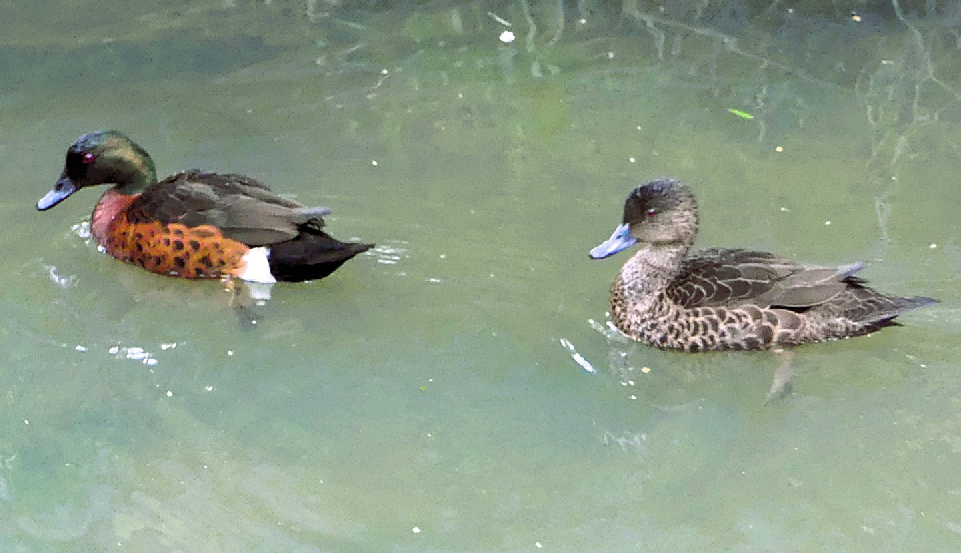
Coincidentally – he’d seen them too. However, it is possible that the other two were juvenile males who should definitely not be meddling in adult business…
Frogs
A prior resident of our wetlands, the Eastern Common Froglet (Crinia signifera), has been heard at a couple of sites in the park’s corridor – so the species might be returning to the Creeklands soon. However, as noted on our Frogs page, the Striped Marsh Frog (the one you normally hear in the wetlands) is known to eat almost any animal smaller than itself, including small frogs like the Froglet – which might explain why it disappeared from the park in the first place!
 Blackburn Creeklands
Pingback: Park News, September 2024 | The Blackburn Creeklands
Pingback: Park News, October 2024 | The Blackburn Creeklands