The Blackburn Creeklands – Part of a Corridor
- The Blackburn Creeklands park is managed by Whitehorse Council as one of several “Bushland Parks”.
- This park classification recognises the importance of the vegetation in the Blackburn Creeklands and its role as contributing to a wildlife corridor and as habitat.
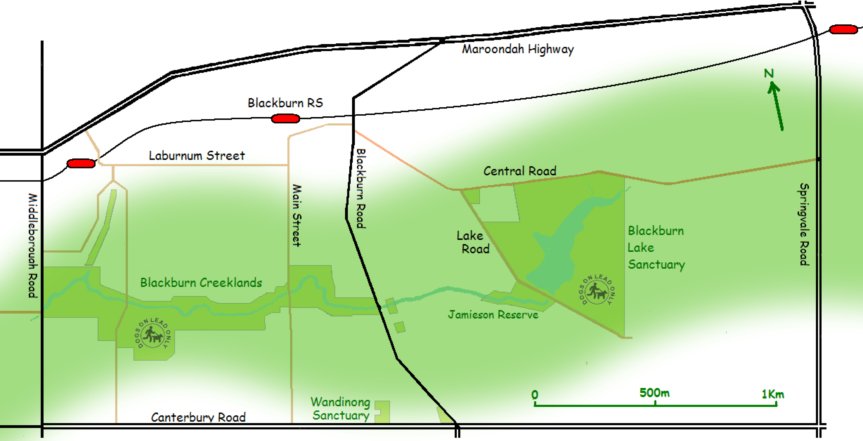
- So our park not only provides a wonderful resource for recreation, it also forms part of a wildlife corridor linking with the Blackburn Lake Sanctuary and also with areas further afield both east and west.
What is a Corridor?
- Looking at the Blackburn Lake Sanctuary and the Blackburn Creeklands, they form part of an east-west corridor running along Gardiners Creek. This corridor harbours and attracts indigenous animals and plants to our urban environment. Neighbouring private properties, eg neighbouring the parks and along Central Road and Jeffery Street, also contribute to the corridor.
- This corridor continues westwards generally following Gardiners Creek to the Yarra and eastwards towards the Dandenongs and links with north-south corridors heading to Warrandyte and beyond.
- Corridors are critical for ecological processes including the movement of animals and the continuation of viable populations. By providing links to larger areas of habitat, corridors enable migration, colonisation and interbreeding thereby increasing biodiversity.
- Species that migrate seasonally can do so more effectively and safely when they can use protected pathways through human activity. Also, animals and plants are able to migrate to new areas when food or water are lacking in their normal habitat (eg due to drought or fire). Plants and animals can breed with counterparts in neighbouring regions so that genetic diversity for the overall population improves.
- Population increases also require animals to move to obtain adequate food and water.
Neighbouring Properties
- Local wildlife uses both the park’s and also private resources to go about their normal life. We believe our park is too narrow to form a viable habitat in its own right for the diversity of species we have – the park needs a buffer of private land with compatible habitat and also wildlife corridor links to habitat further afield.
- This not only includes canopy trees on nearby private land but also includes:
- compatible understorey vegetation
- softening property boundaries and the visual interface with the park.
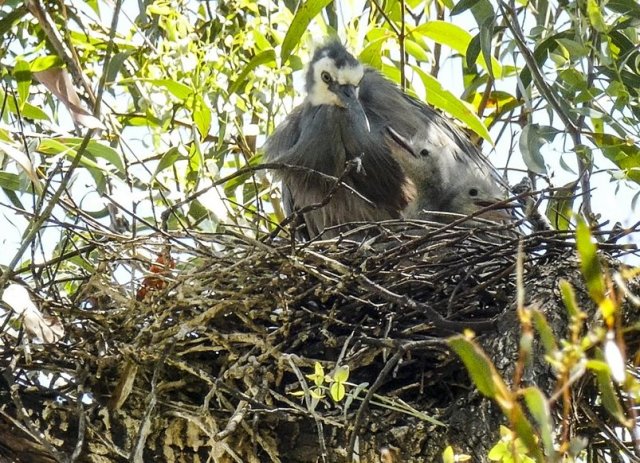
Parent and White-faced Heron chicks in a newly renovated nest in Linum Street
- We’ve noticed that some local birds tend to successfully breed in favourite spots in The Corridor eg the White-faced Herons in Acacia Avenue and Linum Street. Others, like the Tawny Frogmouths, nest both inside the park and within The Corridor. Many species return to places they’ve had breeding success before.
- This breeding success underscores the value of locals in the park Corridor maintaining suitable habitat in their properties for wildlife.
Other Benefits
- Apart from assisting local fauna and flora, there are many other benefits in full participation in The Corridor – eg higher property values, lower energy costs, lower road maintenance costs and participation in reducing the “Heat Island Effect” of cities. This 2008 diagram was sourced from the US Environmental Protection Agency with our highlighting:
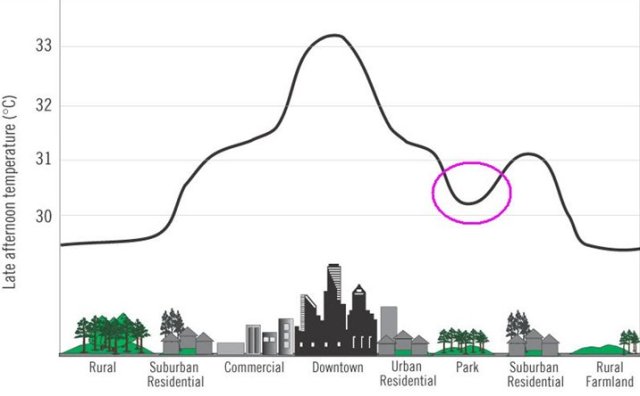
- An urban heat island is an urban area that is significantly warmer than its surrounding rural area due to human impacts. The temperature increase tends to be larger at night and is most noticeable both when winds are weak and during summer and winter. The main cause of the effect is the modification of land surfaces with waste heat from energy use a secondary contributor. Nearly 40 percent of the increase is believed to be due to the prevalence of dark rooves, with the remainder coming from dark-colored pavement/roads and the declining presence of vegetation.
- Anecdotally, we know of several locals who regularly walk along the creek on hot summer nights to refresh themselves because they know it is much cooler there… We also know that parks “lower our temperature” psychologically too.
Planning Controls
- Planning controls within the municipality, most notably the zones and Significant Landscape Overlays, protect existing vegetation and require tree plantings in new developments.
- Under its Urban Forest Strategy, the City of Whitehorse has set itself ambitious targets for the improvement of tree canopy cover within the municipality.
What Can You Do?
- One of Committee’s objectives is to encourage the community residing in our park Corridor to plant and weed compatibly.
Protect the Trees You Have
- Tall trees and the canopy are highly valued in Blackburn, not only by residents, but also the birds which live, feed and breed in them – and also use them to “get around safely”. Microbats, beetles and bugs (food for many!) love living under their bark!
- Some ways we can take care of these magnificent and so‐important old trees, keeping them strong and healthy, are:
- Prevent the ground beneath them from becoming compacted (eg by cars parking alongside or driveway construction too close).
- Mulch around the base to retain moisture (but please make sure the mulch is kept well away from the base of the trunk as wet mulch can cause the bark to rot and encourage insect attack, which weakens the structure of the tree).
- Give them all some “breathing” space!
- Don’t allow plants such as Agapanthus and Oyster Plant (Acanthus) and other invasive tuberous‐rooted plants to grow around the base – their root systems can ring‐bark the tree beneath the soil so that it withers and dies before you realise why!
- Keep ivy out of your gum trees! As it climbs up the tree, its suckers penetrate the bark and outer sapwood, which carries vital nutrients and moisture up to the canopy from the roots. The phloem, the layer just under the bark, carries moisture and nutrients (resulting from transpiration & photosynthesis of the leaves) back down to the roots. Ivy is a very hungry hanger‐on, and interrupts this nutrient flow, robbing even the strongest of trees of their life’s requirements. Once ivy grows vertically, it flowers and seeds – spreading the pest.
- A healthy tree makes excellent habitat, its beauty to be admired and valued!
Check Out the Gardens for Wildlife Program
- The Gardens for Wildlife program is active in our municipality to support local residents setting an area aside in their gardens for local wildlife – the benefits including assisting bio-links and corridors.
- Here’s a number of recommended things you could do in your garden to assist wildlife:
- Protect any indigenous canopy trees you may have – or plant one if you have room!
- Provide dense shrubs for bird shelter, nectar plants for honeyeaters and local daisies for butterflies.
- Install a cat-proof birdbath, a frog-friendly pond or bog with unpolluted water.
- Keep a patch of natural mulch for beetles and worms.
- Provide a warm, sheltered corner for lizards.
- Click here to visit Council’s web page for more information and links to other resources.
Plant Indigenous!
- An on-line Indigenous Gardening Guide for Whitehorse is available here . A hard-copy version has also been produced – check the above link for availability.
- Check out these resources on our web-site:
- Fauna and Flora page.
- Flora page provides an overview of our indigenous flora and our weeds.
- Favourite Flora page – the best of our Plants of the Month.
- Worst Weeds page – the worst of our Weeds of the Month!
Where Can I Buy Plants ?
- If you’d like to do your bit for the corridor and put some indigenous plants (ie native plants local to our area) into your own garden, please visit either or both of our local volunteer based nurseries:
- Bungalook: 63-107 Fulton Road, Blackburn South (Melway: Map 61 J4) – open on Wednesdays 9.30-12:00 and Fridays 9.30-1:00pm.
- Greenlink: 41 Wimmera Street, Box Hill North (Melway: Map 47 E6) – open on Tuesdays and Wednesdays 9.00-12.00.
- Occasional Sale Days occur on Saturdays.
- We have links to their web-sites on our Useful Links page. We should note gratefully that they provide most of the plant stock used for re-vegetating the Creeklands at our working bees and by our Monday Maintenance Team.
- Prices are very reasonable and stock is locally indigenous.
Further Information
- The Blackburn and District Tree Protection Society has been a defender of our precious treed environment since the late 1950s. Our good friends from the B&DTPS won the Victorian Urban Landcare Award 2017 in recognition of their book Fighting for the Trees – which tells the Society’s interesting story from its inception in 1959 thru to 2016.
- Local Corridor resident Tony Kjar has produced a comprehensive document on the Corridor – especially the way its protections have developed over time. Tony has recently expanded his document to include more on fauna, bird territories, habitat and soils. He has kindly provided us with a copy which you can download here.
 Blackburn Creeklands