The following is a list (no doubt incomplete) of various locally indigenous plants used traditionally for food. The base data has come from Bungalook Nursery’s list with additions from other sources. In particular, the Woiwurrung names IN CAPITALS used by the Wurundjeri in our area are derived from the guidebook: ABORIGINAL PLANTS in the grounds of Monash University (School of Biological Sciences, 2010). Note: We understand that the latter would have been based on original work (1998) authored by Dr Beth Gott (who passed away in 2022 aged nea 100). She was an academic at Monash and pioneer of researching aboriginal food plants – decades ahead of her time.
| Botanical Name | Woiwurrung & Common Names | Part of Plant | Usage | |
|---|---|---|---|---|
| — Tree gums and sap | ||||
| Acacia dealbata | MOY-YAN, Silver Wattle | Gum | Gum is edible – sucked like candy; soaked in water to make a jelly. | |
| Acacia mearnsii | GARRONG, Black Wattle | Gum | Gum used as a chewing gum that dissolves as you chew. | |
| Acacia pycnantha | Golden Wattle | Gum, seed | Roasted seeds and gum eaten. | |
| Allocasuarina littoralis | WAYETUCK, Black Sheoak | Gum, seed | The gum chewed or made into a jelly by melting in hot water. The young cones were eaten. | |
| Eucalyptus viminalis | WURUN, Manna Gum | Sap | Sugary sap eaten and flowers soaked in water to make a sweet drink. | |
| — Leaves | ||||
| Lomandra longifolia | KURAWAN, Spiny-headed Mat-rush | Leaf base | White leaf bases chewed to release starch. | |
| Mentha australis | PANARYLE, River Mint | Leaves | Leaves used to make tea and also to treat coughs and colds. | |
| Prostanthera lasianthos | CORANDERRK, Victorian Christmas-bush | Leaves | Aromatic leaves used to make tea or flavour food. | |
| Prostanthera melissifolia | Balm Mint-bush | Leaves | Aromatic leaves used to make tea or flavour food. | |
| — Berries, fruit, flowers | ||||
| Acrotriche serrulata | BURGIL BURGIL, Honey Pots | Flowers | The small flowers, underneath the plant, are full of a fragrant nectar. | |
| Billardiera mutabilis | GARAWANG, Common Apple Berry | Fruit | Fruit eaten raw when ripe or roasted when green. | |
| Cassytha melantha | Dodder Laurel | Fruit | Aromatic and tangy fruit look like small olives. | |
| Coprosma quadrifida | MORR, Prickly Currant-bush | Fruit | Berries are sweet and high in Vitamin C. | |
| Dianella admixta | Black-anther Flax-lily | Fruit | Dark blue or purple berries edible. | |
| Dianella laevis | Pale Flax-lily | Fruit | Dark blue or purple berries edible. | |
| Dianella tasmanica | Tasman Flax-lily | Fruit | Dark blue or purple berries edible. | |
| Einadia nutans | Nodding Saltbush | Fruit, leaves | Red berries are sweet to eat. Leaves can also be eaten but should be boiled first. | |
| Exocarpus cupressiformis | BALLEE, Cherry Ballart | Fruit | Small orange berries turn red when ripen to a sweet and palatable fruit. Green seed not eaten. | |
| Rubus parvifolius | EEPAEEP, Native raspberry | Fruit | Has edible small fruit somewhat like small raspberries but not as sweet. | |
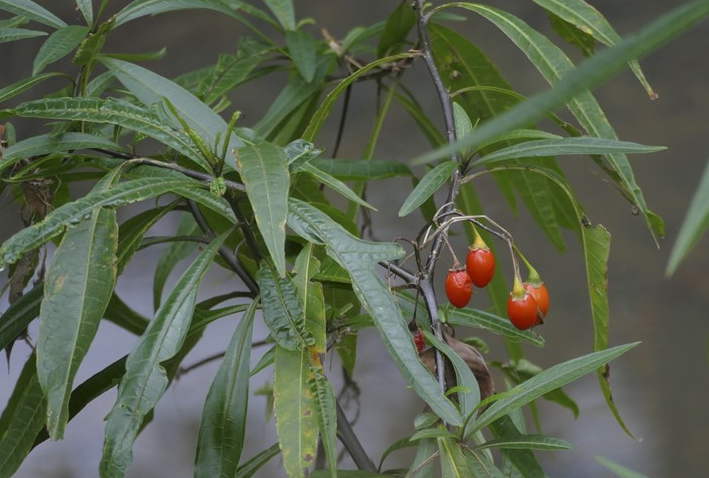
| Solanum aviculare | Kangaroo Apple | Fruit | Has berries/fruit which are poisonous while green, only edible once fully ripe (orange). | |
| — Tubers/ roots | ||||
| Arthropodium milleflorum | Pale Vanilla Lily | Tuber, flowers | Tubers can be eaten raw or cooked. Flowers can be eaten raw. | |
| Arthropodium strictum | Chocolate Lily | Tuber | Tubers can be eaten raw or cooked. | |
| Bulbine bulbosa | PIKE, Bulbine Lily | Tuber | Tubers can be roasted and eaten, they are sweet tasting and contain calcium and iron. | |
| Burchardia umbellata | Milkmaids | Tuber | Tubers can be roasted and eaten. | |
| Clematis aristata | Austral Clematis, Old Man’s Beard | Taproot | Taproot can be roasted and eaten. | |
| Clematis microphylla | Small-leaved Clematis | Taproot | Taproot can be roasted and eaten. | |
| Geranium solanderi | Crane’s Bill, Native Carrot | Taproot | Woody taproot rich in starch can be cooked and eaten. | |
| Kennedia prostrata | KABIN, Running Postman | Nectar, stems | Nectar is sweet like honeysuckle, stems can be used for twine. | |
| Microseris walteri | MURNONG, Yam Daisy | Tuber | Tuber can be roasted or fried. | |
| Typha sp | BOURT-DEET, Cumbungi, Bulrush | Rhizome | Rhizome is rich in starch. Also the young flowering stems were eaten raw. | |
| — Seed | ||||
| Acacia melanoxylon | BURN-NA-LOOK, Blackwood | Seed | Seeds are edible and flowers can be cooked and eaten. | |
| Acacia pycnantha | Golden Wattle | Seed, gum | Roasted seeds and gum can be eaten. | |
| Linum marginale | Native Flax | Seed | Numerous small seeds eaten. | |
| Themeda triandra | Kangaroo Grass | Seed | Seeds can be ground to produce flour. |
 Blackburn Creeklands